India’s Homegrown 32-Slice CT Scanner: The Real Test Will Be Hospital Readiness, Not Just Manufacturing
Government support for Panacea Medical Technologies to develop an indigenous 32-slice CT scanner is a step towards strengthening India’s medical-device manufacturing base. But a scanner becomes valuable only when it produces reliable diagnostic images, meets radiation-safety requirements, remains affordable over its working life and can be serviced quickly when something goes wrong.
A hospital’s CT scanner is most valuable when a doctor needs an answer quickly: Is there internal bleeding after an accident? Has a disease progressed? Does a patient need urgent intervention? In these moments, the equipment’s country of origin matters far less than its diagnostic performance, availability and reliability.
That is why India’s effort to develop a homegrown 32-slice computed tomography (CT) scanner deserves attention—but also careful scrutiny.
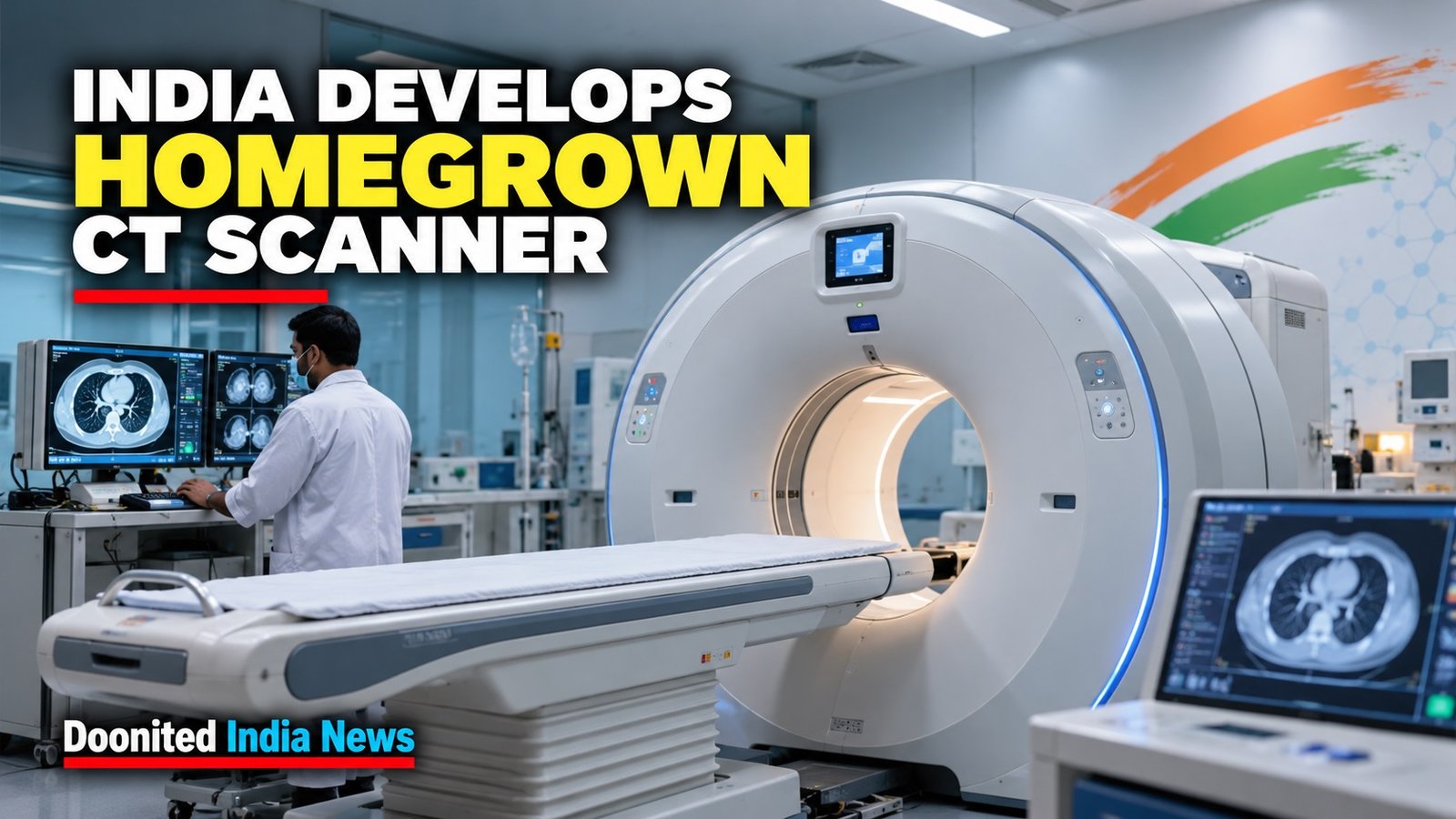
On 15 October 2026, the Technology Development Board (TDB), under the Department of Science and Technology (DST), announced an agreement with Panacea Medical Technologies Pvt. Ltd., based in Malur, Karnataka, to support the development and commercialisation of an indigenous 32-slice CT scanner. The project aims to expand domestic medical-imaging capabilities under the government’s Make in India initiative. The announcement does not establish that the scanner has completed validation, received all required regulatory approvals or entered routine hospital use.
What does a 32-slice CT scanner do?
A CT scanner uses X-rays and computer processing to create cross-sectional images of the body. These images help clinicians examine organs, bones, blood vessels and other internal structures without surgery.
The term 32-slice broadly describes a scanner’s ability to acquire multiple image sections during a rotation. Such systems can serve a range of routine diagnostic needs, depending on the scanner’s design, software and clinical application.
But slice count is not a complete measure of quality. Image clarity, scan speed, radiation-dose management, reconstruction software, patient positioning and the system’s ability to handle different body types all matter. The appropriate scanner also depends on the hospital’s case mix: a district hospital performing common diagnostic examinations has different requirements from a tertiary centre handling complex cardiac or specialist imaging.
A new domestic scanner therefore needs to demonstrate more than a headline specification. Clinicians need evidence that it delivers dependable images for its intended uses, while radiology teams need equipment that is practical to operate and maintain.
Why domestic manufacturing matters
India’s medical-device market includes products ranging from basic hospital equipment to sophisticated diagnostic and therapeutic systems. For advanced devices, dependence on imported equipment and components can expose hospitals to foreign-exchange movements, overseas supply disruptions, long spare-parts lead times and service costs.
Developing a domestic CT scanner could help build local engineering expertise, supplier networks and technical support. If production scales successfully, it may also give hospitals another option when comparing equipment and service contracts.
The wider benefit could extend beyond the scanner itself. Product development can create demand for precision engineering, electronics, software, testing facilities and skilled technicians. These capabilities can support future medical devices and help Indian manufacturers move into more complex products.
However, domestic production does not automatically mean lower prices. A scanner may still depend on imported components, specialised detectors, X-ray tubes or other critical parts. Manufacturing volumes, component sourcing, financing, warranty provisions and service arrangements all influence the final cost.
The right question is not simply whether the equipment is made in India. It is whether the overall system offers hospitals a competitive combination of performance, safety, price and dependable support.
Safety and regulatory approval are essential
CT scanners use ionising radiation, so safety is central to their development and operation. India’s Atomic Energy Regulatory Board (AERB) regulates diagnostic X-ray equipment under the applicable radiation-protection framework.
AERB explains that manufacturers must meet the relevant requirements for the equipment they produce, including obtaining the required type approval for a prototype before commercial-scale production. Hospitals and diagnostic facilities must also meet applicable licensing, installation, shielding, staffing and quality-assurance requirements before operating equipment for patient diagnosis.
The TDB announcement concerns development and commercialisation support. It should not be interpreted as confirmation that the particular scanner has already passed all relevant tests or received regulatory clearance. Those milestones must be established separately before the system can be adopted for clinical use.
The real hospital calculation: total cost of ownership
For a hospital administrator, the purchase price is only the beginning of the financial calculation. The total cost of ownership (TCO) includes the expenditure required to install, operate, maintain and eventually replace the equipment over its working life.
Several factors can determine whether a lower-priced scanner is genuinely economical:
-
Spare parts: Are critical components available locally, and how long would replacements take to arrive?
-
Service and uptime: Can trained engineers respond quickly when the scanner fails? How much diagnostic capacity is lost during downtime?
-
Power and facilities: What electrical supply, cooling, room layout and shielding does the system require?
-
Software and upgrades: Are reconstruction software, cybersecurity updates and technical support included in the contract, or billed separately?
-
Clinical performance: Does the system meet the hospital’s imaging needs without unnecessary repeat scans or avoidable delays?
-
Warranty and lifecycle support: What is covered, for how long, and what happens when the equipment reaches the end of its supported life?
A scanner that costs less to buy but remains out of service for extended periods may prove more expensive than a higher-priced alternative. Conversely, a domestic system with competitive performance and responsive local support could deliver significant value, particularly in hospitals that face budget constraints.
Panacea’s existing experience in medical technology is relevant to its ability to develop complex equipment. But radiotherapy systems and diagnostic CT scanners have different technical and operational requirements. A nationwide service network, access to spare parts and reliable maintenance procedures will need to be demonstrated for the new product.
Why public procurement and field testing matter
A new medical device does not become commercially successful merely because a prototype works. Hospitals need confidence that the equipment performs consistently across different clinical environments and can be supported over many years.
That makes the transition from development to deployment particularly important. Evaluation should include image quality, radiation-dose performance, system reliability, usability, maintenance requirements and compatibility with hospital information systems. Results from testing and carefully selected clinical deployments can help establish where the scanner is suitable and where further development is needed.
Public procurement can create a route to scale, but purchasing decisions should be based on transparent performance and lifecycle criteria. Domestic origin can be a legitimate industrial-policy consideration; it should not replace clinical evidence, patient safety or value-for-money assessment.
The same principle applies to price comparisons. Until a commercial price and the relevant warranty and service terms are published, claims that the scanner will be substantially cheaper than imported alternatives should be treated as expectations rather than established results.
Make in India must mean dependable in India
India’s ambition to manufacture advanced medical equipment is worthwhile. Local capability can strengthen supply resilience, create skilled jobs and give hospitals more choices. It can also build expertise that supports the next generation of diagnostic and therapeutic devices.
But medical technology is not judged by manufacturing announcements. It is judged by the images it produces, the safety standards it meets, the clinicians it supports and the patients who benefit from timely diagnosis.
For Panacea’s CT scanner, the milestones to watch are clear: validated clinical performance, required regulatory approvals, a transparent price, accessible spare parts, trained service engineers and evidence that hospitals can keep the system operating reliably.
If these elements come together, the project could contribute to a stronger domestic medical-device industry. If they do not, an indigenous design alone will not solve hospitals’ practical problems.
The true measure of a homegrown CT scanner will be whether a hospital can depend on it when a patient cannot afford to wait.
Learning point
When evaluating a new medical device, look beyond the announcement and the headline specification. Ask whether it has been independently evaluated, meets regulatory requirements, suits the hospital’s clinical needs and can be maintained affordably throughout its working life.


World Beyond the News
Bees Communicate Where Food Is
Honeybees use movement patterns known as waggle dances to communicate information about food locations.
Street Food Reflects Local History
Many famous street foods developed from migration, trade, local ingredients and the everyday needs of working communities.
A Day on Venus Is Extremely Long
Venus rotates so slowly that one rotation relative to distant stars takes longer than its trip around the Sun.
Human Achievement Continues to Push Limits
Athletes, engineers, scientists and explorers regularly establish new benchmarks in speed, endurance, scale and precision.