Blue Dart–India Post Partnership: Can India’s Small-Town Sellers Reach More Customers?
A new agreement combines Blue Dart’s express logistics network with India Post’s reach across 1.64 lakh post offices. The phased initiative could help online sellers serve smaller towns and remote communities—but delivery coverage, service reliability and the actual cost to merchants will determine its impact.
The last mile may decide who gets to sell online
An online seller can have a good product, competitive pricing and a professional website—and still lose a sale because a courier does not serve the buyer’s PIN code. For businesses outside India’s biggest cities, that gap between customer demand and delivery access can be a real commercial barrier.
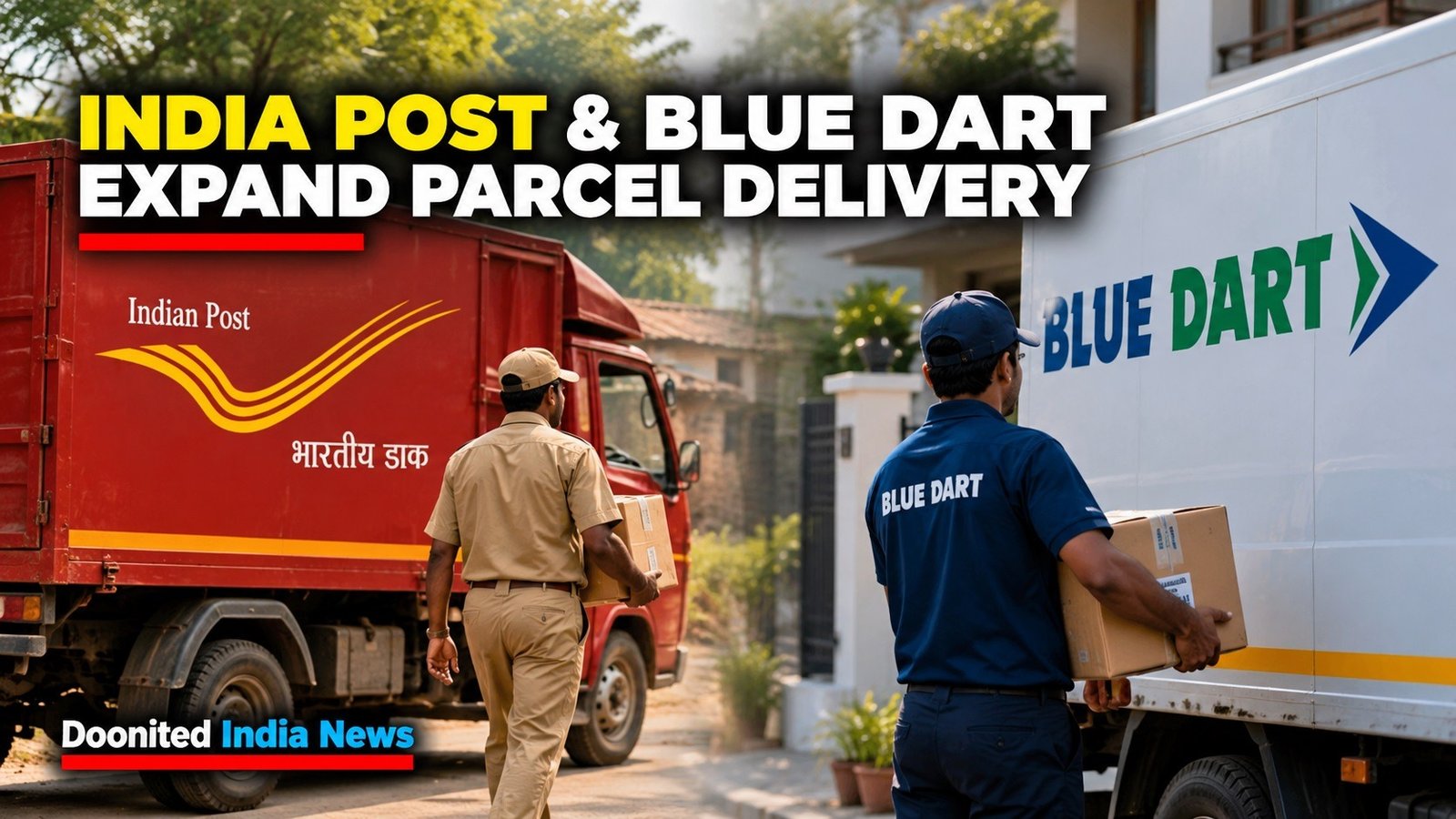
A new partnership between Blue Dart Express and the Department of Posts aims to narrow that gap. Announced on 9 October 2026, the agreement brings together Blue Dart’s express logistics capabilities and India Post’s extensive postal network to expand parcel delivery into Tier III and Tier IV towns, rural areas and remote locations. The expanded coverage is being introduced in phases, rather than becoming universally available overnight.
If implemented effectively, the arrangement could help smaller online businesses reach customers beyond their existing delivery footprint. But the announcement is the start of an operational expansion, not proof that every previously unserviceable PIN code is now covered.
How the partnership is expected to work
India Post operates more than 1.64 lakh post offices across the country, giving it a presence that extends well beyond major commercial centres. Blue Dart, meanwhile, operates an express air and surface logistics network serving businesses and consumers.
The partnership is designed to combine these complementary strengths. Blue Dart can extend its reach by using India Post’s network to deliver eligible shipments to additional locations, while the postal department gains an opportunity to handle more parcel business and strengthen its role in organised e-commerce logistics.
Why smaller towns matter to e-commerce
India’s online market is not confined to metropolitan consumers. Small-town households, local entrepreneurs and rural customers increasingly participate in digital commerce, but delivery infrastructure can determine which products they can buy and which markets local businesses can serve.
Consider a small business selling clothing, home décor, handicrafts or packaged goods. Its website might attract orders from several states, but serving every destination through separate logistics arrangements can increase complexity. Some locations may be outside a courier’s regular service area; others may attract additional charges or require special handling.
A broader delivery network could help such businesses test new markets without immediately building their own distribution infrastructure.
The opportunity is particularly relevant to micro, small and medium enterprises (MSMEs), direct-to-consumer brands and sellers based outside major cities. It could also support artisans and rural enterprises seeking customers in other parts of India.
However, wider coverage does not automatically mean lower shipping costs. Merchants will still need to compare tariffs, pickup arrangements, COD remittance terms, return charges and service-level commitments. The partnership’s commercial value will depend on those details as much as on the number of PIN codes it can reach.
What it could mean for small online sellers
A larger potential customer base
Access to additional delivery destinations can allow sellers to accept orders that might otherwise be rejected because of courier limitations. For businesses with distinctive regional products, that can create opportunities beyond their immediate geography.
But merchants should verify coverage before promising delivery. The announcement confirms a phased expansion; it does not publish a definitive list establishing that every PIN code is already serviceable through the arrangement.
Better visibility for customers
Tracking can reduce uncertainty about where a shipment is and whether it has moved between logistics partners. OTP-based delivery authentication is intended to provide an additional check at handover.
Neither feature eliminates every problem. Tracking systems need timely data from all parties, and customers still need a clear process for reporting missing, delayed or incorrectly delivered parcels.
COD remains a practical test
Cash on delivery remains relevant for customers who prefer to pay when goods arrive. The partnership includes COD parcels, according to the official announcement.
It would therefore be premature to claim that the arrangement will automatically reduce return-to-origin (RTO) rates. That outcome would need to be demonstrated through operational data.
What consumers in remote areas should know
For consumers, the potential benefit is access: a product previously unavailable for delivery to their address may become accessible through an expanded service network.
This could be useful for people in smaller towns who shop online for clothing, household products, electronics and other goods. Nevertheless, the partnership should not be interpreted as a guarantee that every product or seller will serve every remote destination.
Customers should check the delivery estimate and charges displayed at checkout, confirm that the seller accepts orders for their PIN code, and retain the shipment tracking number. For a delayed or disputed delivery, they should first identify which organisation is handling the shipment and follow the complaint process provided by the seller or logistics provider.
The agreement also does not, by itself, establish that every parcel can be collected from a post office or automated parcel locker. Blue Dart and India Post have previously collaborated on digital parcel lockers at selected post offices, but that earlier initiative should not be confused with universal locker access under the new arrangement.
The partnership reflects a broader opportunity for India Post: using its physical reach to participate more deeply in modern parcel logistics while working with commercial partners that bring express transport, customer relationships and operational expertise.
The department’s role in rural delivery is not limited to this agreement. In May 2026, it also signed an agreement with Flipkart for last-mile parcel delivery services across India, using a similar combination of commercial e-commerce demand and postal-network reach.
That coordination is where the real operational challenge lies. A large network provides potential reach, but service quality depends on capacity, accurate routing, handover procedures, staffing and the ability to handle peak-period volumes.
There is also a need for transparency around performance. Merchants will benefit from published serviceable PIN codes, clear delivery timelines, predictable pricing, COD settlement terms and a straightforward dispute-resolution process. Customers should not have to navigate an organisational handover without knowing whom to contact when something goes wrong.
What happens next?
The expanded service is being rolled out in phases. Businesses should therefore avoid assuming that the entire network is immediately available for every Blue Dart shipment. The next meaningful indicators will be the locations added, the reliability of delivery estimates, the handling of returns and the experience of merchants using the service.
For smaller sellers, the sensible next step is to check current PIN-code serviceability directly with Blue Dart, confirm applicable prices and COD conditions, and test the service on a limited number of orders before making it central to their fulfilment strategy.
For consumers, the benefit will be clear only when expanded reach translates into a dependable delivery experience.
The larger lesson is that digital commerce does not end when a customer clicks “buy”. It succeeds when a parcel reaches the customer reliably and at a price the business can sustain. Blue Dart and India Post have announced a potentially important way to close that gap. Whether it delivers lasting value will depend on how well the partnership works beyond the announcement.


World Beyond the News
Dolphins Use Individual Signature Whistles
Bottlenose dolphins develop distinctive whistles that function somewhat like individual acoustic identifiers.
The Pacific Is Earth’s Largest Ocean
The Pacific Ocean covers more area than any other ocean basin and stretches between Asia, Australia and the Americas.
Artificial Intelligence Learns Statistical Patterns
Modern machine-learning systems identify patterns in large datasets and use those patterns to generate predictions or outputs.
Why Some Stories Spread So Quickly
Emotion, novelty, visual appeal and easy sharing can make a story travel rapidly across social platforms.