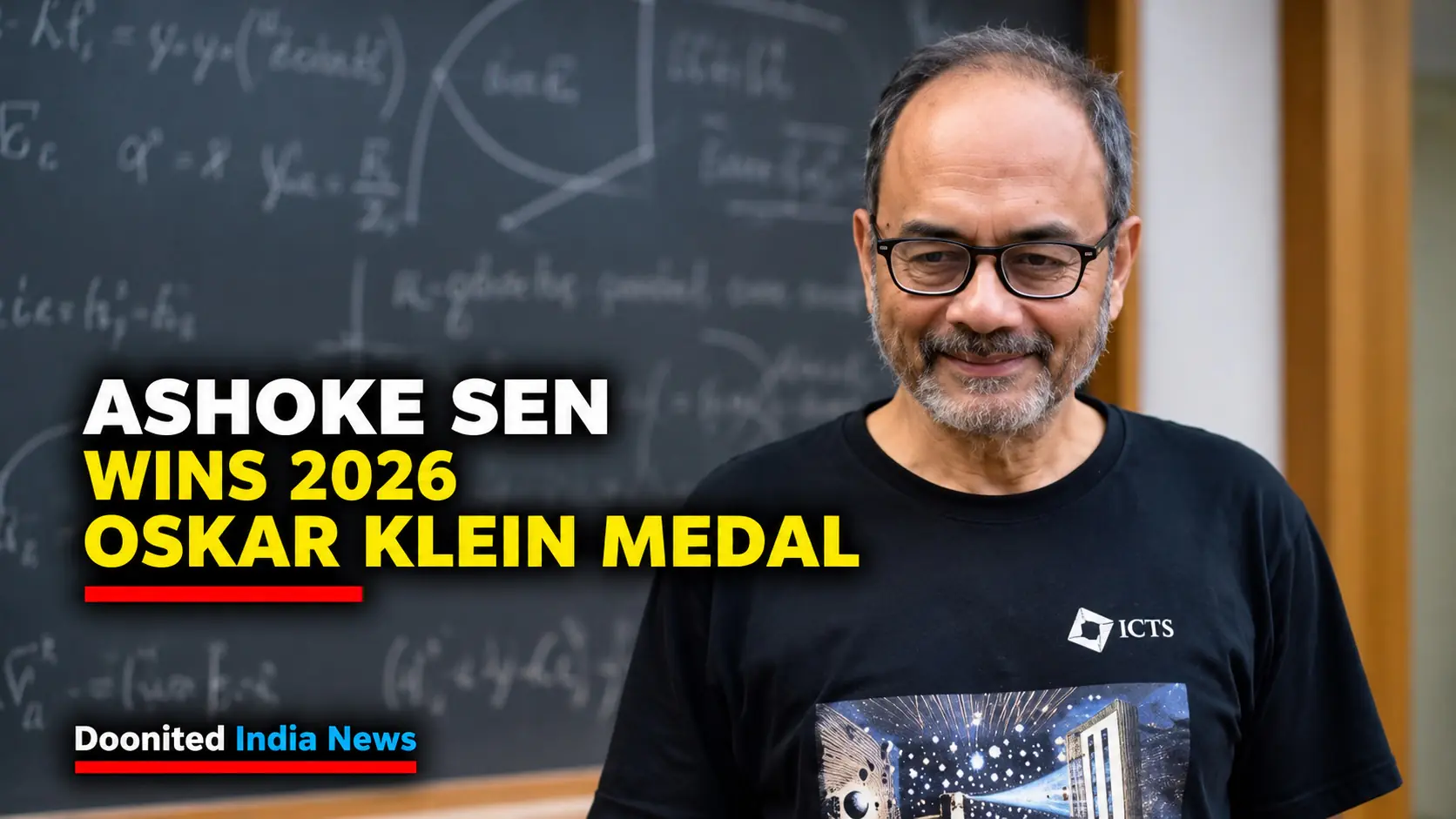
The Indian Physicist Exploring the Deepest Mysteries of the Universe, From the microscopic states of black holes to the mathematical relationships connecting different string theories, Ashoke Sen’s research has helped reshape modern theoretical physics. His 2026 Oskar Klein Medal recognises a career of foundational discoveries—and highlights why India’s contribution to fundamental science matters far beyond its borders.
Ashoke Sen’s Oskar Klein Medal: When India’s Theoretical Physics Takes Centre Stage
A black hole can be described by a handful of observable properties, yet the quantum world underlying it may be extraordinarily complex. How can these two pictures fit together? What happens when gravity, governed by Einstein’s theory of general relativity, must also obey the rules of quantum mechanics?
These are not simply abstract puzzles. They sit at the heart of one of modern physics’ most difficult ambitions: developing a consistent account of nature that can accommodate both gravity and quantum theory.
Indian theoretical physicist Professor Ashoke Sen has spent decades investigating questions of this kind. On 22 October 2026, he delivered the Oskar Klein Memorial Lecture at Stockholm University’s AlbaNova Centre and received the 2026 Oskar Klein Medal, becoming the first Indian physicist to receive the honour, according to the International Centre for Theoretical Sciences (ICTS) in Bengaluru.
The recognition places Sen among an international group of distinguished physicists whose work has helped define major directions in the field. More importantly, it draws attention to research that may not produce an immediate consumer technology but changes the mathematical tools scientists use to understand the universe.
A prestigious recognition for fundamental science
Named after Swedish theoretical physicist Oskar Klein, the medal was established in 1988 and is awarded annually by Stockholm University and the Nobel Committee for Physics of the Royal Swedish Academy of Sciences.
Its previous recipients include prominent figures in physics, among them Chen-Ning Yang, Steven Weinberg and Hans Bethe. Sen’s selection recognises his contributions to string theory, particularly his work on strong–weak coupling duality, black-hole entropy and string field theory.
Sen is an ICTS-Infosys Madhava Chair Professor at ICTS-TIFR, an institution in Bengaluru dedicated to advanced research in theoretical sciences. His career has also been recognised through the Breakthrough Prize in Fundamental Physics in 2012, the Dirac Medal in 2014, the Infosys Prize in Mathematical Sciences in 2009, and India’s Padma Shri and Padma Bhushan.
The Oskar Klein Medal is therefore not an isolated milestone. It adds to a record of recognition for work that has influenced an international research community over several decades.
Why string theory matters
To understand Sen’s contribution, it helps to begin with the challenge confronting theoretical physicists.
The Standard Model of particle physics describes many of the known elementary particles and three fundamental interactions: electromagnetism, the weak nuclear force and the strong nuclear force. Gravity, however, is described by general relativity, which treats it as the curvature of spacetime.
Both frameworks have been remarkably successful within their respective domains. Yet combining them into a complete quantum description of gravity remains an unresolved problem.
String theory offers one mathematical approach. Instead of treating fundamental constituents as point-like particles, it models them as tiny, one-dimensional objects whose different modes of vibration correspond to different particles.
The theory has developed into a broad mathematical framework with connections between gravity, quantum field theory and other areas of physics. It has generated powerful ideas, but it has not yet been experimentally established as the correct description of nature.
That distinction matters. String theory is an active research programme, not a finished explanation of everything. Sen’s significance lies in helping researchers understand its internal structure and uncovering relationships that were not apparent from the theory’s original formulations.
S-duality: when strong and weak become connected
One of Sen’s most influential contributions concerns S-duality, a relationship that can connect descriptions of a physical system at strong coupling with descriptions at weak coupling.
In simple terms, coupling describes the strength of interactions within a theory. When interactions are weak, certain mathematical techniques can make calculations more manageable. When interactions become strong, those same methods may no longer work reliably.
Duality can change the perspective: a system that is difficult to analyse in one description may have an equivalent description in which the relevant interactions are easier to study.
Sen’s work provided important evidence for strong–weak coupling dualities in string theory and quantum field theory. These relationships helped researchers understand how apparently different formulations can sometimes describe the same underlying physics.
The implications are conceptual as well as mathematical. A theory that initially appears to contain several distinct descriptions may reveal a deeper unity when its dualities are understood.
This does not mean every physical theory is interchangeable with every other one. Dualities apply under particular mathematical conditions, and establishing them requires detailed theoretical work. Their value is that they allow physicists to investigate regimes that might otherwise be inaccessible.
Black-hole entropy: looking beyond the event horizon
Black holes present another fundamental puzzle. In classical general relativity, a black hole is characterised by properties such as mass, electric charge and angular momentum. Yet black holes also possess entropy—a thermodynamic quantity associated with the number of microscopic states compatible with a system’s observable properties.
This creates a question: what microscopic states account for a black hole’s entropy?
The problem brings together gravity, thermodynamics and quantum theory. A complete understanding could help explain how information is represented in gravitational systems and how a quantum theory of gravity should behave.
Sen made major contributions to the precise counting of microscopic states for particular classes of black holes in string theory. His work helped connect calculations within string theory to the entropy predicted by black-hole thermodynamics.
The qualification is important: these results concern specific theoretical settings, not every black hole in the universe. Nevertheless, they provide concrete examples of how microscopic quantum descriptions can reproduce macroscopic gravitational properties.
For researchers, that is a significant test of mathematical consistency. It shows how a proposed framework can account for a measurable theoretical quantity rather than merely offer an appealing conceptual picture.
Tachyon condensation and string field theory
Sen’s work on tachyon condensation addresses another difficult question: what happens when certain unstable configurations in string theory evolve towards a more stable state?
In this context, a tachyonic mode signals an instability in the theoretical configuration. It should not be casually interpreted as evidence that ordinary particles have been observed travelling faster than light.
Sen developed influential results concerning tachyon condensation on unstable D-branes—objects that arise in string theory—and helped clarify how particular unstable configurations can decay into more stable ones.
This research contributed to the development of open string field theory, a mathematical framework for describing the dynamics and interactions of open strings.
The importance of such work is not that it directly predicts a new device or a near-term commercial application. Rather, it helps researchers test whether different pieces of string theory fit together consistently and what the theory implies about its possible states.
In fundamental science, a clearer mathematical account of a difficult problem can be a substantial advance even when practical applications remain distant or uncertain.
An Indian research presence with global reach
Sen’s medal also offers a useful perspective on India’s place in international science.
India’s scientific achievements are often discussed through space missions, engineering projects, medical research and emerging technologies. Those fields are important, but fundamental theoretical research is another part of the scientific ecosystem. It builds knowledge that may not have an obvious immediate use but can influence how future generations of researchers approach major questions.
ICTS, where Sen is based, provides an institutional setting for advanced theoretical research and scientific exchange. Its work forms part of an international research landscape in which ideas are tested through mathematical analysis, academic debate, publications and collaboration across institutions and countries.
The lesson is not that one medal proves an entire national research system is flourishing. Recognition for an individual researcher cannot, by itself, measure the quality of funding, training or opportunities available across India.
It does, however, provide a strong reason to recognise the value of long-term scientific work—and to consider how institutions can sustain researchers whose contributions unfold over decades rather than commercial product cycles.
For students, Sen’s career is also a reminder that science does not advance only through laboratory equipment or visible demonstrations. Mathematics, patient investigation and the willingness to work on questions without immediate answers are central to progress.
Does this bring us closer to a “Theory of Everything”?
Sen’s research belongs to a wider effort to understand whether gravity and quantum mechanics can be incorporated into a consistent theoretical framework. But describing his work as having delivered—or conclusively established—the ultimate “Theory of Everything” would go too far.
A complete, experimentally verified theory of quantum gravity remains elusive. String theory continues to be investigated, and important questions remain about its relationship to the physical universe and how its proposals might be tested.
Sen’s achievements are best understood as foundational contributions to this continuing scientific effort. By developing duality relationships, advancing microscopic calculations of black-hole entropy and clarifying aspects of string field theory, he has helped make difficult questions more mathematically tractable.
That is an important distinction between scientific progress and scientific certainty. Research can change what scientists are able to calculate, compare and understand without resolving every question that motivated the work.
The real significance of the honour
The 2026 Oskar Klein Medal recognises Ashoke Sen’s influence on theoretical physics and brings renewed attention to India’s contribution to a field concerned with the most fundamental structure of reality.
Its wider message is about the value of intellectual work whose results cannot always be measured in immediate applications. Understanding black holes or the mathematical structure of string theory may not offer a quick solution to an everyday problem. Yet such research tests the boundaries of human knowledge and creates methods that other scientists can build upon.
The universe is unlikely to surrender its deepest secrets to a single discovery. Progress comes through many connected advances, often spread across generations and countries.
Sen’s honour recognises his part in that long effort—and offers a timely reminder that Indian science has a place not only in applying knowledge, but also in helping create it.


World Beyond the News
Birds Can Navigate Using Earth’s Magnetic Field
Several bird species can sense Earth’s magnetic field, helping them navigate during long-distance migration.
Fermentation Is a Global Food Tradition
People across continents have used fermentation for centuries to preserve food and create distinctive flavours.
Modern Batteries Store Energy Chemically
Rechargeable batteries repeatedly move ions between electrodes, allowing electrical energy to be stored and released.
Why Songs Become Global Hits
Streaming platforms, short-form video, playlists and international collaborations can rapidly carry music across borders.