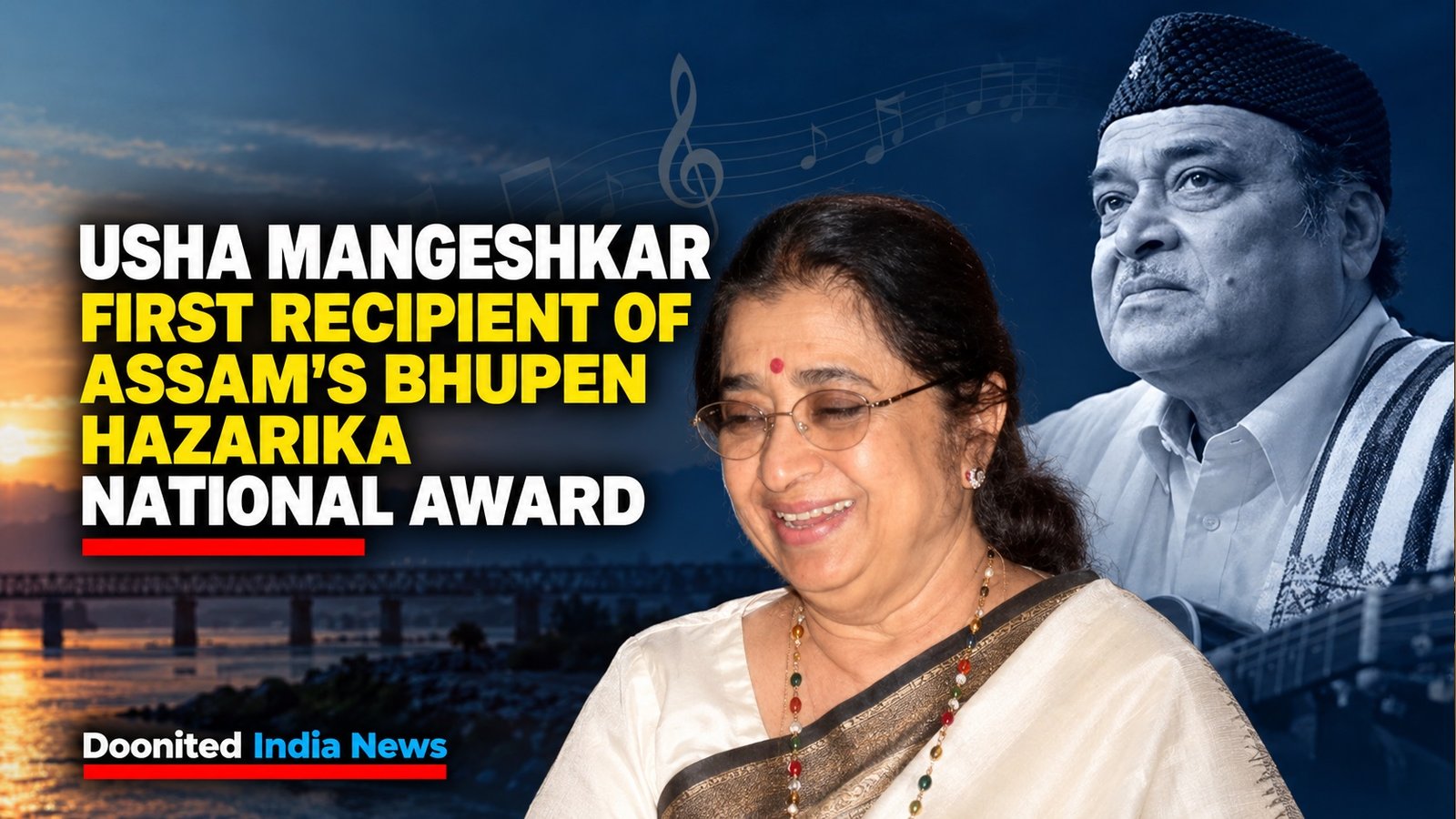
Beyond Bollywood: Usha Mangeshkar’s Recognition Connects India’s Musical Traditions
Indian music has rarely respected the boundaries that divide languages, regions and audiences. A melody composed in Assam can travel far beyond the Northeast; a playback singer associated with Hindi or Marathi cinema can become part of a much wider musical tradition.
That cultural exchange provides the backdrop to a new honour announced by the Assam government.
Veteran playback singer Usha Mangeshkar has been selected as the inaugural recipient of the Bharat Ratna Dr. Bhupen Hazarika National Award. Assam Chief Minister Himanta Biswa Sarma announced the decision following a state Cabinet meeting on 23 October 2026.
According to the announcement, Prime Minister Narendra Modi is scheduled to present the award on 29 November at Bharat Mandapam in New Delhi, during the concluding ceremony of Bhupen Hazarika’s birth centenary celebrations.
The award will carry a cash prize of ₹10 lakh and a citation. It is intended to recognise nationally or internationally recognised personalities whose work relates to music, the arts, cinema and Bhupen Hazarika’s broader artistic legacy. The award is planned to be conferred once every three years.
Beyond the ceremony, the announcement raises a larger cultural question: how should India recognise artists whose contributions extend across regional traditions, languages and generations?
Usha Mangeshkar: An artistic identity of her own
Usha Mangeshkar occupies a distinctive place in the history of Indian playback singing.
She belongs to one of India’s most influential musical families, alongside her elder sisters Lata Mangeshkar and Asha Bhosle. Yet her career should not be understood merely through those family associations.
Her work spans Hindi and Marathi cinema, devotional music and regional repertoire. One of her best-known Hindi film songs is Mungda, from the 1978 film Inkaar, composed by Rajesh Roshan. The song became a lasting example of her contribution to popular Hindi film music.
Her career also reflects a feature of India’s recording industry that is sometimes overlooked: singers frequently work across different musical environments, from commercial cinema to devotional recordings and stage performances.
These forms demand different approaches to interpretation. Film playback singing must serve a character and a scene; devotional music often depends on a sustained emotional connection with its audience; regional songs may draw on distinct linguistic and cultural traditions.
An artist’s range cannot be measured by the number of languages in which they record alone. It also lies in the ability to understand a song’s context and communicate its emotional character.
The Assam government’s decision to honour Mangeshkar in the name of Bhupen Hazarika places that broader musical contribution at the centre of the recognition.
Bhupen Hazarika: The voice of Assam and the Northeast
Born on 8 September 1926, Bhupen Hazarika was a singer, composer, lyricist, poet and filmmaker whose work became deeply associated with Assam and the wider Northeast.
His centenary in 2026 marks 100 years since his birth. He died on 5 November 2011, but his songs continue to circulate through recordings, performances and cultural programmes.
Hazarika’s significance extends beyond his role as a musician. His work frequently addressed human dignity, social inequality, community life and the relationships between people and their surroundings. He used music to express regional experiences while engaging with themes that audiences elsewhere could understand.
His career also crossed linguistic and geographical boundaries. He worked in Assamese, Bengali and Hindi musical and film environments, helping bring the Northeast’s cultural voice to audiences across India.
That achievement matters in a country where the national cultural conversation can sometimes be dominated by the largest commercial film industries. Regional music does not need to become detached from its origins to acquire wider relevance.
Hazarika’s legacy demonstrates how a strongly rooted cultural identity can speak to a much larger public.
The national award bearing his name seeks to extend recognition of that legacy beyond the centenary itself.
Where two musical journeys meet
The reported connection between Mangeshkar and Hazarika is central to the award announcement.
Their musical association provides a concrete reason to consider the honour as more than a general lifetime-achievement award. It links the legacy of a major Assamese composer with the work of a singer whose career spans several branches of Indian popular music.
This relationship also illustrates the collaborative nature of recorded music.
A song may originate with a composer, but its final identity depends on the singer’s interpretation, the arrangement, the musicians and the circumstances in which it reaches listeners. Playback singers are often heard by millions without receiving the same public attention as the performers seen on screen.
The strongest musical partnerships survive because their individual contributions complement one another.
In Hazarika’s case, the wider significance of collaboration lies in how songs can carry the language, emotional atmosphere and social concerns of one region into another. The listener need not understand every word to recognise the feeling conveyed by a melody or voice.
That is not a substitute for understanding a language or its culture. It is an invitation to engage with both.
The award’s cultural value will ultimately depend not only on whom it honours, but also on whether it encourages audiences to discover the music and artistic traditions behind the name.
Why the award matters beyond Assam
The proposed award is a cultural initiative by the Assam government with a national scope.
Its triennial schedule distinguishes it from annual entertainment awards. A three-year interval could provide an opportunity to recognise artists whose careers have developed over decades rather than concentrating exclusively on recent commercial success.
However, the award is newly instituted. Its long-term significance cannot yet be measured by its inaugural announcement alone.
That will depend on future recipients, the transparency of selection criteria, the breadth of artistic fields represented and the extent to which the honour brings renewed attention to Hazarika’s work.
There is also a practical opportunity for cultural institutions, broadcasters and music educators.
A centenary celebration can become a one-day event in the public calendar, or it can serve as the starting point for a longer engagement with an artist’s catalogue. Schools, universities, cultural organisations and digital platforms could use the occasion to introduce younger listeners to Assamese music, regional cinema and the history of Indian playback singing.
The second approach would give the celebration a more durable purpose.
Preserving a musical legacy requires more than ceremonies
India’s musical heritage is extraordinarily diverse, but recognition and preservation are not the same thing.
Awards create visibility. They do not, by themselves, preserve ageing recordings, document regional performance traditions, improve access to archives or ensure that younger musicians can learn from earlier generations.
These tasks require sustained work by public institutions, broadcasters, archives, researchers and cultural organisations.
For a figure such as Hazarika, preservation also involves presenting his music in context. His songs should be understood not simply as nostalgic recordings, but as creative works shaped by the society, language and historical circumstances in which they emerged.
Similarly, Mangeshkar’s career deserves to be considered through its musical contributions rather than only through her association with a famous family.
A thoughtful award can help open these conversations. Its value increases when recognition leads audiences towards the work itself.
A national award with a regional foundation
The decision to honour Usha Mangeshkar during Hazarika’s birth centenary brings together two important strands of India’s musical history.
One is the contribution of individual singers whose voices become part of everyday cultural life. The other is the capacity of regional artists to communicate experiences that transcend their place of origin.
The planned ceremony at Bharat Mandapam on 29 November 2026 will provide a national platform for that connection. The presentation is scheduled, but the ceremony has not yet taken place as of 25 October 2026.
The larger test will come afterward.
If the new award encourages audiences to listen more closely to Hazarika’s compositions, explore Assamese music and recognise the work of artists across linguistic traditions, it will have achieved something more enduring than a headline.
India’s musical unity does not depend on making every region sound the same. It depends on creating space for different voices to be heard, understood and valued.
That is the cultural promise behind an award named after Bhupen Hazarika—and the standard against which its future impact should be judged.


World Beyond the News
Birds Can Navigate Using Earth’s Magnetic Field
Several bird species can sense Earth’s magnetic field, helping them navigate during long-distance migration.
Fermentation Is a Global Food Tradition
People across continents have used fermentation for centuries to preserve food and create distinctive flavours.
Modern Batteries Store Energy Chemically
Rechargeable batteries repeatedly move ions between electrodes, allowing electrical energy to be stored and released.
Why Songs Become Global Hits
Streaming platforms, short-form video, playlists and international collaborations can rapidly carry music across borders.