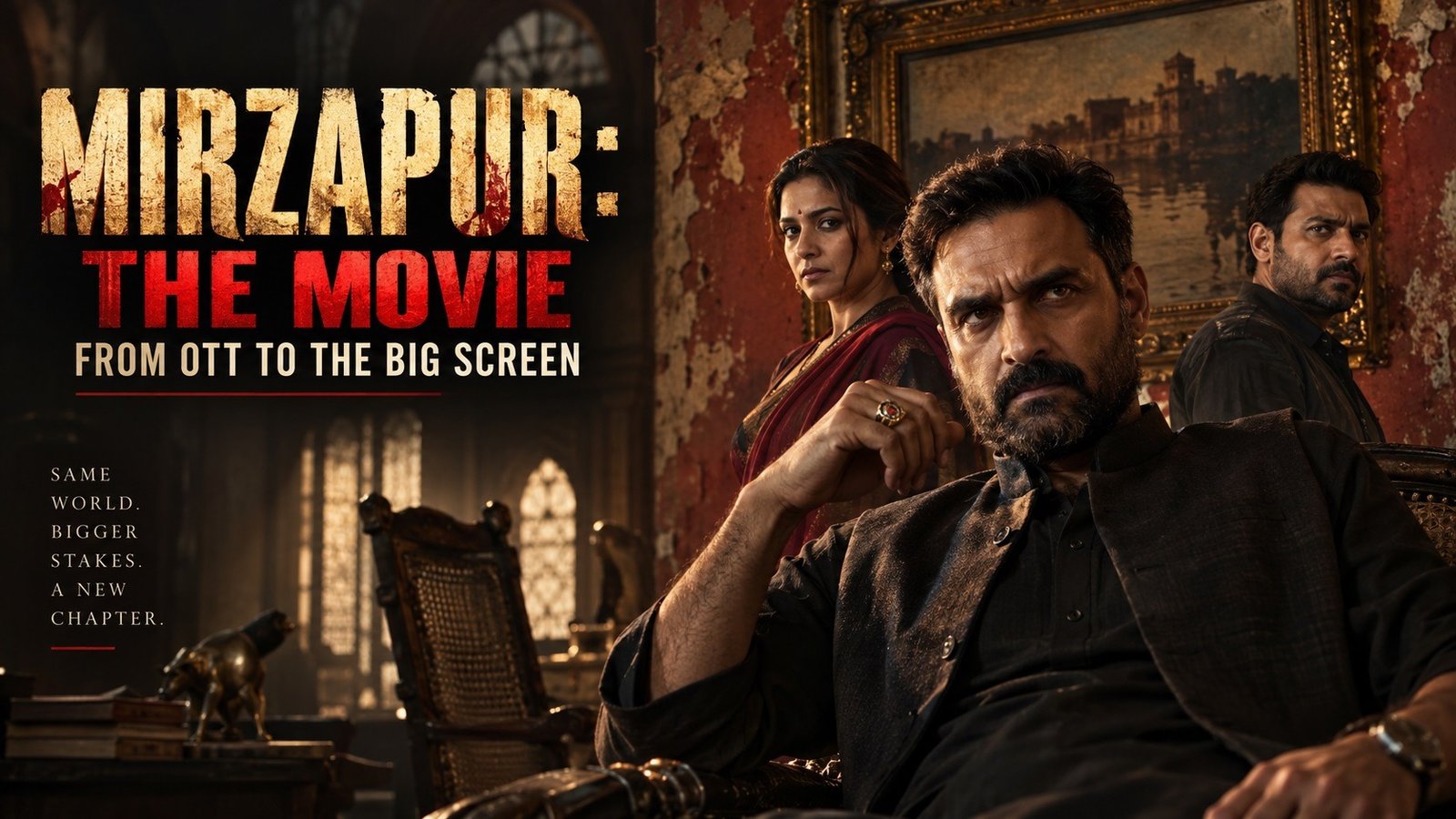
From OTT to the Big Screen: What Mirzapur’s Movie Move Says About India’s Streaming Era
When Mirzapur: The Movie opened in cinemas on September 4, 2026, it did more than extend a popular crime franchise. It tested whether an Indian story built for streaming could turn digital fandom into theatrical footfall — and the early numbers suggest that audiences were willing to make the journey.
For years, the conventional direction in Indian entertainment seemed obvious.
Films became shows.
Cinema stars moved to streaming.
Stories that might once have been released in theatres were increasingly designed for OTT platforms.
Then Mirzapur decided to travel in the opposite direction.
The franchise that became one of India’s best-known streaming properties has now entered cinemas with Mirzapur: The Movie, directed by Gurmeet Singh and written by Puneet Krishna, with the returning ensemble including Pankaj Tripathi, Ali Fazal, Divyenndu, Rasika Dugal and Ravi Kishan. The film is produced by Excel Entertainment.
The move is interesting because the film is not asking audiences to discover an unknown world.
It is asking them to leave the living room and pay for a ticket to revisit one they already know.
That is a very different proposition.
From binge-watching to buying a ticket
The original Mirzapur built its audience through Amazon Prime Video over three seasons.
That changed the economics of audience-building.
A theatrical film traditionally has to persuade people to make a trip to the cinema before they know whether they will like the characters or story. An established streaming franchise begins with something extremely valuable: familiarity.
Audiences already know Kaleen Bhaiya, Guddu Pandit, Munna Tripathi and the world surrounding them.
That familiarity became the film’s biggest marketing asset.
Ahead of release, advance bookings were already substantial. The Indian Express reported more than 2.1 lakh tickets sold across tracked shows before release, with advance collections reported at ₹9.60 crore including blocked seats.
The experiment therefore began before the first show.
The question was no longer whether people knew Mirzapur.
They clearly did.
The question was whether knowing it was enough to make them go to the cinema.
The early answer was visible at the box office
The film opened on September 4 and quickly demonstrated the commercial power of its existing audience.
After seven days, the Indian Express reported worldwide collections of ₹212.44 crore, while the domestic net total was reported at approximately ₹148.45 crore.
By the second week, the film continued to add significant revenue, with reports placing worldwide gross above ₹280 crore after 12 days.
By Day 15, Times of India reported a worldwide gross of approximately ₹296 crore, with domestic net collections above ₹203 crore.
These are trade-reported figures and should be treated accordingly, but the broad pattern is unmistakable: the franchise successfully converted a large portion of its streaming familiarity into theatrical demand.
That is the structural story.
Why Mirzapur was particularly suited to the experiment
Not every OTT series can make this transition.
A show needs more than viewers. It needs a recognisable identity.
Mirzapur has accumulated several ingredients that work well theatrically: memorable characters, a distinctive fictional world, catchphrases, conflict and a highly recognisable ensemble.
It also has something increasingly valuable in entertainment — fan memory.
Viewers don’t simply remember that they watched the series.
They remember characters.
They remember relationships.
They remember betrayals.
They remember scenes.
That creates something closer to a conventional film franchise than a disposable streaming title.
The movie therefore arrives with an unusual advantage: audiences already have emotional and narrative investment in the property.
The theatre changes the experience
There is, however, a difference between watching Mirzapur at home and watching Mirzapur with hundreds of other people.
Streaming is fundamentally individualised.
You can pause.
You can rewind.
You can stop halfway through an episode because someone has decided that dinner is suddenly more important than the climax.
The cinema offers none of that flexibility.
What it does offer is collective viewing.
Laughter spreads.
Reactions spread.
Dialogue gets an immediate response.
A familiar character appearing on a giant screen can become an event rather than another evening of streaming.
This may be one reason established OTT franchises have theatrical potential.
They can combine the intimacy of digital fandom with the communal nature of cinema.
The movie also changes the value of the franchise
There is a business lesson here.
A successful streaming series creates intellectual property.
Once the characters and world become recognisable, that IP can potentially travel across formats — films, new seasons, merchandise, games, music, live experiences and other extensions.
Mirzapur: The Movie demonstrates one such route.
Instead of treating the streaming series as the end product, the producers are treating it as the foundation for a larger entertainment universe.
Reports have even indicated discussions around a possible sequel, while Mirzapur Season 4 remains in development. Those reports should be distinguished from formally announced production details.
The underlying commercial idea is nevertheless clear.
A successful digital franchise does not necessarily have to remain digital.
But there is a danger in simply exporting OTT popularity to theatres
The transition is not automatically guaranteed.
A streaming audience is not identical to a theatrical audience.
On OTT, viewers may watch because the content is convenient, inexpensive relative to individual cinema tickets and available immediately.
The cinema asks for more commitment.
There is a ticket.
There may be travel and parking.
There is food that somehow costs approximately the same as a small household appliance.
And there is a fixed showtime.
A franchise therefore cannot assume that streaming popularity automatically guarantees theatrical success.
It needs a reason for audiences to leave home.
In Mirzapur’s case, the combination of established characters, a large-scale continuation of the story and the curiosity surrounding the franchise appears to have provided that motivation.
The content challenge is different too
A streaming series has room to develop characters over many episodes.
A feature film has roughly three hours — and Mirzapur: The Movie itself has a certified runtime of about 3 hours 17 minutes. The film received an A certificate from the Central Board of Film Certification, with reported modifications involving language and intimate scenes.
That creates a different storytelling problem.
A film cannot simply behave like another long episode.
It needs theatrical momentum.
It needs a cinematic scale.
It needs to reward viewers who have followed the franchise while remaining sufficiently coherent for audiences who may know the world less intimately.
That balancing act may become increasingly important as more OTT properties attempt theatrical spin-offs.
India’s entertainment industry is becoming platform-agnostic
The larger lesson is perhaps bigger than Mirzapur.
The old distinction between “Bollywood film” and “OTT series” is becoming less useful.
What increasingly matters is the IP.
A successful story can begin in a theatre and move to streaming.
It can begin on streaming and move to theatres.
It can exist simultaneously across platforms.
The audience is not necessarily loyal to a format.
It is loyal to stories, characters and entertainment experiences.
This is a significant change in the Indian market.
Streaming platforms helped create a generation of viewers comfortable with long-form storytelling, regional-language content and unconventional narratives. The theatrical industry, meanwhile, still provides something streaming cannot fully reproduce: the sense that watching something is an event shared with strangers.
The two ecosystems are therefore becoming competitors, partners and distribution channels at the same time.
The intriguing part: Mirzapur did not abandon OTT
There is an important misconception to avoid.
The theatrical move does not mean streaming has lost.
Quite the opposite.
The film’s theatrical audience exists partly because streaming created the franchise in the first place.
The cinema release is therefore better understood as an extension of the OTT ecosystem rather than a rejection of it.
The streaming platform created the familiarity.
The franchise created the fan base.
The theatrical release monetised that familiarity in a different environment.
And, eventually, the film is expected to have an OTT life as well, although an official streaming premiere date should be distinguished from media speculation until formally announced.
This is less a battle between cinema and OTT than a demonstration that successful entertainment IP can move between them.
There is also a cultural question
Mirzapur is a crime drama built around violence, power and criminal politics.
Its success raises a broader question about what happens when streaming stories become mass theatrical events.
The Delhi High Court has recently questioned the use of the song Shoorveer in a violent sequence in the film and directed the CBFC to consider proposed changes, while the filmmakers defended the contextual use. That dispute remains part of the film’s wider public conversation.
This illustrates an important difference between streaming and cinema.
Once a streaming property becomes a large theatrical release, its imagery and cultural choices can enter a much broader public conversation.
Success increases visibility.
Visibility increases scrutiny.
That is simply part of the price of becoming a mass entertainment property.
DOONITED VIEW: The real product is not the movie — it is the universe
The most interesting thing about Mirzapur: The Movie is not that a web series has become a film.
That has happened before.
The more significant development is the emergence of franchise ecosystems in Indian entertainment.
The streaming era has taught producers that audiences can develop long-term relationships with fictional worlds. The next step is learning how many different forms that relationship can take.
A successful streaming series can become a theatrical event.
A theatrical film can send audiences back to earlier seasons.
A new season can revive interest in the film.
The characters keep travelling between screens.
That creates a circular entertainment economy rather than a straight line from release to release.
For Indian studios, this could become increasingly important.
For audiences, it means the phrase “watch the movie” may eventually become less important than “follow the franchise.”
And there is an amusing irony in that.
OTT was supposed to make cinema less necessary.
Instead, streaming may have discovered a way to make its biggest stories valuable enough to return to the cinema.
Mirzapur has now provided one of India’s clearest real-world tests of that idea.
The experiment is no longer theoretical.
The audience has already bought the tickets.

World Beyond the News
Why Elephants Stay Close to Their Herd
Elephants live in highly social family groups and use calls, touch and body movements to maintain strong bonds.
Most of the Deep Ocean Remains Difficult to Explore
Extreme pressure, darkness and distance make deep-ocean exploration one of Earth’s greatest scientific challenges.
Spacecraft Can Travel Without Traditional Roads
Spacecraft use carefully calculated trajectories and gravity assists to travel enormous distances through space.
Why Movie Trailers Are Released in Stages
Major films often use teaser trailers, full trailers and final promotional spots to build awareness over time.