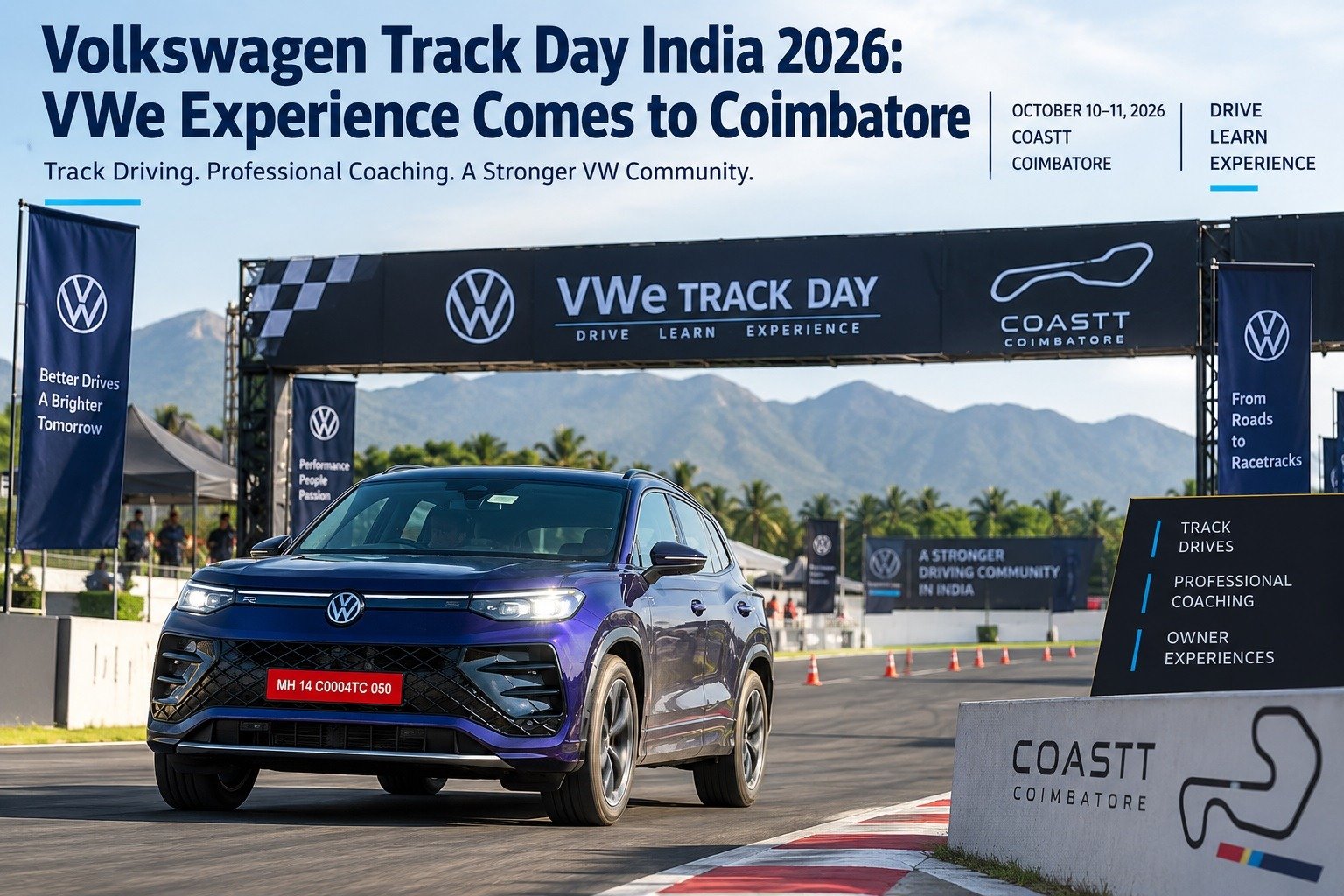
Volkswagen Brings Track-Day Culture to Indian Car Owners
Volkswagen India is taking its performance-car community away from public roads and onto a proper racetrack, launching VWe Track Day Experiences at CoASTT in Coimbatore. The initiative combines performance driving, professional instruction, vehicle-control exercises and owner community activities.
There is something slightly amusing about buying a performance-oriented car and then spending most of its life negotiating traffic lights, speed breakers and the occasional magnificently unpredictable Indian lane change.
Volkswagen India now wants to give some of its customers a different setting.
The company has launched VWe — Volkswagen Experiences — Track Day, a new platform designed to let owners experience the dynamics of their cars in a professionally managed environment. The inaugural event will take place at CoASTT, Coimbatore, on October 10 and 11, 2026.
And this is not simply a “drive fast and take photographs” weekend.
Volkswagen’s format combines circuit driving, autocross, slalom, off-road activities, professional coaching, technical sessions and community interaction.
In other words, the company is attempting to turn the relationship between owner and car into something that continues after the showroom handover.
From showroom to racetrack
The first VWe Track Day is divided around different groups of Volkswagen performance-oriented cars.
October 10 is the GTI + R-Line day, for owners of the Golf GTI, Tiguan R-Line and Tayron R-Line.
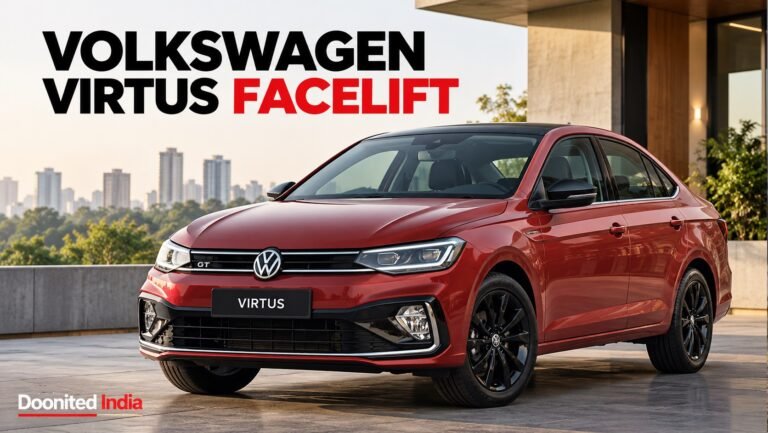
October 11 is the GT day, bringing together owners of models including the Virtus GT, Taigun GT and Polo GT, according to Volkswagen’s official event platform.
Autocar India’s report on the launch similarly identifies the Golf GTI, Tiguan R-Line, Tayron R-Line, Virtus GT and Taigun GT among the participating models.
The event will use CoASTT’s 3.8km circuit with 14 turns, giving owners considerably more room to understand their cars than a typical public-road drive can provide.
That distinction is important.
On a public road, exploring the limits of a performance car is not merely impractical; it can be dangerous. A racetrack creates a controlled environment where braking, cornering, acceleration and vehicle balance can be experienced with professional supervision.
It is about learning, not just speed
Volkswagen’s programme begins with instructor-led familiarisation and lead-and-follow sessions. Participants can progressively increase their pace while learning the circuit and understanding track rules and flag signals.
The programme also includes slalom and autocross challenges, where precision and vehicle control become more important than simply pressing the accelerator.
There is even a drag-race format between comparable cars on an approximately 400-metre section of the circuit. Karting and additional skill-based activities are also part of the programme.
That makes the event interesting for a reason beyond automotive entertainment.
A fast car does not automatically make someone a good driver.
Understanding braking points, steering inputs, weight transfer, throttle control and the behaviour of a car through a corner can make a driver more aware of what the vehicle is actually doing.
And that knowledge can be useful even when the car eventually returns to ordinary Indian roads, where the objective should generally be arriving safely rather than setting a personal lap record between two traffic signals.
The off-road surprise
The Track Day isn’t restricted to tarmac.
Volkswagen’s programme includes an off-road experience using the Tayron R-Line, with instructor guidance through inclines, declines, axle-articulation sections and water-wading areas.
The inclusion is significant because it expands the idea of a performance experience beyond the Golf GTI’s traditional hot-hatch identity.
The Tayron R-Line, meanwhile, gets to demonstrate that its capabilities are not limited to looking suitably serious in a premium shopping-centre car park.
For participants, the combination of circuit work, handling exercises and off-road driving also means they can experience different aspects of Volkswagen’s current performance-oriented portfolio within the same programme.
No previous track experience required
Perhaps the most accessible element is that previous track-driving experience is not required.
Volkswagen’s official event information says participants must be over 18, hold a valid driving licence and have at least one year’s driving experience.
For the main circuit and timed autocross, participants drive their own eligible Volkswagen. The vehicles must be roadworthy, properly registered and insured, with tyres in good condition. Volkswagen also states that vehicles, including modified or tuned cars, undergo a safety inspection before being allowed onto the track.
That safety screening is more than administrative fine print.
Once performance driving is involved, the condition of tyres, brakes and other components becomes a genuine safety issue. A racetrack is controlled, but physics remains stubbornly uninterested in marketing slogans.
What does it cost?
The registration fee is ₹2,500 per participant, according to both Volkswagen’s official event information and Autocar India’s report. Volkswagen’s event page says the GT Day fee includes activities, lunch and merchandise.
The official programme also describes hospitality areas and other activities around the driving sessions, making the weekend as much about the owner community as the cars themselves.
That community element may ultimately be one of the more important parts of the initiative.
Volkswagen is building an ownership experience
Automakers have increasingly realised that selling a car is only one part of maintaining a relationship with customers.
Road trips, owner clubs, driving events, technical workshops and motorsport-linked experiences allow brands to create communities around their products.
Volkswagen has already used its VWe Volkswagen Experiences platform for community-focused activities, including curated driving experiences and expeditions. The new Track Day format takes that philosophy into a more performance-oriented environment.
The timing is also interesting.
Volkswagen India’s current portfolio includes the Golf GTI, Tiguan R-Line, Tayron and GT versions of the Virtus and Taigun. The company is therefore developing a wider performance identity in India rather than relying solely on one enthusiast-oriented model.
The bigger Indian story: performance without public-road drama
India’s car culture has matured considerably.
There is a growing enthusiast community interested in performance cars, motorsport, detailing, modifications, road trips and driving experiences. But public roads remain shared spaces, and high-performance driving has obvious safety limitations outside controlled environments.
That creates an opportunity for manufacturers.
Instead of encouraging customers to discover what their cars can do through unofficial road experimentation, organised track experiences can provide a legitimate alternative.
It also introduces more drivers to concepts that are familiar to motorsport enthusiasts but less commonly taught to ordinary motorists: racing lines, braking technique, vehicle dynamics and track discipline.
DOONITED VIEW: The best part may happen before the accelerator hits the floor
Volkswagen’s Track Day initiative is easy to market as an adrenaline experience.
But its more interesting value lies elsewhere.
It treats performance driving as a skill rather than simply a specification.
Horsepower figures, acceleration times and aggressive-looking body kits are easy to sell. Teaching customers how a car behaves under braking, how steering inputs affect balance and how to control a vehicle progressively is a much more substantive form of engagement.
There is also a useful cultural message here.
India does not need more people treating public roads as racetracks. It does need more opportunities for enthusiasts to explore performance driving where performance driving belongs — in controlled environments with proper instruction and safety procedures.
That makes the Coimbatore event more than a promotional weekend.
It is a small example of India’s car culture moving from owning performance machines to learning how to use them responsibly.
And perhaps that is the most sensible kind of horsepower education.
The first lap may be about excitement.
The lesson should be about control.


World Beyond the News
Octopuses Can Change Their Appearance
Octopuses can rapidly alter their skin colour and texture to communicate, camouflage themselves and respond to danger.
Some Cities Exist Across Two Continents
A small number of cities are geographically associated with two continents, creating unusual cultural and geographic identities.
Earth’s Climate Is Measured in Many Ways
Scientists track temperature, atmospheric gases, sea level, ice cover and other indicators rather than relying on a single climate number.
Streaming Changed How Audiences Discover Shows
Recommendation systems and global streaming releases allow audiences to discover programmes far beyond their original markets.