From Made in India to Invented in India: The New Technology Ambition
For years, India’s technology story could be summed up in two familiar phrases: Made in India and Engineered in India.
The first described the country’s manufacturing ambitions. The second captured India’s extraordinary rise as an engineering, software and research-and-development base for global technology companies.
Now, a third phrase is entering the conversation: Invented in India.
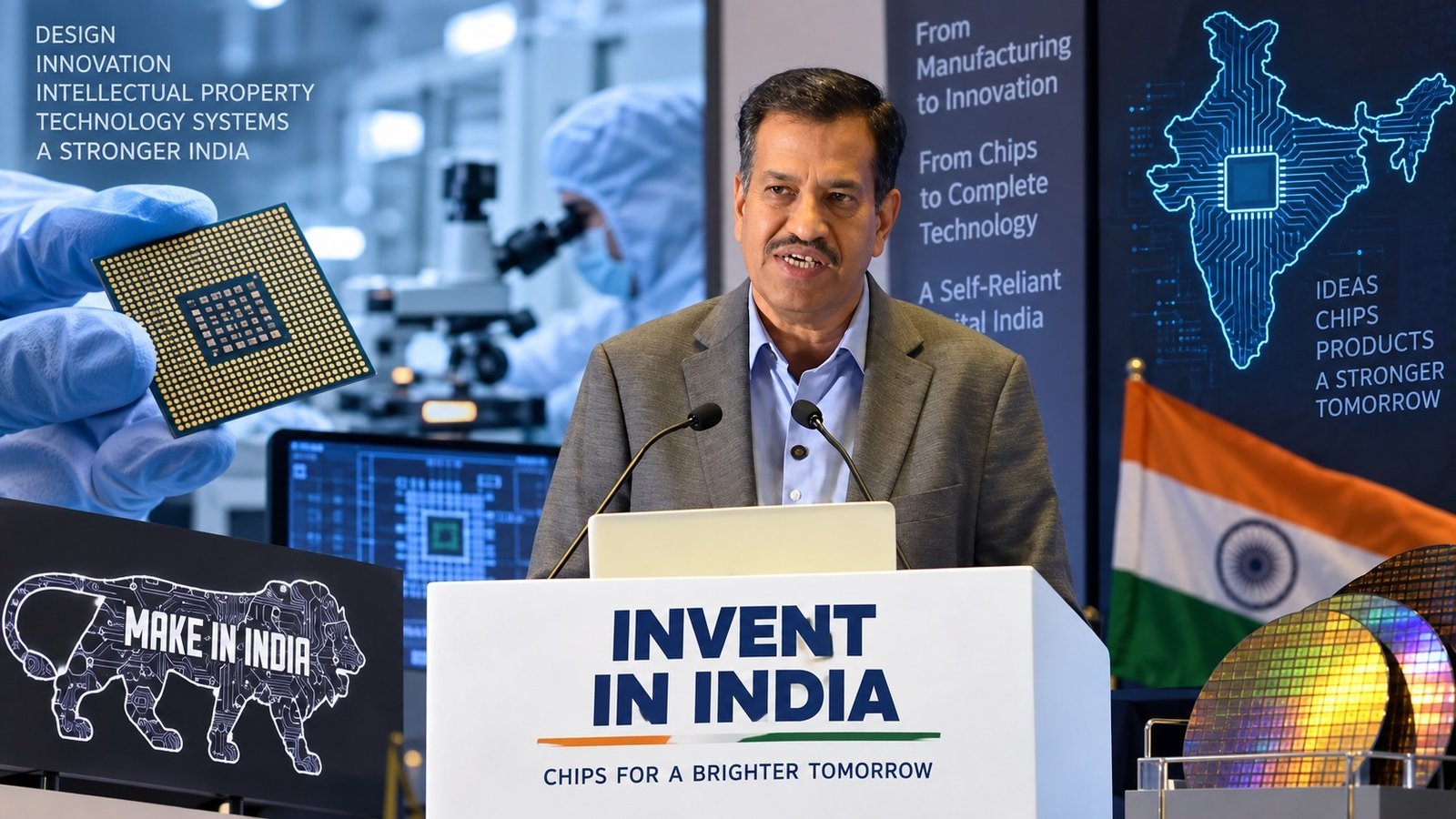
At SEMICON India 2026 in New Delhi, Vikram Meghal, Senior Vice President of Engineering at Infosys, argued that India needs to move from “engineered in India” towards “invent in India” — particularly by taking greater ownership of semiconductor products, chips and complete systems. His argument comes at a moment when artificial intelligence is changing the economics and architecture of the technology industry.
That shift may ultimately prove more significant than another factory announcement.
Because making something is valuable. Designing it is more valuable. But owning the technology, intellectual property and product around it can capture an entirely different level of economic value.

India Has Already Built the Engineering Muscle
India does not have to begin this journey from zero.
The country’s technology sector has spent decades developing engineers, software specialists, embedded-systems professionals and R&D teams serving global companies. Infosys itself describes the semiconductor opportunity as extending across chip design, verification, physical design, AI-enabled engineering, manufacturing and the connection between silicon and applications.
That accumulated capability matters.
A semiconductor is not simply a tiny piece of silicon. Around it sits an enormous ecosystem involving architecture, electronic-design automation, intellectual property, verification, packaging, testing, manufacturing equipment, software and eventually the products that use the chip.
SEMICON India’s own 2026 theme — “Transform Tomorrow: Silicon to Systems – Building the Ecosystem” — reflects that broader ambition. The event brings together chip design, manufacturing, advanced packaging, materials, equipment, software, AI, startups, academia and talent development.
In other words, the conversation is becoming less about one chip factory and more about the entire technology chain.
The Semiconductor Opportunity Is Getting Bigger — and Harder
Artificial intelligence has dramatically increased the importance of semiconductors.
AI data centres require enormous quantities of computing, memory and networking hardware. Meghal described the current period as a “once-in-a-generation” demand window and argued that India has an opportunity to participate in a rapidly expanding market.
But opportunity should not be confused with guaranteed success.
Semiconductor technology is brutally capital-intensive and technically demanding. A country can attract factories without automatically creating globally competitive semiconductor companies headquartered there.
That is where the “invent in India” argument becomes important.
If Indian companies merely manufacture components designed elsewhere, the country captures manufacturing value.
If Indian engineers design chips for foreign companies, India captures engineering and R&D value.
If Indian companies create their own semiconductor IP, products and systems — and successfully sell them around the world — the value chain becomes much deeper.
That is the bigger prize.
India Is Already Moving Beyond the Factory
There are signs that this transition is beginning.
At SEMICON India 2026, L&T Semiconductor Technologies unveiled 40 semiconductor products spanning areas including power electronics, connectivity, compute, automotive and AI-enabled applications. Among the products showcased was an India-designed silicon-carbide MOSFET platform aimed at applications such as EV fast charging and microgrids, alongside other products including a BLDC motor controller and a vision-camera system-on-chip.
Meanwhile, the government says India-made chips are now being exported, while semiconductor projects are moving into commercial production. The government has also said that Semicon 2.0 will expand attention beyond manufacturing to areas such as semiconductor design, equipment, R&D and talent.
These developments are important because they demonstrate that India’s semiconductor ambition is becoming broader than simply attracting a multinational fab.
The country wants the ecosystem around the fab as well.
The Global Supply Chain Is Opening a Window
Geopolitics has also changed the semiconductor equation.
The global chip industry remains heavily concentrated in a relatively small number of locations. Companies and governments are therefore looking for more resilient supply chains and additional manufacturing and technology partners.
India is attempting to position itself within that diversification.
Reuters reported that Applied Materials announced plans to invest $5 billion in India over the next decade, expanding its research, supply-chain and workforce footprint. The report also noted that India has committed more than $21 billion to semiconductor incentives, while the country is still waiting for large-scale fabrication capacity to fully mature.
The distinction is crucial.
Investment announcements are not the same thing as a mature semiconductor ecosystem.
Factories have to be built. Production has to reach commercial scale. Yield rates have to become competitive. Customers must trust the output. Engineers need to be trained. Suppliers need to develop alongside the fabs.
And, eventually, Indian companies need to create technology that customers actually want to buy.
That last part cannot be solved by a subsidy.
Semicon 2.0: From Infrastructure to Intellectual Property
India’s next phase therefore has two simultaneous objectives.
The first is physical: fabs, assembly and testing facilities, packaging, equipment, materials and supply chains.
The second is intellectual: design capability, semiconductor IP, research, product companies and skilled talent.
The government has described Semicon 2.0 as an expansion of the semiconductor ecosystem, with attention to design, equipment, fabs, advanced packaging, R&D and talent. It has also said that roughly ₹1 lakh crore of investment commitments have emerged and that the programme could create close to one lakh new employment opportunities across the ecosystem.
There is also a significant talent component.
According to the government, the broader programme is intended to train one lakh technicians, while earlier initiatives have already expanded semiconductor design capabilities among engineering institutions.
This matters because semiconductor leadership cannot be imported in a box.
A fab can be purchased.
A machine can be installed.
But the ability to design the next generation of chips has to be cultivated.
The “Invent in India” Test
The real test for India’s semiconductor strategy will therefore not be the number of factories alone.
It will be easier to measure through questions such as:
How many Indian-designed chips reach commercial markets?
How much semiconductor intellectual property is owned by Indian companies?
How many products created in India become global products?
Can Indian startups move from prototype to mass production?
Can universities and industry turn research into commercially useful technology?
Can India develop complete systems rather than stopping at individual components?
These questions are harder than counting investment announcements — but they are much closer to measuring technological depth.
From Silicon to Systems
Perhaps the most interesting change is that the ambition is moving beyond the chip itself.
A successful technology product is rarely just a semiconductor.
It is a combination of hardware, software, AI, connectivity, manufacturing, security and user experience.
That is why the phrase “silicon to systems” matters.
India already has considerable experience in software and engineering. Its opportunity is to connect that strength with semiconductor design and physical products.
Imagine the difference between designing part of an automotive chip for an overseas customer and developing the architecture, chip, software stack and complete automotive system for global markets.
The second requires much more than engineering manpower.
It requires product thinking.
And that is precisely where India’s next technological challenge lies.
The Hard Truth: “Invented in India” Cannot Become a Slogan
There is a danger in turning technological ambition into advertising language.
India has made genuine progress, but it has not suddenly become a full-spectrum semiconductor superpower.
Large-scale fabrication remains difficult. Capital requirements are enormous. Global incumbents possess decades of manufacturing experience and intellectual property. Supply chains for specialised equipment and materials remain international. And even a technically impressive chip is worthless if nobody buys it.
India therefore needs patience as well as ambition.
It also needs stronger links between universities, startups, established companies and government programmes.
The semiconductor race is not a sprint to announce the largest factory.
It is a long contest to build knowledge, products, customers and intellectual property.
India’s Technology Story Is Getting More Interesting
For decades, India’s technology success was often measured through software exports, IT services and engineering centres.
Those remain important.
But the next chapter could look considerably different.
It could include Indian-designed chips powering electric vehicles, telecommunications equipment, industrial systems, energy infrastructure and AI applications. It could include semiconductor startups creating specialised products rather than simply supplying engineering services. It could involve Indian research institutions contributing IP that eventually becomes commercial technology.
That is the promise behind the move from Made in India to Invented in India.
The country does not need to choose between manufacturing and invention.
It needs to connect them.
The factory can make the chip. The engineer can design it. But the real technology economy begins when the product, intellectual property and global customer belong to the people who created it.
That is the deeper lesson emerging from SEMICON India 2026.
India’s next technology ambition is not merely to become the workshop of the semiconductor age.
It is to become one of its laboratories, product houses and technology owners.
And that is a considerably bigger ambition than putting a “Made in India” label on the box.
DOONITED Editorial Perspective
The most useful way to read India’s semiconductor push is neither as a guaranteed technological breakthrough nor as merely another manufacturing policy.
It is an attempt to climb the value chain.
Manufacturing creates capacity. Engineering creates capability. Invention creates ownership.
India now has to prove that all three can work together.
Meaningful Learning for Readers
The semiconductor story is ultimately not only about computer chips. It is about who owns the technology behind the products that will define the next decade — AI systems, electric vehicles, telecom networks, industrial automation and intelligent devices.
For India, that makes “Invent in India” more than a slogan. It is a test of whether engineering talent can be converted into globally competitive products and intellectual property.
Sources
SEMICON India 2026 / SEMI and India Semiconductor Mission; Infosys; Press Information Bureau; Financial Express; The Economic Times; Reuters.

World Beyond the News
Why Elephants Stay Close to Their Herd
Elephants live in highly social family groups and use calls, touch and body movements to maintain strong bonds.
Most of the Deep Ocean Remains Difficult to Explore
Extreme pressure, darkness and distance make deep-ocean exploration one of Earth’s greatest scientific challenges.
Spacecraft Can Travel Without Traditional Roads
Spacecraft use carefully calculated trajectories and gravity assists to travel enormous distances through space.
Why Movie Trailers Are Released in Stages
Major films often use teaser trailers, full trailers and final promotional spots to build awareness over time.