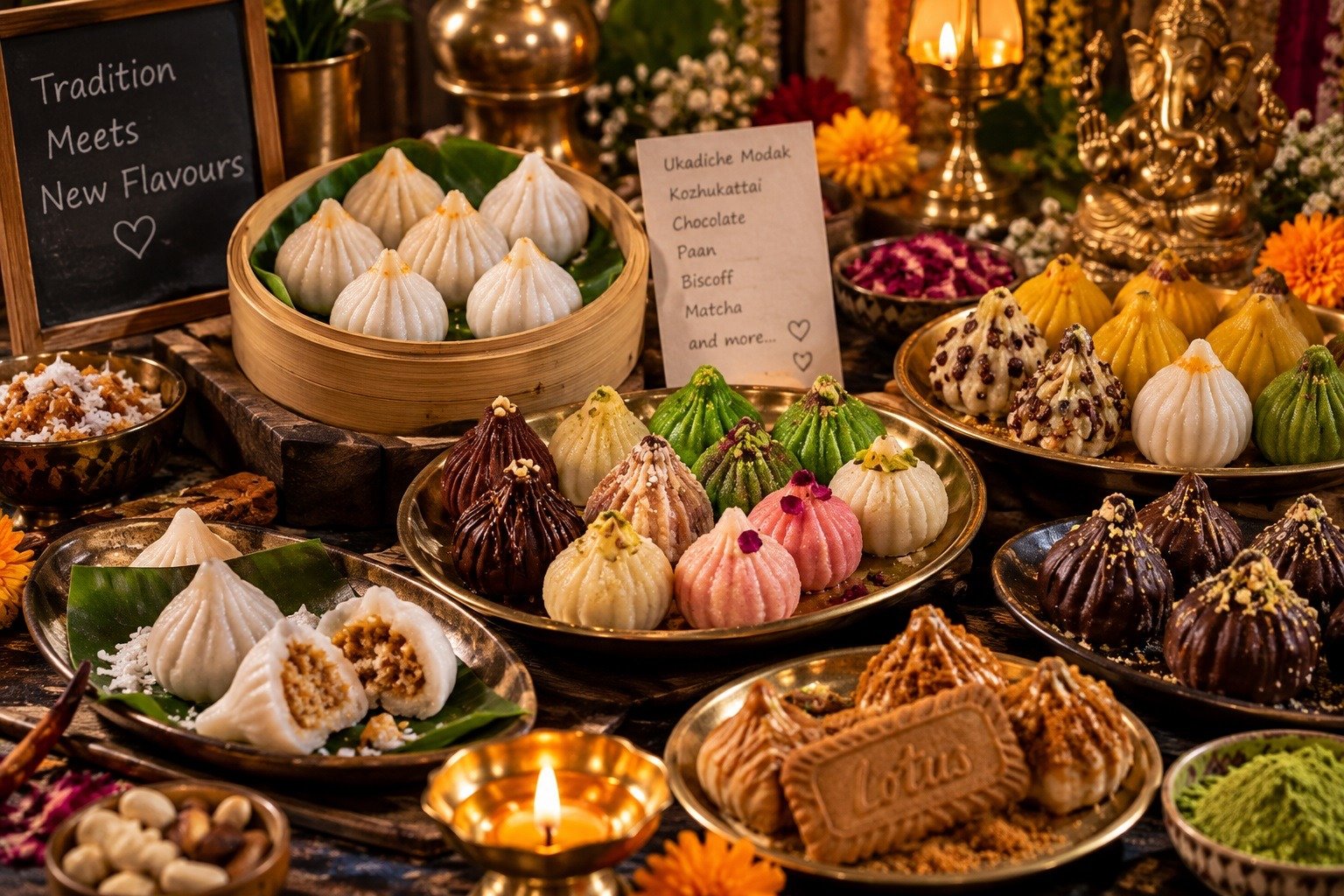
How India’s Festival Food Is Changing
There was a time when asking what flavour of modak someone wanted during Ganesh Chaturthi would have produced a fairly predictable answer.
Ukadiche.
Coconut. Jaggery. Rice flour. Steamed.
Then the modern Indian dessert industry discovered chocolate.
And apparently decided that Lord Ganesha’s favourite sweet could have a much longer menu.
In 2026, Indians can find modaks inspired by chocolate, paan, rose, dry fruits, Biscoff, cheesecake, brownie and even matcha alongside traditional preparations. Current Google Search data shows continuing interest in classic varieties such as Maharashtra’s Ukadiche Modak, South India’s Kozhukattai and Andhra-Telangana’s Kudumulu, while searches for contemporary flavours such as chocolate and paan are also gaining attention.
This is not necessarily a story about tradition disappearing.
It is a story about tradition becoming adaptable.
And India’s modak may be one of the clearest examples of how festival food is responding to changing tastes, urban lifestyles, social media, health-conscious consumers and the increasingly imaginative Indian dessert market.
The Original Still Has the Strongest Claim
Before discussing chocolate, it is worth remembering what the traditional modak actually represents.
The Ukadiche Modak associated strongly with Maharashtra’s Ganesh Chaturthi is made using a steamed rice-flour shell and a filling traditionally based on coconut and jaggery.
It is not simply a sweet shaped like a temple dome.
Its preparation is part of a culinary tradition.
The dough has to be handled carefully. The filling has to reach the right consistency. The pleats are often made by hand. And steaming produces a texture that is fundamentally different from the richer, denser modaks sold in many sweet shops.
The form also exists in different regional traditions.
South Indian preparations such as Kozhukattai, Karnataka’s Kadubu, and Andhra-Telangana’s Kudumulu share similarities with the broader family of rice-flour festive dumplings, while their ingredients, techniques and cultural contexts differ.
So when we talk about “the modak,” we are really talking about a much larger Indian culinary family.
The name changes.
The ingredients change.
The ritual context changes.
But the basic idea of a festive, shaped offering survives.
Then Came Chocolate
Chocolate modak is perhaps the most obvious symbol of the transformation.
It is easy to dismiss it as a novelty.
But that would miss the larger consumer story.
Chocolate has become deeply familiar to Indian consumers, particularly younger urban audiences. Combining it with a recognisable festival shape creates something that feels simultaneously new and familiar.
The result is a product that can appeal to children, younger consumers and people who may not naturally choose a traditional coconut-jaggery sweet.
Recent 2026 food coverage shows chocolate modaks continuing to appear alongside dry-fruit and traditional varieties during Ganesh Chaturthi.
The important point is that chocolate has not replaced the traditional modak.
It has joined the family.
And Indian festivals are very good at adopting new relatives.
From Paan to Biscoff
The experimentation goes considerably further.
Paan-flavoured modaks, rose and ragi versions, dry-fruit preparations and other combinations have entered the festive conversation.
Contemporary dessert makers are also experimenting with combinations such as Biscoff, cheesecake, brownie, matcha, motichoor, pistachio kunafa and sandesh.
A 2026 report from Nagpur, for example, described cheesecake, brownie and matcha among newer modak flavours appearing in the market alongside more established chocolate, orange, gulkand and dry-fruit variations.
At this point, the modak is no longer merely a recipe.
It is becoming a format.
Once consumers recognise the shape and connect it with Ganesh Chaturthi, almost any familiar flavour can be translated into it.
The logic is remarkably similar to what has happened with cakes, ice cream and doughnuts.
The traditional format becomes a canvas.
The Festival Sweet Has Become a Consumer Product
There is another reason this transformation is happening.
The festival has created a large and concentrated demand window.
Modaks are bought for home पूजा, family gatherings, gifting, office celebrations and community events.
The scale is considerable.
Swiggy recorded 103,380 modak orders on Ganesh Chaturthi on September 14, 2026, a 13.3% increase over the previous year. Maharashtra represented 41% of the platform’s modak orders, with Mumbai, Pune, Nagpur, Nashik and Amravati among the leading markets in the state.
That means the modern modak is operating at the intersection of:
religion + food tradition + retail + delivery + gifting + social media.
For sweet shops and restaurants, that is a significant commercial opportunity.
For consumers, it means unprecedented choice.
For traditionalists, it probably means somebody will eventually attempt a peri-peri modak.
The nation may not be emotionally prepared.
Why Fusion Food Works So Well in India
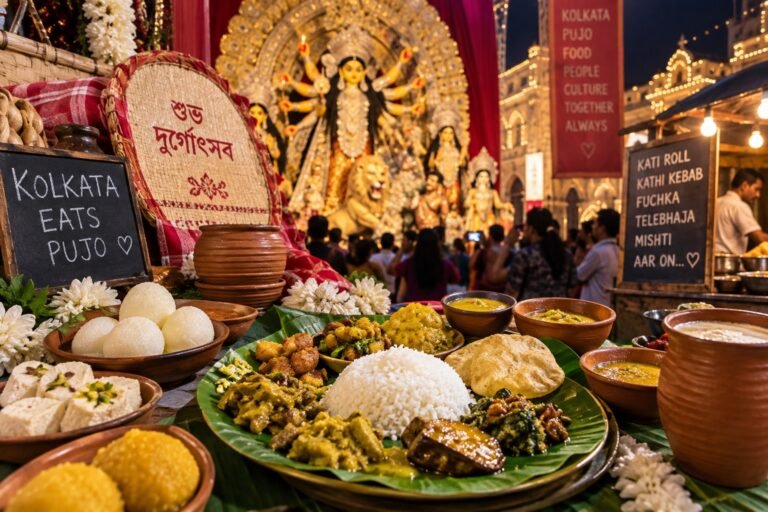
India has always been a country of culinary adaptation.
Recipes travelled between regions.
Ingredients were substituted.
Communities developed their own versions of dishes.
Festive foods changed according to local agriculture, household preferences and available ingredients.
The contemporary fusion trend is therefore not completely alien to Indian food culture.
What has changed is the speed of experimentation.
A new flavour can be imagined by a pastry chef, photographed, uploaded to Instagram, discussed by food creators and sold to consumers within a very short period.
Social media has effectively turned the festival sweet into a miniature product-development laboratory.
The customer is no longer merely eating.
The customer is also commenting, photographing, reviewing and sharing.
A visually unusual modak has an advantage before anyone has tasted it.
It is already halfway to becoming content.
The Shape Matters as Much as the Flavour
There is an interesting psychological element here.
A cheesecake may be familiar.
A brownie may be familiar.
Chocolate is certainly familiar.
But put those flavours into a modak shape during Ganesh Chaturthi and the product becomes culturally specific.
The shape provides the festival connection.
The flavour provides the contemporary connection.
That is why fusion modaks work.
They allow consumers to say:
“I am trying something new.”
without entirely leaving the cultural language of the festival.
This is perhaps the secret behind much of India’s modern festive food.
Tradition supplies the emotional recognition.
Innovation supplies the curiosity.
The Rise of the Premium Modak
The transformation is also changing the economics of festival sweets.
Modaks are increasingly being positioned as premium gift products rather than simply household sweets.
Packaging, presentation, ingredients and novelty can all influence price.
Mumbai’s Ladu Samrat, for example, expected to sell more than 10,000 kg of modaks during the 2026 Ganesh festival, illustrating the enormous scale of demand even for a traditional sweet.
Meanwhile, premium dessert businesses can use ingredients and techniques associated with contemporary pastry culture to create higher-priced versions.
The result is a curious spectrum:
home-made Ukadiche modak → neighbourhood sweet-shop modak → branded fusion modak → luxury dessert modak.
The shape remains broadly recognisable.
The price can travel rather further.
Health Has Entered the Modak Conversation
Another significant change is the growing demand for alternatives perceived as healthier.
Nutrition-conscious consumers are experimenting with versions using dates, nuts, ragi, reduced or no added sugar and other ingredients.
Recent reporting has featured dark-chocolate and pistachio modaks without added sugar, while other recipes have explored dates and whole-grain alternatives.
But this is where consumers should be careful with the word “healthy.”
Removing refined sugar does not automatically make a sweet low-calorie.
Adding nuts can increase nutritional value but also energy density.
Chocolate can range from relatively simple cocoa-based preparations to extremely rich confectionery.
A modak is still a festive sweet.
There is nothing wrong with enjoying it as one.
The smarter approach is to understand what is actually in it rather than trusting the word “guilt-free” printed on a box.
AI Has Entered the Kitchen Too
Perhaps the most contemporary development is that technology is influencing not only how modaks are sold, but also how people imagine them.
Current reporting around the 2026 festival notes that home cooks are using AI tools to explore recipes and generate new combinations.
That opens an intriguing possibility.
A traditional family recipe could be combined with a modern ingredient.
A regional flavour could be adapted to a different cooking technique.
A home cook could ask an AI system for ideas based on ingredients already available in the kitchen.
But there is an important limit.
AI can suggest a recipe.
It cannot provide the grandmother who taught you how to fold the modak.
That part remains stubbornly human.
Does Innovation Dilute Tradition?
This is the real cultural question.
If a chocolate modak becomes popular, does that diminish the Ukadiche Modak?
Not necessarily.
Indian food history suggests otherwise.
Traditional dishes frequently survive because people continue to cook them while new versions develop around them.
The strongest evidence is the continuing demand for traditional modaks.
Even in a market filled with fusion versions, Ukadiche remains central to Ganesh Chaturthi celebrations.
The coexistence matters.
A family can make traditional modaks at home and buy chocolate ones for children.
A sweet shop can sell khoya, motichoor and paan versions while maintaining a classic steamed preparation.
A restaurant can create an experimental dessert without claiming that it has replaced the traditional offering.
Food culture becomes richer when innovation adds a layer rather than erases the foundation.
From Maharashtra to the Rest of India
The modern modak story is also a story about India’s national food market.
Ganesh Chaturthi is strongly associated with Maharashtra, but the festival is celebrated in many parts of the country.
As delivery platforms, social media and organised food retail expand, regional festival foods increasingly travel beyond their original geography.
A consumer in Delhi can order Maharashtrian-style Ukadiche Modak.
A customer in Bengaluru can encounter multiple interpretations.
A sweet shop in Nagpur can experiment with matcha or cheesecake.
A Bengali kitchen can give the modak its own flavour identity.
That movement does not necessarily erase regional food culture.
It can actually make regional foods more visible.
The challenge is to preserve context while encouraging experimentation.
The Future May Be “Tradition Plus”
India’s festival-food market is moving toward a useful middle ground.
Not tradition versus innovation.
But:
tradition + innovation.
The traditional recipe continues.
The modern flavour joins it.
The family preparation remains.
The premium box appears beside it.
The sweet shop experiments.
The food creator films it.
The delivery app carries it.
And the consumer decides what deserves to return next year.
That last part is important.
Trends can be manufactured.
Traditions cannot.
A flavour can go viral in September and disappear by October.
A food memory can last for generations.
The Modak Is Changing — and That May Be Its Greatest Strength
The story of India’s festival food is not really about chocolate defeating coconut and jaggery.
It is about a culture comfortable enough with its traditions to experiment with them.
The modak has survived because it means more than its ingredients.
Its shape, ritual association and place in Ganesh Chaturthi give it cultural meaning.
That allows cooks and food businesses to reinterpret it without necessarily destroying its identity.
So yes, there may now be chocolate modaks.
Paan modaks.
Biscoff modaks.
Cheesecake modaks.
Matcha modaks.
And probably several varieties that somebody’s food startup team is currently discussing in a Bengaluru café.
But somewhere in an Indian kitchen, someone is still patiently making the old one.
Rice flour.
Coconut.
Jaggery.
Steam.
And perhaps that is exactly how food culture should evolve.
The new can arrive without asking the old to leave.
DOONITED Editorial Perspective
The modern modak is a useful lesson in how Indian culture adapts.
Innovation becomes acceptable when it speaks the language of the tradition it is entering.
A chocolate modak works because the consumer recognises the modak first.
The same principle applies far beyond food — Indian fashion, music, architecture and design repeatedly demonstrate that tradition can become a foundation for experimentation rather than an obstacle to it.
The real test is not whether a new flavour is “authentic.”
It is whether the original tradition remains alive alongside it.
In 2026, the evidence suggests that it does.
Meaningful Learning for Readers
Festival food is changing because consumers are changing.
Urban lifestyles, social media, premium gifting, delivery platforms, health awareness and global flavours are influencing what appears on Indian festive tables.
But changing a recipe does not automatically mean abandoning heritage.
The future of Indian festival food may belong to the foods that can do both — preserve a memory and offer something new.
The humble modak may already have figured it out.

World Beyond the News
Why Elephants Stay Close to Their Herd
Elephants live in highly social family groups and use calls, touch and body movements to maintain strong bonds.
Most of the Deep Ocean Remains Difficult to Explore
Extreme pressure, darkness and distance make deep-ocean exploration one of Earth’s greatest scientific challenges.
Spacecraft Can Travel Without Traditional Roads
Spacecraft use carefully calculated trajectories and gravity assists to travel enormous distances through space.
Why Movie Trailers Are Released in Stages
Major films often use teaser trailers, full trailers and final promotional spots to build awareness over time.