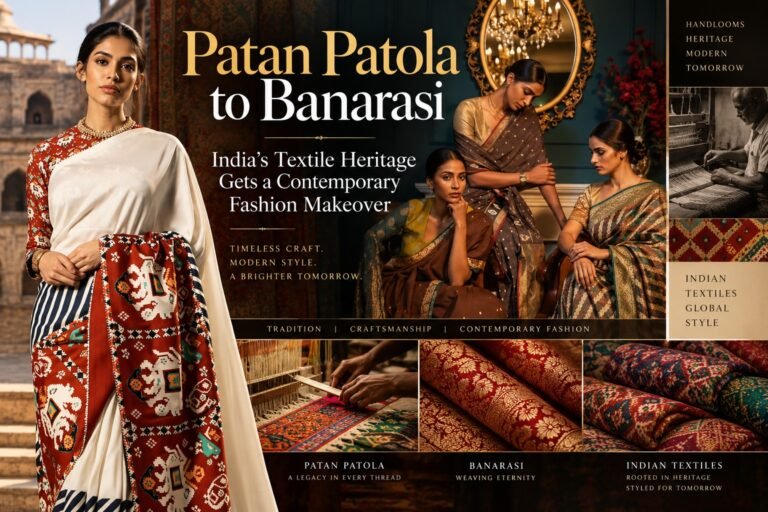
The Saree Goes Global: How India’s Six Yards Became a Fashion Statement Without Losing Its Soul For generations, the saree did something rather remarkable. It travelled everywhere without actually needing a passport. It went with Indian families to London, New York, Dubai, Toronto, Singapore and Sydney. It appeared at weddings, festivals, community gatherings and religious celebrations. Mothers taught daughters how to drape it. Grandmothers preserved old silk sarees carefully enough to make them family archives. Now the rest of the fashion world appears to have discovered what Indian women have known for centuries: a long piece of unstitched fabric can be remarkably sophisticated. The saree is increasingly visible on international red carpets, in fashion conversations and in contemporary designer collections. ELLE India recently highlighted this shift through appearances by Deepika Padukone, Alia Bhatt, Zendaya and Naomi Campbell, alongside the rise of pre-draped and experimental saree styles. But calling this simply a “fashion trend” misses the more interesting story. The saree is becoming a case study in how traditional Indian design can enter global fashion without necessarily becoming Westernised first. This isn’t the saree’s first international journey The current attention can sometimes create the impression that the saree has suddenly arrived


World Beyond the News
Bees Communicate Where Food Is
Honeybees use movement patterns known as waggle dances to communicate information about food locations.
Street Food Reflects Local History
Many famous street foods developed from migration, trade, local ingredients and the everyday needs of working communities.
A Day on Venus Is Extremely Long
Venus rotates so slowly that one rotation relative to distant stars takes longer than its trip around the Sun.
Human Achievement Continues to Push Limits
Athletes, engineers, scientists and explorers regularly establish new benchmarks in speed, endurance, scale and precision.