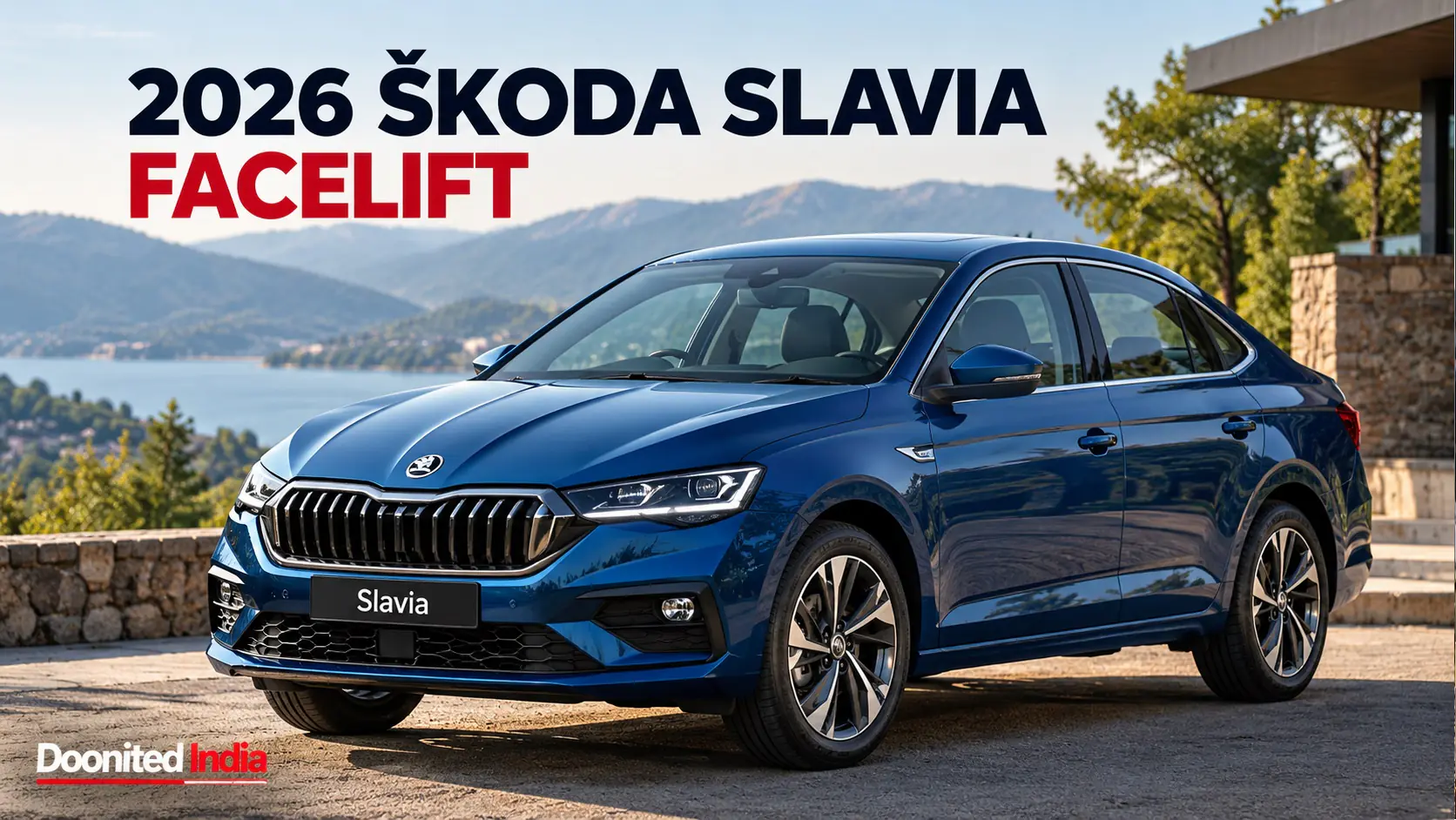
2026 Škoda Slavia Facelift: A Smarter Automatic, More Comfort and a Crucial October Price Tag
The updated Škoda Slavia has already been unveiled in India, with bookings open. The key date for prospective buyers is the first week of October 2026, when Škoda is expected to announce prices. The facelift brings a new eight-speed automatic for the 1.0-litre TSI, a 360-degree camera, larger digital displays and a rear-seat massage function. The official price—and the value of these upgrades across the variant range—will determine how compelling the package is.
The Slavia’s facelift is about more than a fresh face
For a market increasingly drawn to SUVs, the updated Slavia makes a case for the traditional sedan through a familiar formula: a more polished design, useful technology and a little extra comfort for the people travelling in it.
The facelift does not reinvent the car’s basic shape. Instead, it refreshes the details that buyers notice every day. The front gets redesigned LED headlamps with revised daytime-running-light signatures, while the bumpers, grille detailing and alloy-wheel designs have also been updated. At the rear, redesigned LED tail-lamps incorporate sequential turn indicators, adding a more distinctive visual signature.
Two new exterior colours—Arctic Silver and Cappuccino Beige—join the palette. The Monte Carlo variant brings its own sportier visual treatment, including black exterior accents and dual-tone colour options. Cappuccino Beige is expected to arrive later, with deliveries of that shade scheduled from December 2026.
The result is an evolution rather than a dramatic redesign. That is not necessarily a drawback: the Slavia’s proportions and recognisable silhouette remain intact, while the refreshed lighting and detailing help it look current.
The eight-speed automatic is the mechanical headline
The most consequential change sits beneath the bonnet—or, more precisely, in the transmission.
The 1.0-litre TSI turbo-petrol engine now gets an eight-speed torque-converter automatic, replacing the earlier six-speed automatic. A six-speed manual remains available with this engine. The larger 1.5-litre TSI continues with the seven-speed DSG automatic.
Why does this matter? An extra pair of ratios does not automatically make a car faster, more efficient or smoother in every situation. The real-world outcome depends on gear ratios, calibration, engine response and how the gearbox behaves in traffic. But the change gives Škoda an opportunity to improve the 1.0 TSI automatic’s flexibility and everyday usability.
For Indian buyers who spend long stretches in stop-and-go traffic, the quality of an automatic transmission can matter more than a headline acceleration figure. A gearbox that responds predictably at low speeds and does not feel confused when traffic suddenly opens up is a practical upgrade—not just a specification-sheet talking point.
The 1.5 TSI and its seven-speed DSG remain the choice for buyers who prioritise the larger engine’s performance character. The 1.0 TSI automatic, meanwhile, could appeal to those who want a turbo-petrol sedan without stepping up to the more powerful powertrain.
Rear-seat massage: a small feature with a big message
One of the facelift’s most attention-grabbing additions is a rear-seat massage function, described by Škoda as a segment-first feature. The car also gains a 360-degree Area View camera and Park Pilot with front parking sensors.
These additions address two very different aspects of ownership. The camera system is about convenience and confidence when manoeuvring in tight parking spaces. The massage function is about comfort—particularly for passengers who regularly sit in the back.
That distinction matters in India, where a sedan may serve as a family car during the weekend and a chauffeur-driven car during the working week. Rear-seat comfort can influence a purchase just as much as the driver’s experience.
However, buyers should check the variant list carefully. The rear-seat massager and some of the more advanced digital features are expected to be restricted to higher trims, rather than offered across the range. The feature may be a headline-grabber, but its real value depends on how much buyers must spend to get it.
Bigger screens, smarter connectivity
The cabin retains its familiar overall layout, but the digital equipment gets an upgrade. The facelift offers a 10.1-inch infotainment touchscreen and a 10.25-inch digital driver’s display. Wireless Android Auto and Apple CarPlay are supported, while the new-generation infotainment system incorporates an AI Companion powered by Google Cloud’s Automotive AI Agent.
The AI-enabled voice assistant is designed to help occupants access information and manage functions such as music, calls and climate control through voice interaction. It is a sign of how quickly connected-car technology is moving from premium segments into more attainable vehicles.
Still, the usefulness of an in-car assistant depends on practical details: how reliably it understands speech, how quickly it responds, what functions work in India, and whether connectivity is dependable. A long feature list is promising; a system that works consistently on an ordinary commute is what earns customer trust.
The larger displays should also make key information easier to read, although buyers should assess screen glare, interface simplicity and distraction levels during a test drive. Bigger screens are not automatically better ergonomics.
What about safety and everyday practicality?
Škoda says the updated Slavia continues with six airbags and the model’s five-star Global NCAP safety credentials. The 360-degree camera and front parking sensors add low-speed visibility assistance, while the 1.5 TSI variants now receive rear disc brakes.
These are meaningful additions, but they should not be confused with a new crash-test result for the facelift. Buyers should also check the exact safety and convenience equipment offered on their chosen variant. Features can differ across trims, and a model-level headline does not mean every version has every item.
The Slavia’s core appeal remains its sedan format: a conventional boot, a relatively long wheelbase and a driving position that differs from the taller stance of an SUV. For buyers who do not need the high seating position or flexible cargo arrangement of a sport-utility vehicle, that remains a perfectly sensible choice.
The price will decide how persuasive the upgrade is
The expected ex-showroom price range is being reported at approximately ₹11 lakh to ₹19 lakh, but this is an estimate, not an announced price list. Some automotive listings show different projected ranges, reinforcing the need to wait for Škoda’s official variant-wise pricing.
That final number matters because the Slavia competes in a segment where buyers can compare it with the Volkswagen Virtus, Hyundai Verna and Honda City. A buyer is not simply choosing between sedans; they are weighing engine performance, automatic-transmission behaviour, rear-seat comfort, equipment, service experience and long-term ownership costs.
The facelift’s new features may support a price increase. But the size and distribution of that increase will matter. If desirable equipment is concentrated in the most expensive variants, customers may find that the headline starting price tells only part of the story.
Prospective buyers should compare the exact variant they intend to purchase, including transmission, safety equipment, warranty, service packages and the final on-road price. Booking before prices are announced may secure a place in the queue, but it does not remove the need to understand the final financial commitment.
DOONITED View: A sedan makes its case through the details
The 2026 Slavia facelift is a measured update. It preserves the car’s identity while addressing several areas that can shape daily ownership: the automatic gearbox, parking visibility, cabin technology and rear-seat comfort.
Its broader significance is that the sedan has not disappeared from India’s aspirational car market. It has to work harder for attention, and its appeal increasingly depends on delivering a distinctive experience rather than simply matching the equipment list of an SUV.
The eight-speed automatic could prove more important to many buyers than the more glamorous massage function. The 360-degree camera may be used more often than the AI assistant. And the final price could outweigh every new feature combined.
In other words, the Slavia’s October test is not just about how much new technology Škoda has added. It is about whether buyers feel that the complete package—at the price announced—is worth choosing.
Learning Point
When evaluating a facelift, separate the genuinely useful upgrades from the features that merely look impressive in a brochure. Test the transmission in traffic, check which variant includes the equipment you want, and compare the final on-road price. The best value is found in the version that suits your actual driving and ownership needs—not necessarily the one with the longest feature list.


World Beyond the News
Why Elephants Stay Close to Their Herd
Elephants live in highly social family groups and use calls, touch and body movements to maintain strong bonds.
Most of the Deep Ocean Remains Difficult to Explore
Extreme pressure, darkness and distance make deep-ocean exploration one of Earth’s greatest scientific challenges.
Spacecraft Can Travel Without Traditional Roads
Spacecraft use carefully calculated trajectories and gravity assists to travel enormous distances through space.
Why Movie Trailers Are Released in Stages
Major films often use teaser trailers, full trailers and final promotional spots to build awareness over time.