BMW’s September Electric Push: Can the i5 LWB Make Luxury EVs More Indian?
BMW’s September 2026 launches tell a story about two ends of the luxury-car market. On September 7, the company introduced the BMW i5 Long Wheelbase (LWB) in India at an introductory ex-showroom price of ₹79.60 lakh. Four days later, it launched updated versions of the BMW 7 Series and all-electric i7, with prices starting at ₹1.95 crore.
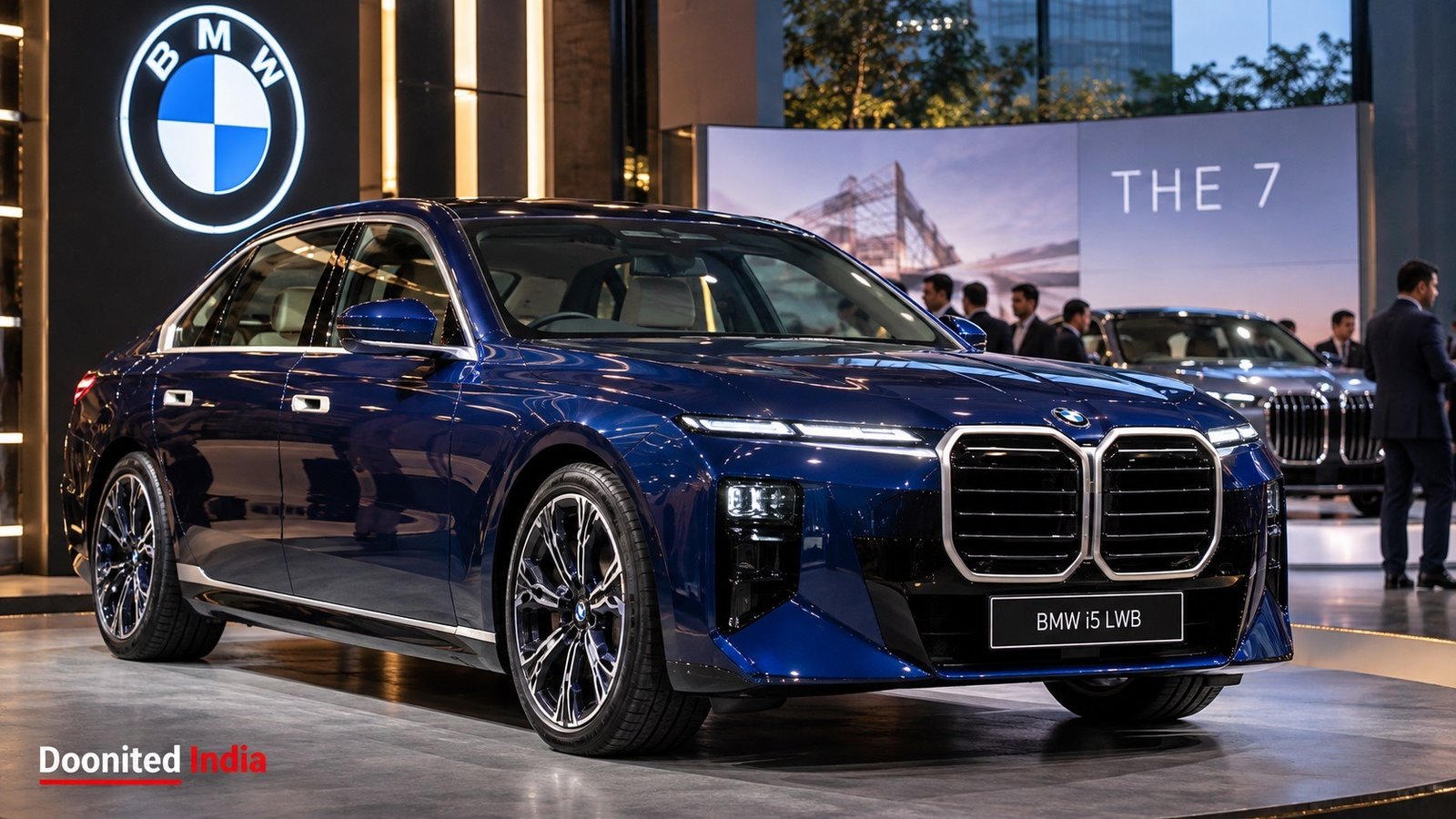
The i5 LWB is the more accessible of the trio, but its significance goes beyond its price. It is BMW India’s first locally produced electric sedan, assembled at the company’s Chennai plant. Its longer wheelbase and rear-seat-focused cabin also reflect a familiar Indian luxury-car priority: the person in the back seat matters just as much as the person behind the steering wheel.
The updated 7 Series and i7, meanwhile, showcase BMW’s latest approach to flagship comfort, digital interfaces and electric performance. Together, the launches raise a practical question: as luxury brands localise more electric vehicles, can they make premium EV ownership easier without compromising the experience customers expect?
BMW i5 LWB: an electric sedan shaped for India
The i5 LWB is offered in a single eDrive35L M Sport configuration. Its 81.6 kWh battery powers a rear-mounted electric motor producing 268 hp and 410 Nm of torque. BMW claims a 0–100 km/h time of 6.7 seconds and a top speed of 195 km/h.
The headline range is up to 669 km under the Indian MIDC test cycle. That is a certified test figure, not a promise that every owner will cover 669 km in everyday driving. Actual range will depend on speed, temperature, traffic, air-conditioning use, driving style and the vehicle’s load.
The i5 LWB’s long-wheelbase format is central to its appeal. Its wheelbase measures 3,105 mm—110 mm longer than the standard-wheelbase i5—creating additional room for rear passengers. Rear-axle air suspension is intended to improve ride comfort, while features include four-zone climate control, front-seat ventilation, a panoramic glass roof and a 17-speaker Bowers & Wilkins sound system.
The cabin also gets a 12.3-inch driver display and a 14.9-inch infotainment screen. The emphasis is not simply on making the car electric, but on making the electric journey feel suitably premium.
At ₹79.60 lakh ex-showroom, the i5 LWB sits in a price bracket where buyers will weigh it against both luxury electric cars and conventional petrol-powered executive sedans. The purchase decision will involve more than the range figure: rear-seat comfort, charging access, service support and the cost of ownership will all influence its appeal.
Local assembly: an important milestone, not the whole story
Local production can help a manufacturer serve the Indian market with greater flexibility and potentially improve cost competitiveness compared with importing a fully built vehicle. It can also deepen the role of Indian manufacturing facilities in the company’s global operations.
BMW says the i5 LWB is assembled at its Chennai plant. The company also offered a limited-run First Edition at the same introductory price; all 99 units had reportedly sold out before the launch.
However, local assembly should not be confused with complete local sourcing. The extent of domestically sourced components, the supply chain for the battery and other major systems, and the availability of replacement parts remain relevant to the broader industrial picture.
For customers, the immediate benefit is a locally assembled luxury EV with a specification tailored to rear-seat comfort. For India’s automotive ecosystem, the longer-term opportunity lies in building deeper capabilities in electric powertrains, battery systems, software and high-value component manufacturing.
The flagship pair: 7 Series and i7 get a digital rethink
On September 11, BMW launched the updated 7 Series and i7 in India. Both start at ₹1.95 crore ex-showroom, while the performance-oriented i7 M70 xDrive is priced at ₹2.65 crore.
The updated petrol-powered BMW 740 M Sport uses a 3.0-litre turbocharged six-cylinder petrol engine with a 48-volt mild-hybrid system. It produces a claimed 400 hp and 540 Nm, with an eight-speed automatic transmission sending power to the rear wheels. The updated Indian 7 Series line-up is offered in petrol form; the diesel variant is not part of the current range.
The all-electric BMW i7 50 xDrive M Sport uses a 112.5 kWh battery and produces 455 hp and 600 Nm. BMW claims a WLTP range of up to 728 km. The higher-performance i7 M70 xDrive delivers up to 680 hp and 1,015 Nm in Sport mode, with a claimed WLTP range of 686 km.
The distinction between the range figures matters: the i5’s 669 km claim is based on MIDC, while the i7’s 728 km figure uses WLTP. These test cycles differ, so the numbers should not be compared as if they were measured under identical conditions.
The refreshed flagship cabin puts digital technology at the centre of the experience. The new layout includes BMW Panoramic Vision, a 17.9-inch central touchscreen and a 14.6-inch passenger display. Rear passengers retain the 31.3-inch 8K Theatre Screen, while features include powered doors, high-end surround sound, comfort seating and driver-assistance technology.
For a car designed around chauffeur-driven travel, the rear cabin is more than a collection of luxury features. It is where passengers may work, take calls, relax or travel between meetings. The challenge is to make all that technology intuitive rather than turning the dashboard into a very expensive control room.
The EV ownership question: range is only one part of the journey
Luxury EVs can offer quiet running, smooth acceleration and fewer routine powertrain service requirements than comparable combustion-engine vehicles. But the ownership experience still depends heavily on the charging environment.
A buyer with reliable home or workplace charging has a different set of considerations from someone who depends entirely on public chargers. Apartment residents may need permission, electrical upgrades or a dedicated charging arrangement. Long-distance drivers will want to understand charger availability along their regular routes and allow for charging time during journeys.
The i5’s claimed range provides a useful starting point, but buyers should plan with a realistic buffer rather than treating the test-cycle number as a guaranteed distance. Charging speed, charger compatibility, battery conditioning and the availability of functioning charging stations can all affect a trip.
There is also the question of resale value and battery-related confidence. Buyers should examine the warranty terms, what the battery warranty covers, the service network and the process for diagnosing or repairing high-voltage components. These are ordinary ownership questions—not reasons to avoid an EV—but they deserve clear answers before a substantial purchase.
What the launches say about India’s luxury market
The i5 LWB and the updated 7 Series/i7 serve different buyers, yet they share a theme: rear-seat comfort remains a major part of the Indian luxury-car proposition.
The i5 brings that emphasis into a locally assembled electric sedan below the ₹1 crore mark. The 7 Series and i7 push the idea further with executive-lounge seating, large entertainment displays and advanced cabin technology.
The launches also illustrate that electrification is not a single, uniform transition. Some customers may prefer a fully electric sedan; others may continue to choose a petrol luxury car. Charging access, driving patterns, price and personal preference all influence that decision.
For the wider industry, the useful measure of progress will be whether premium EVs help build a more dependable ownership ecosystem: stronger service capability, better charging access, clearer battery support and greater consumer confidence. New models can attract attention, but infrastructure and after-sales experience are what make a market durable.
DOONITED View: luxury EVs must deliver beyond the showroom
BMW’s September launches show how the Indian luxury market is evolving. The i5 LWB combines local assembly with a long-wheelbase cabin and an electric powertrain. The i7 demonstrates how far electric luxury can go in performance, range claims and digital comfort. The updated 7 Series keeps a petrol option in the flagship conversation.
The constructive story is the expanding role of Indian manufacturing in premium vehicles, including electric sedans. The caution is equally clear: a high range figure, a long equipment list or a locally assembled badge cannot by itself settle questions about real-world efficiency, charging convenience, battery support or long-term value.
For buyers, the smartest approach is to evaluate the vehicle around actual use. Test the rear seat, drive it on familiar roads, verify the charging arrangement and read the warranty carefully. A luxury EV should make daily life quieter and more comfortable—not add a new logistical puzzle to the calendar.
Learning Point
When comparing luxury electric cars, separate the advertised range from the range you can depend on, and the feature list from the ownership experience you will actually receive. Charging access, real-world efficiency, warranty coverage, service support and resale considerations belong in the same decision as price and performance.


World Beyond the News
Octopuses Can Change Their Appearance
Octopuses can rapidly alter their skin colour and texture to communicate, camouflage themselves and respond to danger.
Some Cities Exist Across Two Continents
A small number of cities are geographically associated with two continents, creating unusual cultural and geographic identities.
Earth’s Climate Is Measured in Many Ways
Scientists track temperature, atmospheric gases, sea level, ice cover and other indicators rather than relying on a single climate number.
Streaming Changed How Audiences Discover Shows
Recommendation systems and global streaming releases allow audiences to discover programmes far beyond their original markets.