2026 Mercedes-Maybach S-Class: A New Definition of Rear-Seat Luxury for India
Launch update: Mercedes-Benz has confirmed the India launch of the facelifted Mercedes-Maybach S-Class for 5 October 2026. The international model brings updated styling, a new digital cabin architecture, expanded personalisation and revised powertrain options. However, the India-specific variant and equipment list had not been fully disclosed in the reporting available ahead of launch. The expected ₹3.10–₹3.20 crore price range is an estimate, not an official price announcement.
When the rear seat is the real VIP lounge
In the world of luxury cars, acceleration figures and engine outputs often dominate headlines. The Mercedes-Maybach S-Class follows a different philosophy. Its central promise is that the journey should feel as carefully considered as the destination—particularly for the person sitting in the rear.
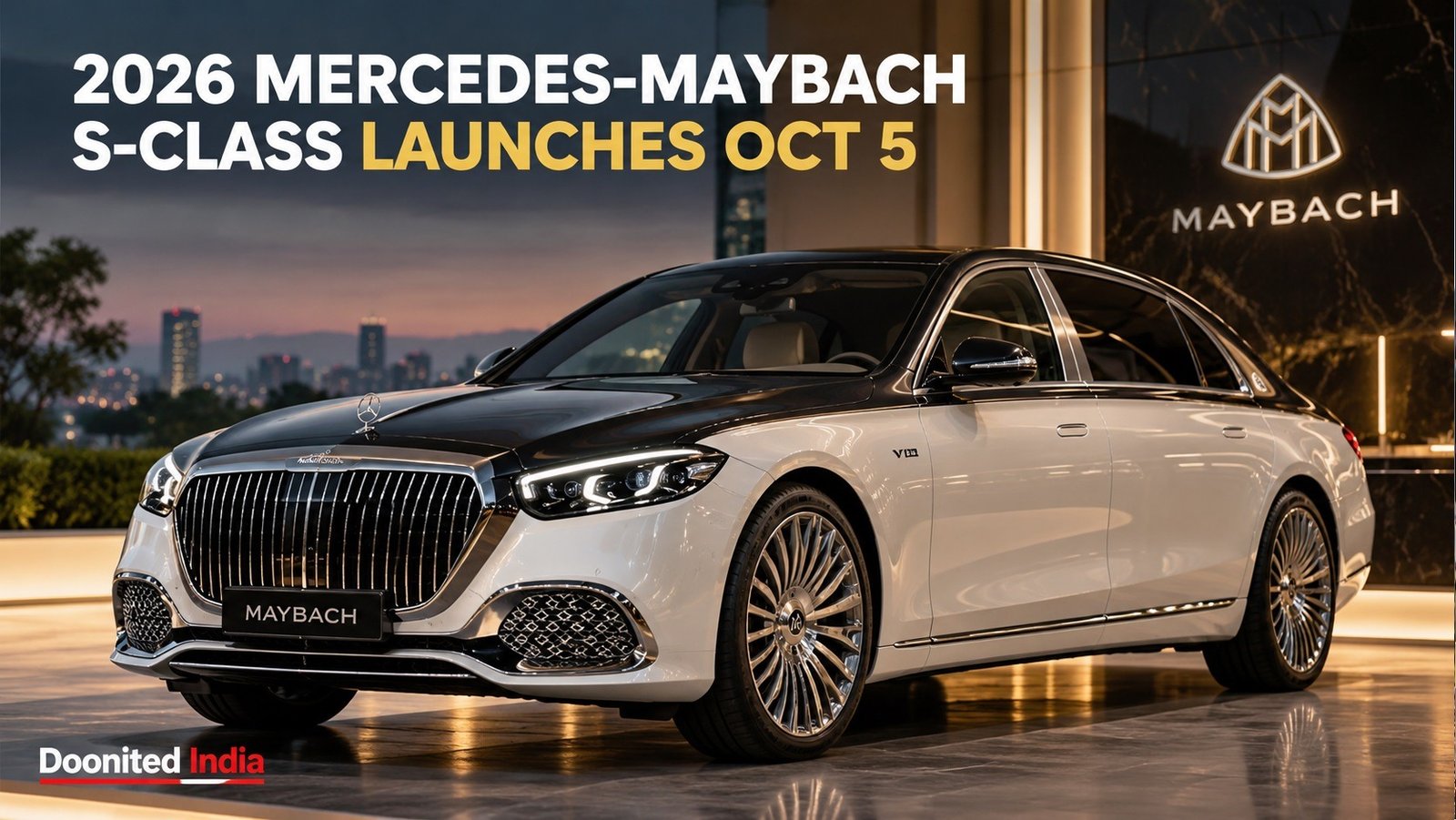
The 2026 facelift builds on that idea. It retains the long, formal silhouette of the Maybach S-Class while introducing a more prominent front grille, updated lighting, new wheel designs and a wider selection of personalisation options. The changes are evolutionary rather than radical: the car is meant to remain instantly recognisable, while signalling that its technology and finish have moved forward.
For India, where large luxury sedans are often chauffeur-driven, the rear cabin is not a secondary feature. It is the space in which owners may work, take calls, relax between appointments or simply escape the noise of the city.
A larger grille, but a deeper technology update
The new Maybach receives a grille that is around 20 per cent larger than before, with illuminated detailing and the brand’s signature vertical slats. An illuminated Mercedes star sits on the bonnet, while the headlamps and tail-lamps adopt updated three-pointed-star lighting signatures.
The Maybach is also longer than the long-wheelbase S-Class, with an additional 180mm in overall length. New 20-inch and 21-inch forged alloy wheels, an illuminated Maybach wordmark and expanded two-tone paint options reinforce its distinct identity.
These details are designed to make the car recognisable without requiring a dramatic redesign. In the ultra-luxury segment, distinction is often communicated through proportion, finish and small details rather than visual noise.
The more substantial changes are inside. The updated cabin adopts a Superscreen layout, combining a 12.3-inch digital instrument display, a 14.4-inch central touchscreen and a 12.3-inch passenger display. The new MB.OS operating system and fourth-generation MBUX bring a more integrated digital environment to the Maybach for the first time.
The technology is intended to connect infotainment, vehicle functions and assistance systems through a more unified architecture. Yet the real measure of success will be whether the system feels intuitive. In a car designed around relaxation, a menu maze is still a menu maze—no matter how expensive the upholstery.
Rear-seat comfort remains the main event
The rear cabin receives particular attention. The updated Maybach’s rear seats can recline by up to 43 degrees, compared with 38 degrees in the standard S-Class. Heating, ventilation and massage functions contribute to the comfort-focused experience.
Two smartphone-style rear controllers replace the earlier tablet-style controller, allowing passengers to operate selected cabin functions. Expanded upholstery choices include additional leather finishes and, for the first time in a Maybach, a leather-free vegan upholstery option.
That last addition is significant beyond its novelty. Ultra-luxury buyers increasingly expect personalisation to extend beyond paint and trim into the materials used throughout the cabin. Offering a leather-free choice broadens the range of preferences the car can accommodate, while maintaining the brand’s emphasis on bespoke specification.
The broader MANUFAKTUR programme also allows more exterior colours, two-tone finishes and individual interior combinations. The result is a car that can be configured around its owner’s preferences rather than simply selected from a short list of standard colours.
Powertrain: global options, Indian details still pending
Internationally, the updated Maybach S-Class is offered with revised petrol and plug-in hybrid powertrains, depending on the market.
The S 580 receives an updated 4.0-litre V8 producing 537hp and 750Nm in the specifications reported by Autocar India. Some markets also offer the S 580e plug-in hybrid, combining a 3.0-litre six-cylinder petrol engine with an electric motor and a 22kWh battery. Its quoted electric-only range is up to 98km under the relevant test cycle.
The S 680 powertrain also varies by market, with V12 and more powerful V8 versions reported for different regions.
These international specifications should not be mistaken for the confirmed Indian line-up. Mercedes-Benz India’s final announcement will establish which engine, hybrid system, equipment and configuration local buyers can order. The same caution applies to performance figures and electric-only range: test cycles and market-specific configurations matter.
The distinction is especially important for a plug-in hybrid. Its everyday value depends on whether the owner can charge regularly and use the electric driving capability. Without that routine, the benefits may differ considerably from the headline figures.
What might it cost in India?
Autocar India estimates a price of approximately ₹3.10 crore to ₹3.20 crore, ex-showroom, for the facelifted Maybach S-Class. The current-generation S 580 has been listed at around ₹2.87 crore before options, providing a reference point—but not a guarantee of the new model’s final pricing.
The final amount paid by a customer will depend on the variant, optional equipment, insurance, registration and applicable local charges. Personalisation can also make a meaningful difference to the final bill.
At this level, the buyer is not simply comparing engine specifications. The purchase includes a particular standard of cabin finish, rear-seat experience, brand service and individual configuration. Even so, the price should be assessed against the equipment actually included, rather than against the most elaborate international specification.
India’s chauffeur-driven luxury market
The Maybach’s proposition aligns with a specific pattern of luxury-car use in India: the owner may spend more time in the rear seat than behind the steering wheel.
That makes rear-seat access, ride comfort, cabin insulation, climate control and the ease of operating entertainment and comfort systems especially relevant. A powerful engine matters, but it is only one part of the experience.
Indian conditions also make practical considerations important. Large sedans need suitable parking and careful route planning in tight urban spaces. Road surfaces, traffic and the availability of trained service support can shape ownership just as much as the car’s technology.
For buyers considering a plug-in hybrid, charging access is another factor. A home or workplace charging routine can make the electric component more useful; without one, the ownership case changes.
DOONITED View: luxury is increasingly about control and choice
The 2026 Maybach S-Class illustrates how ultra-luxury is evolving. The emphasis is no longer only on leather, wood, chrome and a powerful engine. It increasingly includes digital control, personalisation, alternative materials and the ability to tailor the vehicle to the way an individual travels.
The opportunity is clear: a more configurable cabin, updated interfaces and revised powertrains can make the Maybach more relevant to buyers with different preferences. The challenge is ensuring that added technology improves the experience rather than complicating it.
The most meaningful test will come after the Indian launch, when the final price, engine options and standard equipment are known. Until then, buyers should treat global specifications and estimated prices as useful context—not as a substitute for the local product sheet.
A luxury car can offer dozens of screens, settings and custom finishes. But its most important feature may still be simple: arriving after a long journey feeling less tired than when you left.
Learning Point
For a chauffeur-driven luxury sedan, evaluate the rear-seat experience and the exact India-spec equipment—not just the badge, engine or international feature list. The final variant and price announcement on 5 October will provide the information needed for a meaningful buying comparison.


World Beyond the News
Octopuses Can Change Their Appearance
Octopuses can rapidly alter their skin colour and texture to communicate, camouflage themselves and respond to danger.
Some Cities Exist Across Two Continents
A small number of cities are geographically associated with two continents, creating unusual cultural and geographic identities.
Earth’s Climate Is Measured in Many Ways
Scientists track temperature, atmospheric gases, sea level, ice cover and other indicators rather than relying on a single climate number.
Streaming Changed How Audiences Discover Shows
Recommendation systems and global streaming releases allow audiences to discover programmes far beyond their original markets.