VinFast VF 3: Can a Tiny Electric SUV Find a Big Place in India?
India’s electric-car market has a curious gap. Many buyers want to move away from petrol, but a full-size electric SUV can still feel financially out of reach. At the other end, small electric cars promise affordable urban mobility, yet buyers may worry about space, range and whether a compact vehicle can handle the realities of Indian roads.
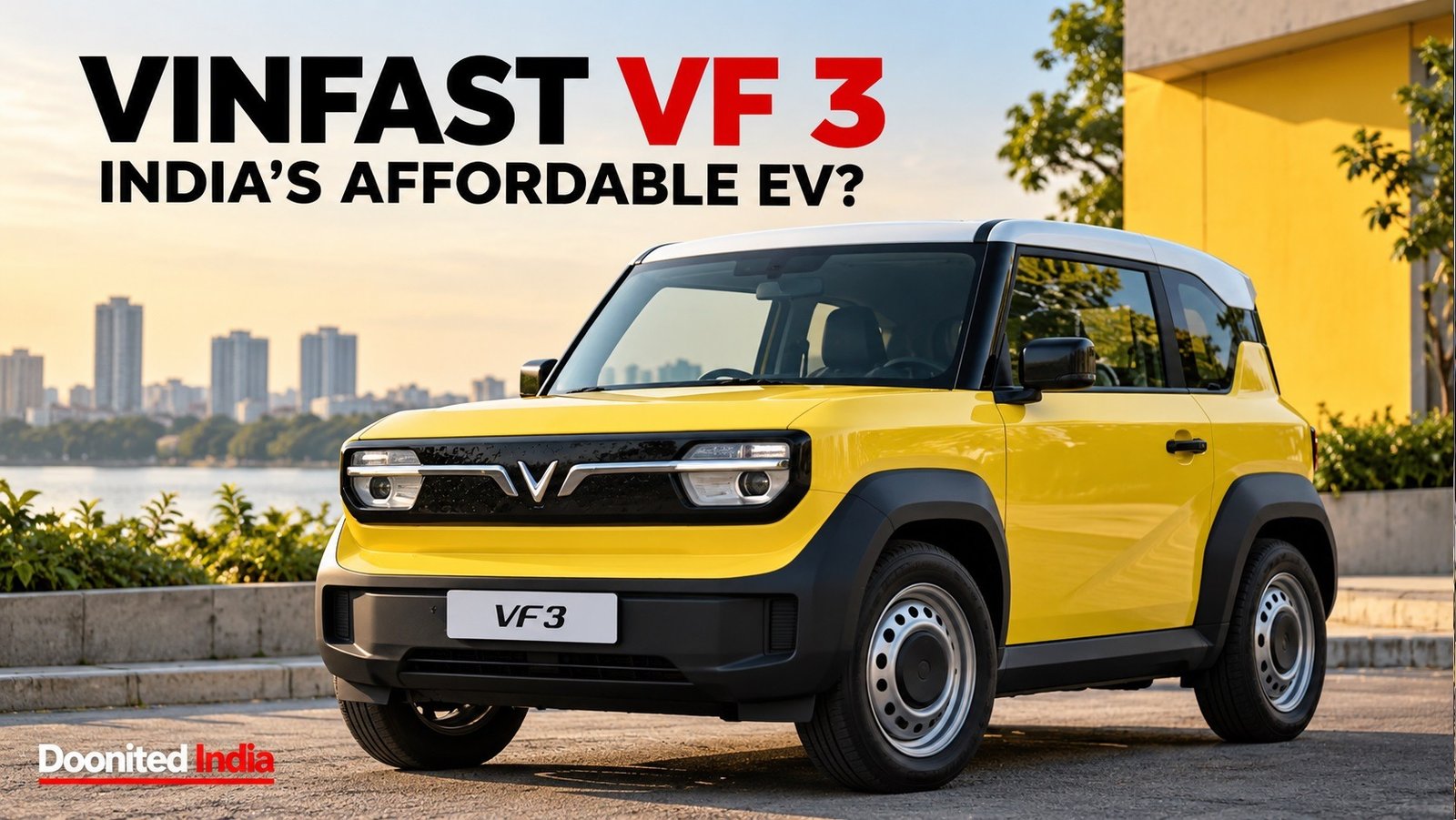
The VinFast VF 3 is designed around this very tension. A tiny, boxy electric vehicle with SUV-inspired styling, it has already reached markets outside India. Its potential Indian arrival has attracted attention because it could bring a distinctive proposition to the entry-level EV space.
But there is an important qualification: as of September 28, 2026, an India launch date and price have not been officially confirmed in the sources reviewed. Although some websites have suggested an October 2026 launch, recent reporting about VinFast’s India strategy makes that timeline uncertain.
The VF 3 is therefore a story about both a promising product concept and the difficult economics of bringing an affordable electric car to India.
A small vehicle with a clear urban mission
The VF 3 is a two-door, four-seat electric mini-SUV with an upright body, short overhangs and a deliberately rugged appearance. Its compact footprint is central to the proposition.
In markets where it is sold, the VF 3 measures approximately 3,190 mm long and 1,679 mm wide. It has a reported ground clearance of around 191 mm with 16-inch wheels. The boxy design gives it a more substantial visual presence than its dimensions might suggest.
That combination could suit crowded Indian cities, where parking space is scarce and narrow streets can make larger vehicles cumbersome. The upright shape also gives the VF 3 a recognisable personality in a segment where many small cars prioritise conventional hatchback styling.
However, compact dimensions bring compromises. The VF 3 has only two doors, which means rear passengers must enter through the front doors. That may be manageable for occasional trips, but less convenient for families carrying children or older passengers. Four seats do not necessarily mean four adults will travel comfortably on longer journeys.
Its small size is an advantage in the city—not a magic trick that makes every space problem disappear.
Battery, range and charging: what the numbers really mean
The VF 3’s published specifications in overseas markets include an 18.64 kWh battery, a single electric motor driving the rear wheels, and torque of 110 Nm. VinFast’s official market specifications list a claimed range of up to 215 km on the NEDC test cycle, with DC fast charging from 10% to 70% taking approximately 36 minutes.
These figures need context. NEDC is a laboratory test cycle, and its range figure should not be treated as a guaranteed distance in everyday driving. Actual range depends on traffic, speed, air-conditioning use, temperature, road gradients, passenger load and driving style.
For a city-focused vehicle, a modest battery can be a sensible design choice. Smaller batteries generally require less energy and material than large packs, and a compact car used for predictable daily commutes may not need a long-distance range.
But the ownership calculation depends on charging access. A buyer with a dedicated home charger and a regular commute may find a small EV convenient. Someone living in an apartment without dependable charging facilities may face a very different experience.
The VF 3’s reported fast-charging time is useful, but its maximum DC charging rate is modest compared with larger EVs. Owners should not assume that a short stop at a public charger will always deliver a large amount of usable range.
The India launch question: a plan under review
The VF 3 was previously reported as a potential India-bound model, with some automotive websites suggesting a late-2026 or October launch. However, the picture changed after Reuters reported on September 1 that VinFast had asked suppliers to pause development and localisation work on the VF 3, VF 6 and VF 7 while it reassessed costs.
The report did not mean that VinFast was abandoning India. The company disputed claims that it had changed or suspended production plans for the models already on sale. Its existing VF 6 and VF 7 operations were to continue.
The distinction is important: a company can maintain its presence in a country while reconsidering which future models make commercial sense there.
A separate Reuters report in September described VinFast’s plans to explore India-specific EVs, reflecting a possible shift towards products designed around local cost and customer requirements.
For the VF 3, that leaves several unanswered questions. Will it launch in India in its current form? Will it be adapted for local requirements? Will its price depend on imported components, local sourcing or a different production plan? Until VinFast makes an official announcement, an October launch date should be treated as speculation rather than a confirmed event.
Could it be an affordable EV?
Some online reports have placed the VF 3’s possible Indian price in the ₹7.5 lakh to ₹10 lakh range. This remains an unverified estimate, not an official price.
That range would put the VF 3 in a very different conversation from larger electric SUVs. Yet the final price would need to be judged against what Indian buyers actually receive: battery capacity, safety equipment, charging capability, warranty, service coverage and the cost of ownership.
The overseas version’s compact format and relatively small battery may help manage costs. But India-specific homologation, safety requirements, localisation, taxes and distribution expenses all affect the final product.
The battery-as-a-service model, used in some overseas markets, is another concept buyers may watch for. Such arrangements can lower the initial vehicle price but introduce recurring battery payments. Whether VinFast would offer such a scheme in India is not confirmed.
A low headline price is only one part of affordability. Buyers need to compare the total cost over several years, including charging, insurance, maintenance, financing and any battery-related subscription.
Safety and practicality cannot be afterthoughts
The VF 3’s small footprint and SUV-like stance may be appealing, but Indian buyers should look closely at the safety specification of any India-market version.
The overseas specification published by VinFast includes basic equipment such as ABS and a single airbag in at least one market configuration. Equipment can differ by country and variant, so this should not be assumed to represent a future Indian model.
For a vehicle intended to broaden access to electric mobility, safety equipment, crash performance and structural protection are fundamental—not optional extras to be considered after the price has been celebrated.
Practicality also needs a real-world test. Buyers should check rear-seat access, luggage space with all seats occupied, visibility, ride comfort over broken roads and how the car behaves with passengers aboard. A mini-SUV can be a useful city vehicle, but its limitations should be understood before purchase.
DOONITED View: India needs affordable EVs—but not at any cost
The VF 3 represents an appealing idea: make electric mobility smaller, simpler and potentially more accessible. A compact EV with a modest battery could work well for urban commuters, second-car households and people whose daily travel is relatively predictable.
But the product’s success in India would depend on more than its dimensions or overseas range figure. It would need a carefully judged price, practical charging options, appropriate safety equipment and a credible service network.
VinFast’s reported pause on localisation work also highlights a larger lesson for the EV industry. India is a major opportunity, but it is not a market where global products can simply be imported into a new price bracket and expected to succeed. Local costs, customer expectations and competitive pressure can force manufacturers to rethink their plans.
For now, the VF 3 is worth watching—but not yet worth booking on the assumption that it will arrive in October. The most useful announcement will be the one that answers the practical questions: when, at what price, with what specification, and backed by what ownership support?
Learning Point
An affordable EV is not defined by its showroom price alone. Battery range, charging access, safety equipment, service support and long-term costs determine whether it genuinely makes electric mobility easier. The VF 3’s potential is clear; its Indian proposition will only become clear when VinFast confirms the product and its terms.


World Beyond the News
Birds Can Navigate Using Earth’s Magnetic Field
Several bird species can sense Earth’s magnetic field, helping them navigate during long-distance migration.
Fermentation Is a Global Food Tradition
People across continents have used fermentation for centuries to preserve food and create distinctive flavours.
Modern Batteries Store Energy Chemically
Rechargeable batteries repeatedly move ions between electrodes, allowing electrical energy to be stored and released.
Why Songs Become Global Hits
Streaming platforms, short-form video, playlists and international collaborations can rapidly carry music across borders.