Norton Atlas and Atlas GT: Can British Design and Indian Manufacturing Redefine the Middleweight Touring Market?
The Norton Atlas and Atlas GT represent a significant new chapter for a historic British motorcycle marque—and a notable development for India’s growing premium two-wheeler industry. With production already underway at TVS Motor Company’s Hosur facility in Tamil Nadu, the motorcycles combine British design and engineering with Indian manufacturing.
The two models share a 585cc liquid-cooled parallel-twin engine, a sophisticated electronics package and a common platform. Their purpose, however, is different: the Atlas is designed for adventure-oriented riding, while the Atlas GT puts greater emphasis on road touring.
Indian launch timing and prices remain the key unanswered questions. Although motorcycle portals point towards an arrival around late 2026, the final Indian launch date, variant line-up and ex-showroom prices should be treated as estimates until Norton or TVS announces them officially.
A British name, an Indian production line
The Norton name carries considerable weight in motorcycling history. The modern company is now part of the TVS Motor Company group, creating a business arrangement that links a British marque’s design and engineering identity with an Indian manufacturer’s production capabilities.
That relationship became tangible on 24 June 2026, when the first Norton Atlas motorcycles rolled off the production line at TVS Motor Company’s Hosur facility. Norton says the Atlas range was designed and engineered at its headquarters in Solihull, United Kingdom, while Hosur provides the manufacturing base for these global models. The company also confirmed that the Atlas would enter the Indian market later in 2026. This is more substantial evidence of an India launch than an estimated date on a motorcycle listing.
For India, the arrangement has a practical commercial logic. Local production can reduce exposure to the costs associated with importing fully built motorcycles and can give the company greater control over supply. It does not, by itself, guarantee a low price: component sourcing, taxes, equipment levels, distribution costs and the scale of production will all influence the final showroom figure.
The Atlas is therefore more than another premium motorcycle arriving on Indian roads. It is also a test of whether TVS can use its manufacturing reach to help Norton build a sustainable presence in a market where customers increasingly expect international engineering, advanced technology and dependable after-sales support.
One engine, two distinct personalities
Both motorcycles use a 585cc, liquid-cooled, parallel-twin engine with a 270-degree crankshaft. Published specifications put output at approximately 69hp and torque at around 57–57.5Nm, depending on the source and its rounding. Power is delivered through a six-speed gearbox, with a bi-directional quickshifter listed for the range.
The 270-degree crank configuration is intended to give the twin-cylinder engine a distinctive character rather than the feel of a purely clinical performance machine. The combination of twin-cylinder power and touring-oriented electronics should make the Atlas family relevant to riders who want to cover long distances without stepping into the larger, heavier and often more expensive adventure-bike category.
The engine figures are published specifications, not independent test results. Real-world performance, refinement, heat management, fuel economy and low-speed behaviour will need to be assessed through road tests once customer motorcycles are available.
Norton Atlas: for the road less travelled

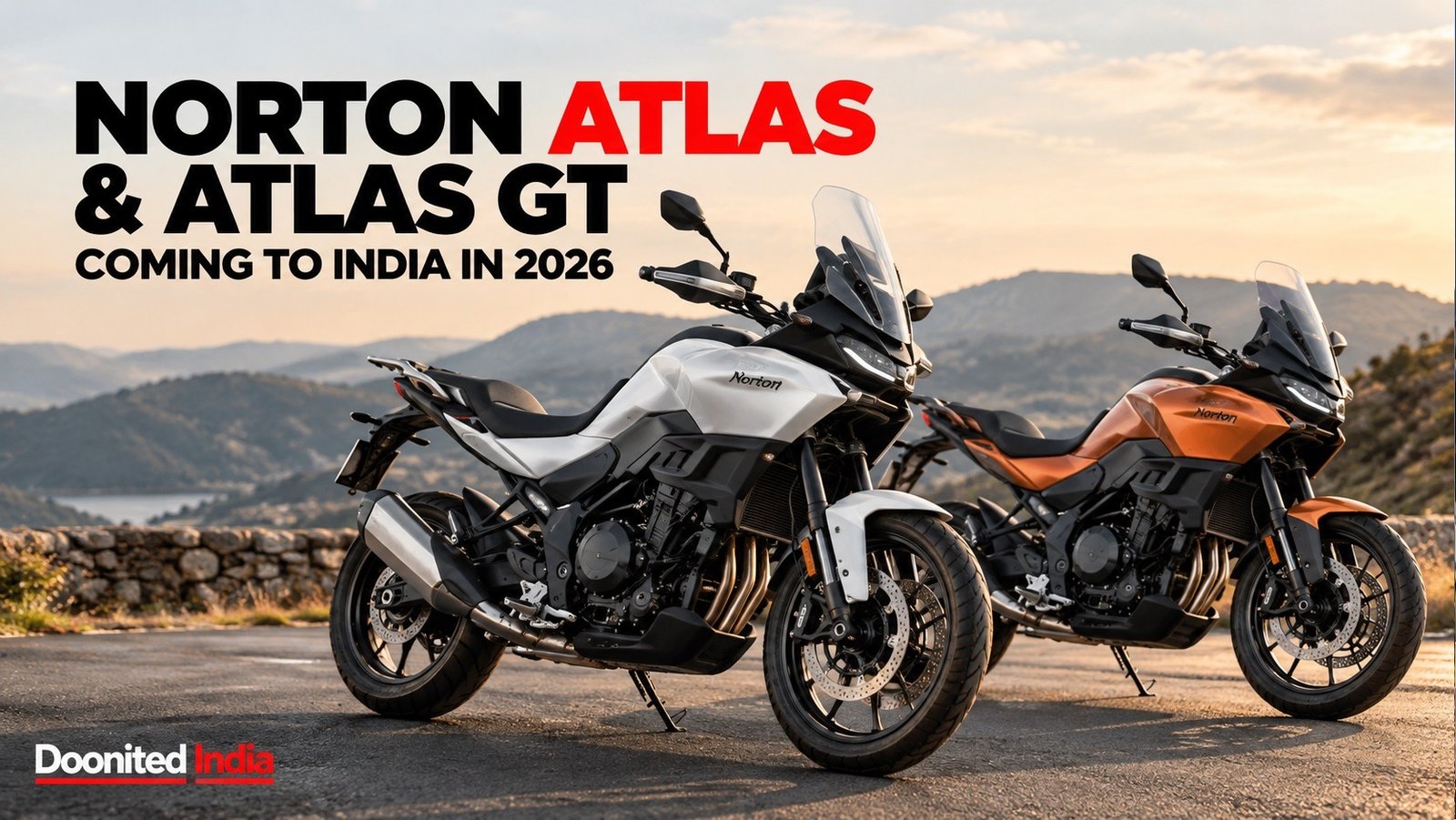
The standard Atlas is the more adventure-focused member of the family. It gets a 19-inch front wheel, longer-travel suspension and a taller 845mm seat height. The larger front wheel and additional suspension travel are intended to suit broken roads and light off-road use better than a road-biased setup.
That distinction matters in India, where a touring route can move from smooth expressway to patched state highway, gravel detour and unexpected construction zone in a single afternoon. An adventure motorcycle needs to be comfortable on the highway but composed when the tarmac disappears.
However, a 19-inch front wheel does not automatically make a motorcycle an off-road specialist. Tyres, ground clearance, suspension tuning, weight, protection and rider skill all matter. The Atlas’s actual capability will become clearer through independent testing rather than its styling alone.
Its 845mm seat height also deserves attention. The tall stance may suit standing riding and rough-road control, but it could make stop-start traffic and uneven parking surfaces less comfortable for some riders. Buyers should sit on the motorcycle before making a decision.
Norton Atlas GT: touring with a road-first setup
The Atlas GT takes a different approach. It uses 17-inch wheels at both ends, a road-focused chassis setup and a lower 815mm seat height. Its suspension travel is shorter than the standard Atlas, reflecting its emphasis on paved roads and touring.
That lower seat height may make the GT more approachable for a wider range of riders, although seat width and the motorcycle’s overall mass also affect how easy it is to manage at a standstill.
For riders whose adventures mostly involve highways, winding hill roads and the occasional city commute, the GT’s configuration may be more relevant than the standard Atlas’s off-road orientation. The choice is not simply between two trim levels; it is between two different uses of the same basic platform.
Technology: useful equipment, not just a showroom headline
The Atlas range’s electronics package is one of its major talking points. Norton specifies a Bosch six-axis inertial measurement unit (IMU), which supports rider aids that can respond to the motorcycle’s lean and movement.
The published equipment includes lean-sensitive ABS, traction control, cornering cruise control and five riding modes. The system also includes additional electronic interventions such as wheelie and rear-wheel control functions, depending on specification.
An IMU-based system can be particularly useful when conditions change unexpectedly. But sophisticated electronics cannot overcome the limits of tyre grip, poor road surfaces or inappropriate speed. Riders should understand the systems and their settings rather than treating them as a substitute for judgement.
The 8-inch TFT touchscreen is another headline feature. It brings together motorcycle information and connected functions, including navigation and smartphone connectivity. Norton’s connected ecosystem also includes its Rider app.
A large screen can improve legibility and make information easier to access, but usability matters more than screen size. Glove-friendly controls, sunlight visibility, intuitive menus and reliable navigation will determine whether the display is genuinely helpful on a long ride.
The hardware package also includes fully adjustable KYB suspension and dual front disc brakes. These are premium components, but the final verdict will depend on calibration, braking feel, suspension response and how well the package works on Indian roads.
The India price question: ₹5 lakh or closer to ₹7 lakh?
Price estimates currently vary across automotive publications and motorcycle portals. Some listings place the Atlas range around the ₹6 lakh mark, while others suggest higher figures for certain variants. Autocar India’s published estimates, for example, put the Atlas at ₹5.70–6.70 lakh and the Atlas GT at ₹5–6 lakh. ZigWheels lists a wider estimated range for the Atlas family, extending to ₹7.25 lakh.
These are third-party estimates, not announced Indian ex-showroom prices. They may also reflect different assumptions about variants and launch timing. The ₹5–7 lakh range is a useful broad expectation, but it should not be treated as a confirmed price band.
A four-variant line-up has been listed by some portals: Atlas, Atlas GT, Atlas Apex and Atlas GT Apex. Whether every variant will be offered in India, and what equipment will distinguish them, requires official confirmation.
The difference between a ₹5.5 lakh and a ₹7 lakh motorcycle is significant. At this level, buyers will consider not only the purchase price but also insurance, accessories, service costs, parts availability and resale prospects. A premium motorcycle can be attractively priced on paper and still become expensive to own if support is inconvenient or parts take too long to arrive.
The competition: a crowded middleweight conversation
The Atlas and Atlas GT will enter a segment with established alternatives, including the Kawasaki Versys 650 and Honda NX500, alongside newer adventure-focused options. These motorcycles do not all offer the same engine configuration, equipment or riding character, so a simple power-and-price comparison will not tell the whole story.
Norton’s opportunity lies in combining a distinctive British identity with modern electronics and local manufacturing. The challenge is earning buyer confidence beyond the specification sheet.
For a touring motorcycle, the ownership experience is part of the product. Riders need confidence that routine servicing will be straightforward, trained technicians will be available, and replacement parts can be obtained without turning a weekend ride into a logistics exercise.
TVS brings manufacturing and Indian-market experience to the partnership. The question is how effectively that capability translates into the premium retail and service experience Norton customers will expect.
What the launch could mean for Indian motorcycling
The Atlas project illustrates a broader shift: India is increasingly becoming a production base for motorcycles designed for international markets, rather than simply a destination for imported premium machines.
That can create opportunities in manufacturing, supplier development and technical capability. It can also make premium motorcycles more commercially viable in India, provided local production leads to meaningful value for customers.
But “made in India” should not be treated as a complete answer to the pricing question. The final cost and ownership experience will depend on the whole business model—from parts sourcing and production volumes to dealer coverage and warranty support.
The Atlas also arrives at a time when buyers have become more discerning. A large touchscreen and a long list of electronic features may attract attention, but customers will ultimately judge the motorcycle by comfort, reliability, handling and the confidence it inspires over thousands of kilometres.
DOONITED View
The Norton Atlas and Atlas GT bring together three elements that make this launch worth watching: a historic British marque, a modern middleweight twin-cylinder platform and manufacturing at TVS’s Hosur facility.
The Atlas is aimed at riders who want an adventure-oriented machine with the hardware to handle rougher routes. The GT offers a more road-focused alternative, with smaller wheels and a lower seat. Both have the potential to appeal to Indian touring riders, but their success will depend on more than technical specifications.
The most important announcement still to come is the Indian pricing and variant structure. If the motorcycles arrive within a competitive price range and are backed by accessible service, Norton could make a more substantial return to the Indian market. If ownership costs or service access become barriers, even an impressive specification sheet may struggle to convert interest into long-term loyalty.
In premium motorcycling, the journey begins at the showroom—but the brand earns its reputation after the sale.
Learning Point
When evaluating an upcoming motorcycle, separate confirmed specifications, estimated prices and actual ownership evidence. The engine and hardware can tell you what a manufacturer intends to deliver. Independent road tests, service coverage and real-world running costs tell you how well that promise works.


World Beyond the News
Why Elephants Stay Close to Their Herd
Elephants live in highly social family groups and use calls, touch and body movements to maintain strong bonds.
Most of the Deep Ocean Remains Difficult to Explore
Extreme pressure, darkness and distance make deep-ocean exploration one of Earth’s greatest scientific challenges.
Spacecraft Can Travel Without Traditional Roads
Spacecraft use carefully calculated trajectories and gravity assists to travel enormous distances through space.
Why Movie Trailers Are Released in Stages
Major films often use teaser trailers, full trailers and final promotional spots to build awareness over time.