Is Your Home Ready for an AI Upgrade?
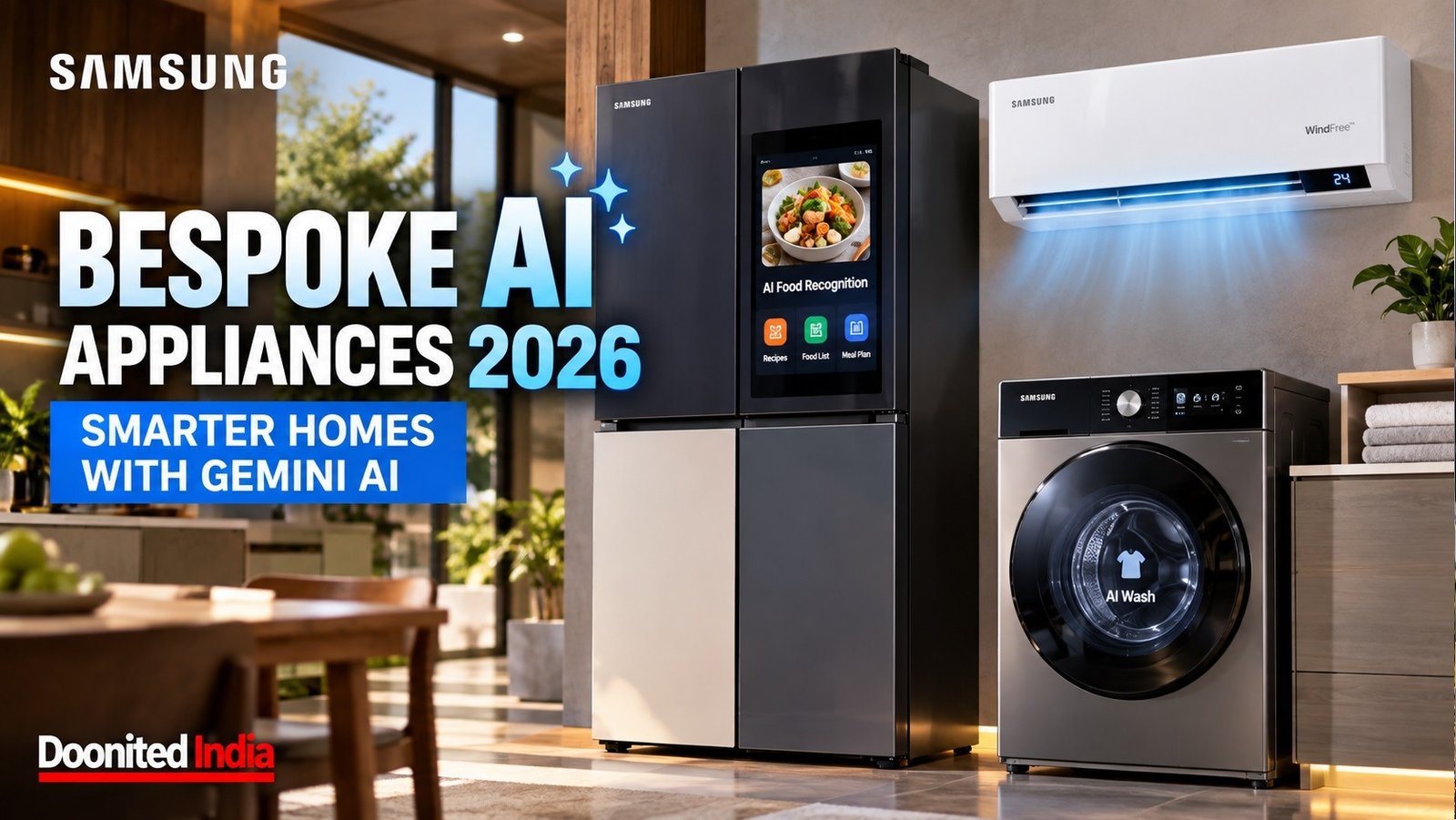
What if your refrigerator could help you plan dinner, your air conditioner could adapt to your sleep routine, and your washing machine could adjust its cycle to the clothes inside? Samsung is bringing these ideas closer to everyday Indian households with its 2026 Bespoke AI home appliance range, launched in India on September 16.
The new lineup brings Google Gemini-enabled AI Vision to the Family Hub refrigerator, personalised cooling features to WindFree air conditioners, and AI-assisted laundry functions into Samsung’s connected home ecosystem. SmartThings, Bixby and Samsung Knox are central to the experience, linking appliances through a common software layer.
The ambition is bigger than making individual appliances “smart”. Samsung wants them to work together, learn household routines and help manage everyday tasks. The practical question for Indian buyers, however, is whether these features deliver enough convenience, energy savings and long-term value to justify the premium.
A refrigerator that can see more than leftovers
The centrepiece of the launch is the 32-inch Family Hub refrigerator with AI Vision built with Google Gemini. Samsung says the upgraded system can recognise a wider range of food items, help maintain an inventory and support recipe discovery and meal planning.
Earlier food-recognition systems relied on a more limited set of recognised items. Samsung’s newer approach is intended to make food tracking more flexible, including recognising certain packaged foods and helping users manage ingredients stored in the refrigerator.
The Family Hub also serves as a household information screen, with features for notes, schedules, entertainment and personalised daily updates. Samsung’s AI Food Manager can help users organise ingredients, monitor use-by dates and find recipes. Localised Family Care and Pet Care features extend the system beyond the kitchen.
The appeal is easy to imagine. A household could check what ingredients are available before shopping, find a recipe that uses food already in the fridge, or keep family reminders in one place.
But AI food recognition should not be mistaken for perfect inventory management. Items may be obscured, placed in containers or moved without the system registering the change. Users should still check food freshness and expiry labels themselves. A refrigerator can assist with household organisation; it cannot yet take full responsibility for what is safe to eat.
The Family Hub is priced at ₹4,00,690 in India, placing it firmly in the premium appliance segment. Buyers will need to decide whether the large touchscreen and connected features offer enough daily value for their household.
WindFree air conditioning: comfort tailored to the household
Air conditioning is particularly relevant in India, where hot summers, humidity and long cooling hours can make comfort and electricity consumption competing priorities.
Samsung’s Bespoke AI WindFree Pro Air Conditioner combines connected controls with AI-enabled features and PM1.0 air purification. The company has also highlighted its Wearable Good Sleep feature, which can work with compatible Galaxy wearables to adjust AC settings based on a user’s sleep patterns.
The idea is to make cooling less dependent on manual temperature changes during the night. Samsung’s Triple Motion Wings airflow system is designed to direct air more precisely, while WindFree technology disperses cooled air through numerous small openings to reduce the sensation of a direct cold draft.
These features could be useful for people who find conventional AC airflow uncomfortable while sleeping. However, wearable-based automation depends on compatible devices, settings and the quality of the data available. It is a comfort feature, not a medical sleep-monitoring service.
Samsung lists the WindFree Pro AC at ₹69,990. The company also promotes AI Energy Mode as a way to manage cooling more efficiently. Its stated savings claims should be treated as manufacturer estimates: actual electricity use depends on room size, insulation, outdoor temperature, set temperature, usage patterns and the specific model.
The range also includes an Infinite 1-Way Cassette AC with WindFree, designed for spaces where a ceiling-mounted installation is appropriate. Samsung says it uses 17,200 micro-holes for draft-free cooling and offers AI comfort and energy-management features. It starts at ₹1,60,000, with capacity options and installation requirements to consider.
For most households, the right AC capacity and installation quality will remain just as important as AI features. A smart air conditioner cannot compensate for an undersized unit, poor insulation or an unsuitable installation.
Laundry that adapts to the load
Samsung is extending AI assistance into laundry through its Bespoke AI Laundry Combo and AI Wash & Dry features. The system is designed to assess factors such as load weight and fabric type, then adjust the wash and drying process.
A dedicated Pet Care Wash Cycle is intended for cleaning pet-related items. SmartThings can also help users monitor appliances and access maintenance-related information.
Automation could make laundry easier, particularly for households managing different fabrics and frequent loads. But users should still follow garment care labels and check the machine’s instructions for delicate fabrics, heavily soiled items and pet accessories.
The wider benefit is convenience: fewer manual choices for routine loads, with the option to intervene when a particular garment needs special treatment. As with other AI appliances, the real test is whether the automatic settings consistently produce good results.
SmartThings, Bixby and Knox: one connected home
Samsung’s 2026 range is built around its AI Home interface, SmartThings connectivity, Bixby voice assistance and Knox security. On supported devices, the AI Home screen provides a central place to control appliances and view information.
Samsung has also introduced Bixby Voice ID, which is designed to recognise individual users and personalise certain interactions. SmartThings services include Family Care alerts and Pet Care functions, extending the ecosystem beyond direct appliance control.
Samsung says its connected-appliance software update service now offers seven years of updates. Longer support can improve the value of an expensive appliance by helping it remain current for more of its useful life. Buyers should still check the exact model’s eligibility and the terms that apply to its software and connected services.
Security deserves attention, too. Samsung Knox is intended to provide layered protection, but a connected home still depends on secure accounts, router settings, software updates and sensible permissions. Consumers should understand which functions require cloud services, what information is shared and how to manage access for family members.
A connected home is only as dependable as the network and services supporting it. When the Wi-Fi goes down, basic refrigeration, cooling and washing should remain the priority—not the ability to ask an appliance a question.
What the prices tell Indian buyers
The headline prices make clear that Samsung is targeting different levels of the premium home market:
Product | Announced India price |
|---|---|
Family Hub refrigerator with AI Vision | ₹4,00,690 |
Bespoke AI WindFree Pro AC | ₹69,990 |
Infinite 1-Way Cassette AC with WindFree | From ₹1,60,000 |
Prices are those reported in Samsung’s launch information and may vary by model, retailer, offers and installation requirements.
The refrigerator’s price is especially significant. At over ₹4 lakh, it is not simply a replacement for a conventional fridge. It is a combined refrigeration, display and connected-home purchase. Consumers should compare capacity, energy consumption, warranty, service availability and the cost of ownership—not just the number of AI features.
For air conditioners, compare the star rating, capacity, annual energy consumption and warranty terms alongside smart functions. For laundry appliances, look at load capacity, water use, cycle duration and repair support. These fundamentals will affect household costs long after the novelty of a new interface wears off.
The bigger idea: appliances that work together
Samsung’s launch reflects a broader shift in consumer technology. The smart home is moving from a collection of internet-connected gadgets towards systems that can coordinate tasks across rooms.
That could be useful in India’s diverse households, where family members may have different schedules, cooling preferences and care responsibilities. Smart alerts and remote controls can add convenience, while energy-management features may help households understand and adjust usage.
But interoperability remains important. Buyers should check which functions work only with Samsung devices, which require a Galaxy phone or wearable, and whether essential controls remain available without a subscription or internet connection.
The smartest home is not necessarily the one with the most connected appliances. It is the one where the technology quietly solves real problems without making everyday life more complicated.
DOONITED View
Samsung’s 2026 Bespoke AI range presents a coherent vision: a refrigerator that helps manage food, an air conditioner that adapts to comfort preferences, and laundry appliances that automate routine decisions. The seven-year update commitment and SmartThings integration are meaningful parts of that proposition.
The caution is cost and complexity. Premium AI features may be valuable to some households, but they should not distract from energy efficiency, reliability, repairability and service support. A refrigerator’s first job is to preserve food; an AC’s is to cool a room efficiently. AI earns its place when it improves those core functions in ways users can actually measure.
For Indian consumers, the best approach is to evaluate each appliance individually, then consider whether the connected ecosystem adds enough value to justify buying into it.
Learning Point
Before paying extra for an AI appliance, identify the everyday task it will improve. Check the model’s energy rating, warranty, update commitment, compatibility and dependence on cloud services. Convenience is valuable—but only when it is reliable, affordable and genuinely useful.


World Beyond the News
Octopuses Can Change Their Appearance
Octopuses can rapidly alter their skin colour and texture to communicate, camouflage themselves and respond to danger.
Some Cities Exist Across Two Continents
A small number of cities are geographically associated with two continents, creating unusual cultural and geographic identities.
Earth’s Climate Is Measured in Many Ways
Scientists track temperature, atmospheric gases, sea level, ice cover and other indicators rather than relying on a single climate number.
Streaming Changed How Audiences Discover Shows
Recommendation systems and global streaming releases allow audiences to discover programmes far beyond their original markets.