Jodhpur RIFF 2026: When Rajasthan’s Folk Traditions Meet the World Under a Desert Moon
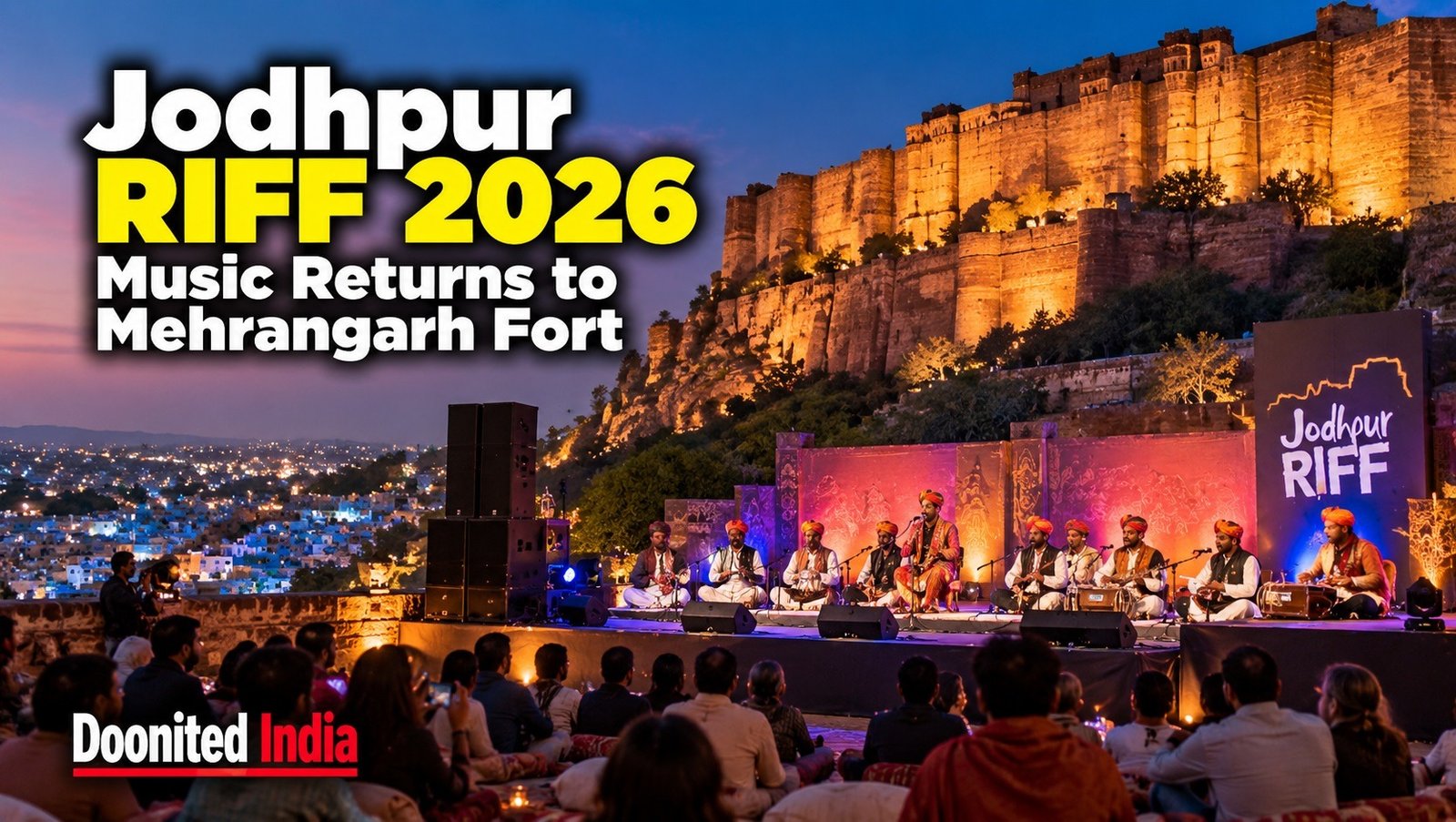
From dawn music at Jaswant Thada to late-night performances within the historic Mehrangarh Fort complex, Jodhpur RIFF returns from October 22 to 26 with Rajasthani folk traditions, Indian classical music and international collaborations. As the festival marks its 20th year, its deeper story is about more than a spectacular setting: it is about keeping living musical traditions visible, valued and economically viable.
A fort becomes a meeting place for musical worlds
As the full moon of Sharad Purnima rises over Jodhpur, the sandstone walls of Mehrangarh Fort will provide the setting for five days of music, dance and cultural exchange. The 2026 edition of the Rajasthan International Folk Festival, widely known as Jodhpur RIFF, runs from October 22 to October 26, with performances and events at venues in and around the fort.
Now in its 20th year, the festival is held under the aegis of the Mehrangarh Museum Trust. Its stated ambition is to support the livelihoods of Rajasthan’s traditional performers while bringing their music into conversation with artists from India and across the world.
The location is more than a dramatic backdrop. Mehrangarh is part of the cultural landscape that gives the festival its identity: a historic fort overlooking a city whose musical traditions have travelled through generations, often sustained by families, communities and local patronage.
But Jodhpur RIFF is not simply a showcase of heritage. Its programme places traditional music alongside contemporary performance, dance, theatre and new collaborations—asking what happens when an old musical language encounters a new audience.
The traditions behind the sound
Rajasthan’s folk music is not one uniform style. It encompasses distinct repertoires, performance practices and community histories, shaped by the region’s social life, devotional traditions and desert environment.
The Manganiyar and Langa communities are particularly associated with hereditary musical traditions in western Rajasthan. Their repertoires include devotional and celebratory songs, performed with instruments such as the kamaicha, sindhi sarangi, dholak and khartal. The morchang, a small jaw harp, adds another distinctive texture to the region’s sound.
The festival’s programme also makes space for communities and forms that may be less familiar to audiences outside Rajasthan. On October 23, the dawn concert at Jaswant Thada features singers Dariya and Kelam from the Meghwal community of Marwar. The festival describes Meghwal singing as a tradition rich in devotional poetry and folklore.
Across the daytime “Fort Festivities,” visitors can encounter forms including Garasia dance, Chari dance, Dandiya Gair and performances by young Langa and Manganiyar musicians. These are not interchangeable spectacles: each carries its own movement vocabulary, musical accompaniment and cultural setting.
The value of presenting them together is that audiences can experience Rajasthan’s traditions as a diverse living culture—not as a single sound reduced to a tourist-friendly label.
From dawn at Jaswant Thada to music after midnight
The schedule offers several ways to experience the festival, depending on whether visitors want a single concert, a full day of performances or a longer immersion.

October 22 — A free city opening
The opening night concert runs from 7:30 pm to 10 pm at the Moon Parking area on the route up to Mehrangarh Fort. It is free and open to the public. The morning Bal Mela is a separate school-focused event.
October 23 — The Meghwal of Marwar
The day begins at 5:30 am at Jaswant Thada, with Dariya and Kelam. Later events include the INAYAT collaboration, combining Kathak with music from Rajasthan’s Langa tradition.
October 24 — Tradition in conversation
The dawn programme turns to the sounds of Manipur. The day also features performances and collaborations spanning folk, contemporary and international music.
October 25 — A musical moonrise
A dawn performance led by pianist and composer Merlin D’Souza is followed by a moonrise concert at Jaswant Thada featuring violinist Ambi Subramaniam with fellow Indian classical musicians.
October 26 — The final dawn
The festival concludes with its final early-morning programme at Jaswant Thada. Visitors should consult the official schedule for the latest details.
The festival’s timetable stretches well beyond the main evening concerts. “Fort Festivities” occupy museum spaces during the day, while events such as Club Mehran and Desert Lounge extend the programme into the night. The result is a festival that moves through the city’s historic spaces rather than remaining confined to one stage.
Global collaborations without losing the roots
International exchange is central to Jodhpur RIFF’s identity. The 2026 programme includes artists working across different musical traditions and contemporary forms.
One example is INAYAT: A Duet for Four, a continuing collaboration between Kathak dancer Tarini Tripathi and Rajasthani musicians Sadiq Khan, Asin Khan and Zakir Khan Langa. The performance brings dance into dialogue with the Langa repertoire, using gesture and movement to respond to songs and instruments rather than simply placing a dance performance beside a musical one.
Another is the return of Colombian artist Killabeatmaker, whose collaboration with Rajasthani dhol drummers and players of morchang and khartal draws together electronic music and regional percussion. The programme also features DOBBY, the Filipino-Murrawari musician from Australia, in a performance rooted in cultural memory and contemporary expression.
Such encounters can create new audiences for traditional artists. They can also challenge the idea that heritage must remain untouched to remain authentic. Traditions have always developed through contact, adaptation and changing social conditions. The important question is whether collaborations respect the musicians and musical knowledge at their centre.
The economics behind cultural preservation
A festival can offer performers visibility, paid work and professional connections. It can also bring visitors to hotels, restaurants, transport operators and other local businesses. But the wider economic effect should not be confused with a guarantee of stable livelihoods for every artist.
The festival itself describes its purpose in terms of positively affecting the livelihoods of Rajasthan’s traditional performers. That ambition matters because the survival of a musical tradition depends on more than an annual stage appearance.
For musicians, sustainability can involve regular performance opportunities, fair fees, apprenticeships, instruments, teaching work, recordings and the ability to pass repertoires to younger generations. A prestigious festival may open doors, but a booking or collaboration does not automatically create year-round income.
This is where cultural festivals face a difficult balance. They need to attract audiences and sponsors, yet they also carry a responsibility to the artists whose knowledge gives the event its meaning. The long-term measure of success is not only the size of the crowd or the international names on the bill. It is whether traditional performers have more opportunities to earn, teach and continue their work after the festival ends.
Jodhpur RIFF’s “Folk Futures” conversation, scheduled for October 25, directly addresses the question of how traditions can be taught and carried forward. It places the future of folk music—not just its performance—on the programme.
A practical guide for visitors
The festival begins with free public events on October 22. The main ticketed programme runs from October 23 to 26, with different passes covering different performances.
According to the official pass information, day passes for October 23, 24 and 25 are listed at ₹7,300, while the full festival pass is ₹17,800. Some individual events have separate pass options: the dawn concerts at Jaswant Thada are listed at ₹400, and the October 25 Moonrise event at ₹600. Visitors should confirm current availability, inclusions and any changes through the official festival website before making plans.
Early-morning performances begin at 5:30 am, so accommodation, transport and access arrangements deserve attention. The festival uses several venues around Mehrangarh Fort, Jaswant Thada and nearby locations; a ticket for one event should not be assumed to cover every programme.
Official schedule and pass details: jodhpurriff.org
Keeping the music alive after the moon sets
Jodhpur RIFF’s appeal lies in the meeting of place, music and time: a historic fort, a full-moon festival and traditions that carry the memory of communities across generations. Its international collaborations can introduce those traditions to new listeners, while its local programme keeps attention on the artists and forms that make Rajasthan distinctive.
Yet cultural preservation cannot be outsourced to five days in October. It depends on whether musicians can sustain their craft, whether younger performers have ways to learn, and whether audiences value the people behind the music as much as the spectacle.
The festival offers a vivid encounter with Rajasthan’s musical heritage. Its lasting contribution will be measured by what continues when the stages fall quiet.

World Beyond the News
Dolphins Use Individual Signature Whistles
Bottlenose dolphins develop distinctive whistles that function somewhat like individual acoustic identifiers.
The Pacific Is Earth’s Largest Ocean
The Pacific Ocean covers more area than any other ocean basin and stretches between Asia, Australia and the Americas.
Artificial Intelligence Learns Statistical Patterns
Modern machine-learning systems identify patterns in large datasets and use those patterns to generate predictions or outputs.
Why Some Stories Spread So Quickly
Emotion, novelty, visual appeal and easy sharing can make a story travel rapidly across social platforms.