Devaragattu Dussehra: When Faith, Memory and Risk Meet on a Midnight Hill
Every Vijayadashami, Devaragattu in Andhra Pradesh turns an ancient story of victory into a living ritual involving thousands of devotees, competing village groups and a midnight confrontation with bamboo sticks. The harder question is no longer whether the tradition is extraordinary, but how a dangerous ritual can survive without allowing preventable injuries to become part of its heritage.
Most Dussehra celebrations end with the symbolic defeat of evil.
At Devaragattu in Andhra Pradesh, the story is enacted with considerably less symbolism.
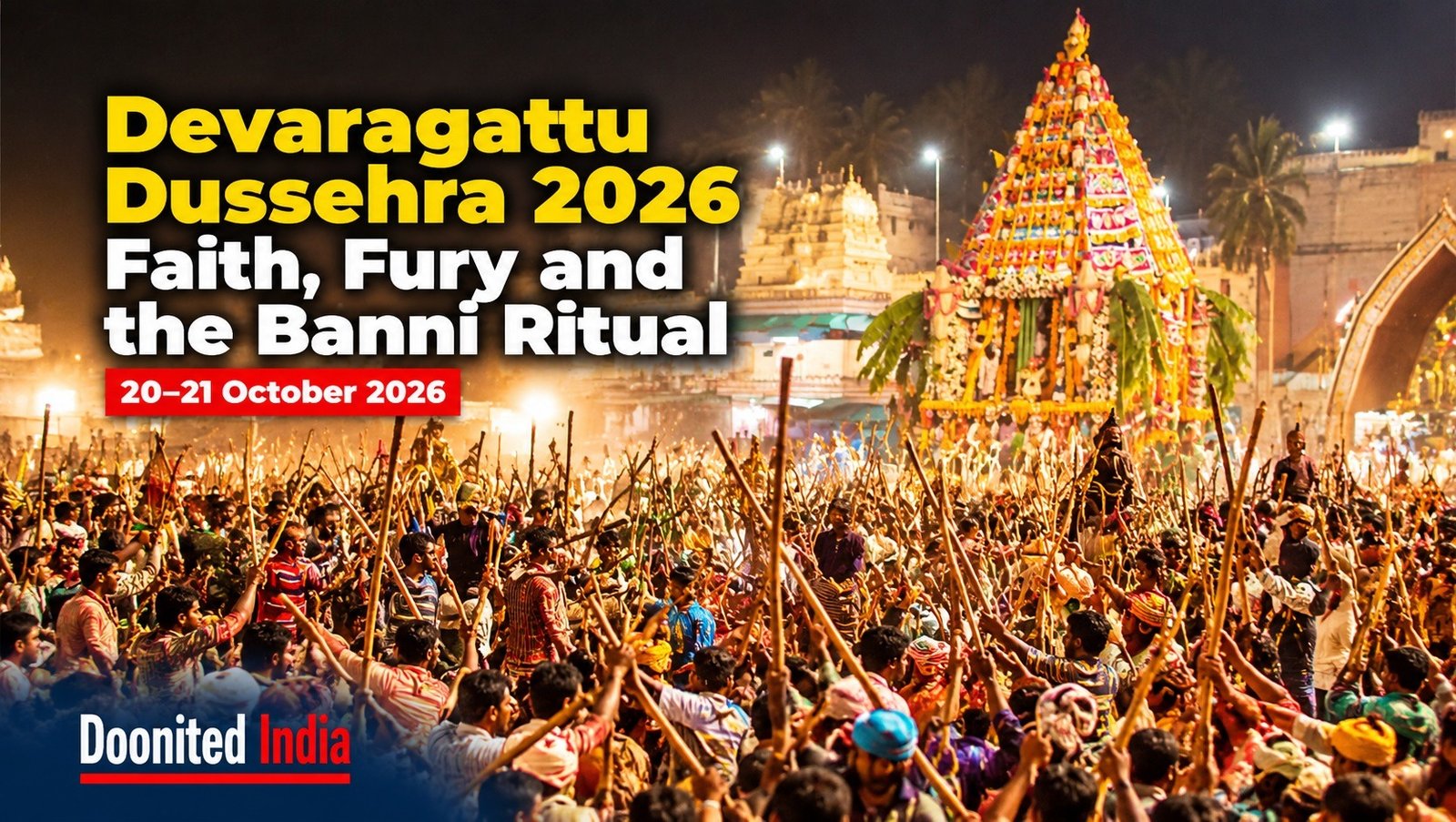
On the night of Vijayadashami, devotees gather around the Sri Mala Malleswara Swamy temple in Kurnool district for the Banni festival. The climax is a midnight ritual in which groups carrying long bamboo sticks compete for control of the processional idols of Mala Malleswara Swamy and Parvathi.
The Ministry of Tourism’s Incredible India portal describes it as a fierce ritualistic re-enactment of the victory of the deities over the demons Mani and Mallasura. The 2026 festival is scheduled for 20–21 October.
For outsiders, the scene can look startling.
For participating communities, it is something much deeper: inherited ritual, village identity, devotion, memory and an annual reaffirmation of belonging.
That distinction matters.
Because Devaragattu cannot be understood simply by calling it a “violent festival.” Nor can the injuries associated with it be dismissed simply as the unavoidable price of tradition.
The real story lies somewhere between those two extremes.
A Dussehra unlike the familiar spectacle
The Banni festival is associated with the Sri Mala Malleswara Swamy temple at Devaragattu in Holagunda mandal of Kurnool district.
According to the traditional account, Mani and Mallasura were demons who troubled saints in the region. The saints sought divine intervention, and Mala Malleswara Swamy and Parvathi ultimately defeated them.
The ritual reproduces that conflict through the movement of the processional deities and the opposing village groups attempting to control or divert the procession.
The festival extends over several days, with religious ceremonies preceding the Vijayadashami climax. Incredible India describes the wider celebration as an 11-day festival, including the celestial wedding of the deities and other rituals.
The stick confrontation is therefore not the entire festival.
It is the dramatic centre of a much larger religious tradition.
That is an important distinction for international readers encountering Devaragattu for the first time.
The fight is ritual — but the injuries are real
The phrase “mock fight” can be misleading.
Historical and contemporary reporting makes clear that the physical consequences have been genuine.
In October 2024, more than 70 people were reported injured during the Banni stick-fight, with some requiring hospital treatment.
The following year, the festival again ended in tragedy. The Times of India reported that two people died and nearly 80 were injured in the 2025 event, with several injured described as being in critical condition. Other reports put the death toll at three, illustrating why casualty figures should be treated carefully unless an official consolidated figure is available.
That discrepancy itself is a useful journalistic warning.
Festival casualty figures can change as hospitals and police confirm information, and early reports may count deaths differently depending on the circumstances.
What is not in serious doubt is the recurring risk.
This is not an abstract debate about whether a ritual looks dangerous.
People have actually been injured and killed around the event.
Why communities continue
It would be easy to describe the festival entirely through the lens of violence.
That would also miss why it has survived.
The Banni tradition connects several villages through a shared ritual system. The opposing groups are not simply strangers meeting for a random confrontation. Their participation is embedded in local religious and social relationships.
Earlier reporting from The New Indian Express described villagers carrying the processional deities from the hill and groups from different settlements attempting to divert the procession, with the ritual interpreted through the story of the divine battle.
There is also an important cultural principle here.
A tradition does not survive merely because somebody has decided it is old.
It survives because communities continue to assign meaning to it.
For participants, therefore, changing the ritual is not necessarily equivalent to improving it. A government order that simply says “stop” may address the physical danger while failing to address the social and religious system that gives the event its meaning.
That is why Devaragattu presents a much harder conservation problem than preserving an old building.
A building can be fenced.
A living ritual has people inside it.
The safety question has already entered the tradition
Authorities have not ignored the danger.
Quite the opposite.
Police and district officials have repeatedly attempted to reduce injuries through surveillance, medical arrangements, barricading and crowd management.
Ahead of the 2024 festival, Kurnool police announced CCTV and drone surveillance, while authorities planned a temporary hospital and other emergency facilities. Police also seized sticks fitted with sharp-edged rings and worked to prevent spectators from climbing trees, following previous accidents.
The following year’s preparations again emphasised preventing unlawful clashes and maintaining order.
In 2025, Kurnool’s Superintendent of Police publicly characterised Banni as a tradition rather than simply a “stick fight”, while warning against people misusing the occasion for violence and saying action would be taken against unlawful behaviour and alcohol consumption.
That distinction may be more important than it first appears.
If authorities want to preserve the festival, they need to understand precisely which elements communities consider sacred and which dangerous behaviours have developed around them.
Technology cannot solve a cultural problem by itself
Drones and CCTV can help.
So can ambulances, lighting, barricades, medical teams and trained emergency personnel.
But technology has limits.
A drone can identify a crowd surge.
It cannot persuade a devotee that changing the way a ritual is performed will not diminish its religious meaning.
A CCTV camera can record an injury.
It cannot prevent a participant from believing that physical suffering is part of devotion.
That is why Devaragattu’s future probably requires something more sophisticated than simply increasing the number of police officers.
It requires ritual redesign without cultural erasure.
That might mean separating participants from spectators more effectively, controlling access to the most dangerous areas, establishing clearly managed ritual zones, improving emergency evacuation routes and creating stronger medical response systems.
But any such change would have to be developed with the communities that actually conduct the festival.
Otherwise, safety measures risk being seen as an external attempt to rewrite local tradition.
The world is learning to ask a different heritage question
International heritage debates increasingly distinguish between monuments and living heritage.
A monument can be preserved in a controlled environment.
Living heritage changes because people practise it.
India has thousands of such traditions: festivals, processions, ritual performances, crafts, food practices, music traditions and religious ceremonies.
Their strength is also their vulnerability.
If they become frozen, they stop being living traditions.
If they are allowed to evolve without any attention to safety, environmental pressure or changing social conditions, they can become unsustainable.
Devaragattu therefore presents a question relevant far beyond Andhra Pradesh:
Can a community preserve the meaning of a tradition while changing the physical conditions that make it unnecessarily dangerous?
That is a very different question from asking whether the tradition should simply be banned.
Heritage should not require preventable tragedy
There is an uncomfortable tendency in the modern tourism economy to turn unusual traditions into spectacles.
The more dramatic the ritual, the more attention it receives.
Devaragattu is particularly vulnerable to this treatment because photographs of the midnight stick confrontation are visually powerful.
But visitors should not mistake spectacle for understanding.
The festival is not an entertainment product created for outsiders. It is a religious tradition rooted in particular villages and a particular mythology.
That places an ethical responsibility on tourism coverage.
The objective should be to explain the tradition rather than encourage spectators to seek out danger.
The same principle applies to media reporting.
Calling the event simply a “bloody festival” produces a dramatic headline but very little understanding.
Calling it only an “ancient spiritual tradition” is equally incomplete if it hides repeated injuries.
Good journalism has to hold both facts together.
The real victory may be making tradition safer
Devaragattu’s story ultimately begins with a victory over demons.
Its modern challenge is different.
The community does not need to defeat its own heritage in order to protect people.
Nor does protecting heritage require accepting every historical form of physical risk.
The most intelligent future for the Banni festival would be one in which the religious narrative, village participation, processional traditions and devotional meaning remain intact while avoidable injuries decline sharply.
That would not make the festival less authentic.
It could make the tradition more resilient.
India’s cultural heritage is not valuable because it is frozen in time. It is valuable because people continue to give it life.
And perhaps that is the most important lesson from Devaragattu.
A tradition proves its strength not by refusing to change, but by knowing what must never be lost — and what can safely be changed.


World Beyond the News
Birds Can Navigate Using Earth’s Magnetic Field
Several bird species can sense Earth’s magnetic field, helping them navigate during long-distance migration.
Fermentation Is a Global Food Tradition
People across continents have used fermentation for centuries to preserve food and create distinctive flavours.
Modern Batteries Store Energy Chemically
Rechargeable batteries repeatedly move ions between electrodes, allowing electrical energy to be stored and released.
Why Songs Become Global Hits
Streaming platforms, short-form video, playlists and international collaborations can rapidly carry music across borders.