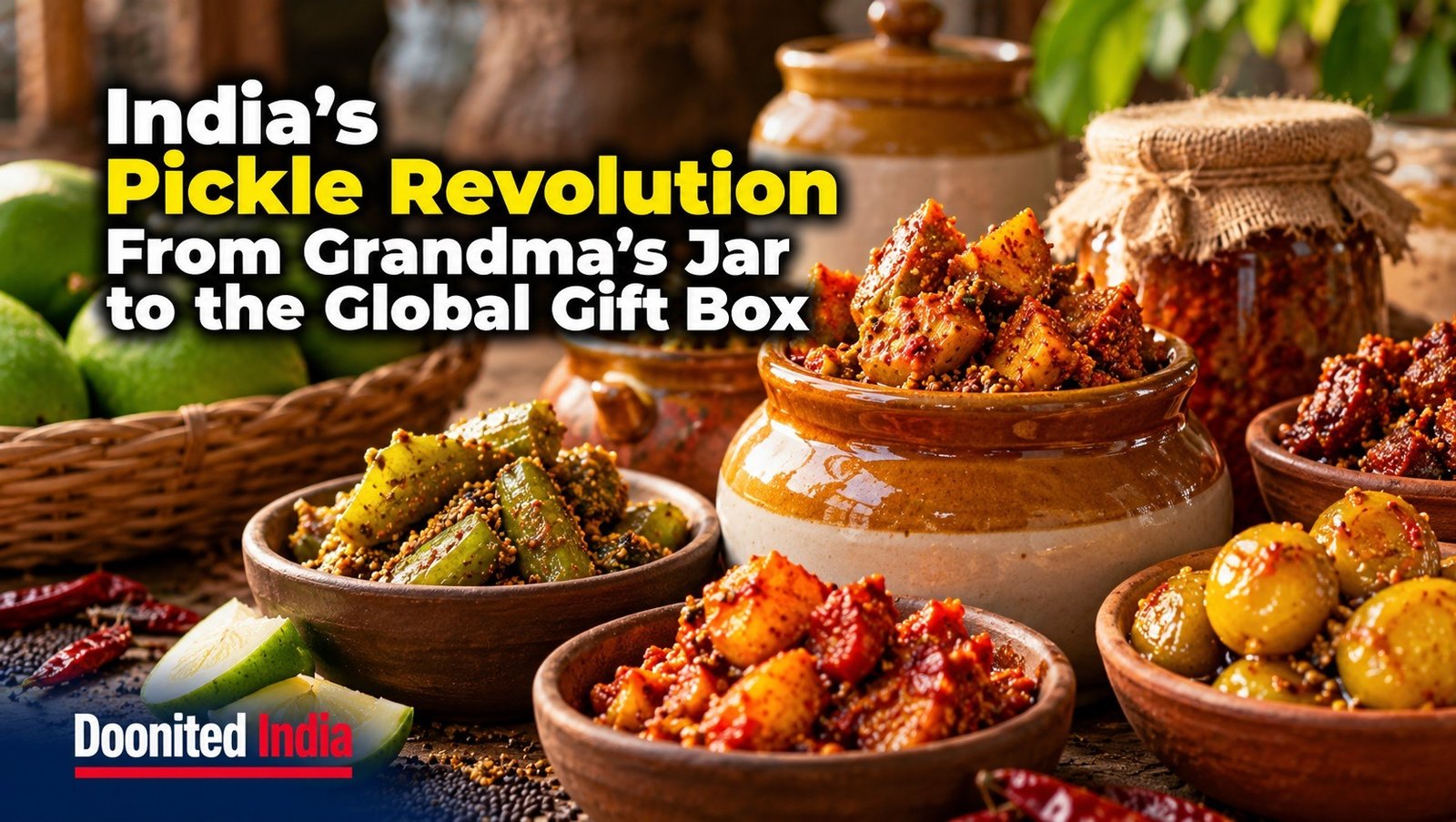
India’s Pickle Revolution: From Grandma’s Jar to the Global Gift Box
India’s pickle is leaving the kitchen shelf. Regional recipes are becoming packaged foods, D2C products and premium gifts—but the real opportunity lies in turning culinary memory into sustainable businesses without losing the identity that made the pickle special in the first place.
There was a time when a jar of pickle needed no marketing.
It might arrive from a grandmother’s kitchen, travel in a steel container to a hostel, appear in a wedding hamper or sit quietly at the back of the refrigerator until somebody remembered it was there.
The label was often unnecessary.
Everybody already knew the recipe.
Today, the pickle is acquiring a label, a barcode, a premium glass jar, an online storefront and sometimes a surprisingly sophisticated origin story.
India’s pickle business is being pulled in two directions at once: towards modern food processing and distribution, and towards the nostalgia of regional, homemade food.
That tension is what makes the humble pickle an interesting business story.
The question is no longer whether Indians love pickles.
They clearly do.
The question is whether India’s enormous culinary diversity can be converted into modern food businesses while keeping the people, places and recipes behind those products economically visible.
The pickle was already a preservation technology
Before the word “food processing” acquired factory-sized machinery and PowerPoint presentations, Indian households were already experts in preserving seasonal produce.
Mangoes, limes, chillies, vegetables and other ingredients could be preserved using combinations of salt, oil, acid, sugar and spices.
FSSAI’s formal definition of pickles reflects that diversity: the regulatory standard covers fruit, vegetables and other edible plant material preserved in salt, acid, sugar or combinations of these, with permitted ingredients including edible oils, chillies, spices, vinegar and other components. (fssai.gov.in)
That matters because the modern pickle industry is not inventing an entirely new product.
It is industrialising an old one.
The challenge is that industrialisation requires consistency.
The home cook can make this year’s mango pickle slightly hotter than last year’s.
A packaged-food company selling thousands of jars cannot rely on “approximately the same.”
It needs controlled ingredients, hygiene, processing, packaging, labelling and shelf-life management.
The grandmother’s recipe now has to meet the factory’s spreadsheet.
From recipe to retail product
IBEF’s recent overview of India’s pickle and condiment sector describes a market increasingly influenced by organised retail, e-commerce, packaging improvements and food-processing technology. It cites commercial market research estimating India’s pickle market at roughly US$624 million in 2025, with continued growth projected through 2034. That figure is a market-research estimate rather than a government statistic, so it is best treated as an indicator of commercial-market expectations rather than an independently measured national total.
The broader direction, however, is easier to establish.
Pickles are becoming easier to buy outside their traditional geography.
A Bengali-style preparation can be ordered in Bengaluru.
A regional chilli pickle can reach a customer in Delhi.
An Indian living overseas can order a familiar flavour without waiting for the next suitcase from home.
Digital commerce changes the economics of this.
A small producer no longer necessarily needs hundreds of physical retailers to find customers.
A good product photograph, reliable packaging, appropriate food licensing and a functioning delivery network can create access to customers far beyond the producer’s district.
That is particularly significant for small women-led enterprises.
The women behind the jar
The commercialisation of traditional foods is also becoming a route into entrepreneurship for women.
In February 2025, ICAR’s Indian Institute of Soil and Water Conservation organised a five-day fruit-and-vegetable processing entrepreneurship programme in Dehradun for 25 women from Self-Help Groups. The training included pickles, mixed pickles, chutneys, jams and other value-added products, along with standards and local marketing strategies intended to help participants generate additional income.
Another ICAR programme involving rural women explicitly linked value addition, product quality, mechanisation and market connections with the potential to increase rural income. Participants learned to make several types of pickles, including mango, lemon, green chilli and mushroom.
These examples are small.
That is precisely why they are important.
India does not need every pickle producer to become a national FMCG brand.
A village-level business supplying nearby towns, a regional online customer base or a diaspora community can still create useful additional income.
The danger is assuming that a recipe automatically becomes a successful business simply because it is “traditional.”
It doesn’t.
The hidden work between kitchen and shelf
A premium pickle jar can make the final product look deceptively simple.
Inside the business, the process is much less romantic.
Raw material has to be sourced at the right quality.
Ingredients need cleaning and preparation.
Salt, oil or acid levels must be controlled appropriately.
Packaging must protect the product.
Labels have to comply with food regulations.
Shelf life has to be established.
Orders have to be packed and delivered.
Customer complaints have to be handled.
And food safety cannot be replaced by nostalgia.
FSSAI maintains specific standards for pickles and food businesses, while its wider regulatory system covers food safety, packaging, labelling and other requirements.
This is where the transition from kitchen to enterprise becomes difficult.
A family recipe can survive on experience.
A commercial product needs a reproducible process.
That difference is easy to underestimate.
Regional identity may be the biggest competitive advantage
There is one thing mass production cannot easily manufacture:
place.
India’s pickle traditions are extraordinarily regional.
The ingredients change.
The oil changes.
The spice profile changes.
The preservation technique changes.
Even the idea of what counts as a “proper” pickle can change from one household or community to another.
That gives Indian producers something valuable in an increasingly crowded packaged-food market: provenance.
A generic “mango pickle” competes primarily on taste, price and packaging.
A product identified with a particular region, ingredient, community or preparation tradition has another story to tell.
But there is a catch.
Provenance should be genuine.
A label that borrows the name of a region merely because it sounds exotic is not the same thing as a product whose ingredients, recipe or production actually have a documented connection to that place.
The premium-food market will eventually reward brands that can substantiate their stories.
The premium pickle is also becoming a gift
Perhaps the most surprising evolution is what happens when the pickle leaves the dining table and enters the gift box.
Premium food gifting has traditionally been dominated by chocolates, dry fruits, tea, coffee and confectionery.
Pickles can now occupy a different space.
A curated collection of regional pickles can function almost like a culinary map of India: mango from one region, chilli from another, a distinctive vegetable preparation from elsewhere.
For Indian consumers, the appeal is nostalgia.
For diaspora consumers, it can be something stronger: a compact, shelf-stable connection to a familiar food culture.
That creates an international opportunity.
Indian food has already travelled globally through restaurants and diaspora communities. Packaged regional foods can travel with it.
But the international market imposes another discipline.
Packaging, labelling, food safety, shelf life and import regulations become critical.
The romantic story of the homemade pickle has to coexist with the very unromantic paperwork of international food trade.
That is not a weakness.
It is the price of scaling.
“Healthy pickle” needs careful language
There is another trend worth watching: the attempt to position pickles within contemporary wellness culture.
Consumers increasingly look for fermented foods, clean labels, traceable ingredients and products perceived as less processed.
But pickle marketing should be careful.
Not every pickle is fermented.
Not every pickle is low in sodium.
Not every traditional preparation automatically qualifies as a health food.
And a product being “natural” does not eliminate food-safety requirements.
FSSAI’s standards show why formulation and preservation method matter. Pickles preserved in brine, oil and vinegar have different specifications, including requirements around drained weight, salt or acidity depending on the type.
The better marketing strategy is therefore not to turn every jar into a miracle product.
It is to tell the truth about what is inside it.
That may actually become a competitive advantage.
Technology should make the pickle safer, not less human
Modernisation does not have to mean industrial uniformity.
Food-processing technology can improve consistency, hygiene, packaging and traceability while allowing distinctive recipes to survive.
IBEF notes the industry’s movement toward more organised processing, improved packaging and digital traceability.
For small producers, however, technology has to be affordable.
A village entrepreneur does not necessarily need an elaborate automated production line.
Sometimes the most useful intervention may be much simpler:
better weighing equipment;
clean processing surfaces;
reliable sealing;
food-safe packaging;
basic batch records;
proper labelling;
digital payments;
and an online route to customers.
The goal should be appropriate technology, not technology for its own sake.
The real opportunity is not another pickle brand
India probably does not need one more company selling a generic mango pickle with a fashionable label.
It needs stronger value chains.
Farmers need reliable markets for suitable fruits, vegetables, spices and other ingredients.
Women-led groups need training and access to finance.
Small producers need food-safety knowledge.
Packaging needs to become more affordable and sustainable.
Brands need transparent sourcing.
And producers need access to markets without surrendering most of the value to intermediaries.
Government and institutional programmes are already working in pieces of this ecosystem. The PMFME framework, for example, has been used to support micro food-processing enterprises and Self-Help Groups through credit-linked assistance, seed capital, training, branding and marketing support, according to IBEF’s review of government data.
The next step is connecting those interventions.
Training without market access produces certificates.
Market access without food-safety capability creates risk.
Packaging without a distinctive product creates another anonymous jar.
The successful model has to combine all three.
The diaspora may be an important test market
For overseas Indians, food often carries an emotional value that is difficult to reproduce through advertising.
A jar of pickle can be small enough to fit into a pantry but large enough to trigger memories of a particular home, region or family.
That gives Indian producers an unusual advantage in diaspora markets.
But nostalgia gets a business through the first purchase.
Quality gets it through the second.
If the product is inconsistent, poorly packaged or difficult to trust, cultural familiarity will not be enough.
This is where India’s regional food entrepreneurs have an opportunity to compete internationally—not by pretending that every Indian pickle is a luxury product, but by offering genuinely distinctive foods with reliable quality.
The future may belong to the jar that tells the truth
The pickle’s journey from kitchen to supermarket shelf is really a story about India’s larger food economy.
Traditional knowledge is being packaged.
Women are turning food skills into businesses.
Regional flavours are finding customers outside their original geography.
Digital commerce is shrinking the distance between producer and consumer.
Food processing is making small-batch products easier to standardise.
And international demand is creating new possibilities for regional Indian foods.
But commercialisation carries a risk.
If every regional recipe is redesigned to taste the same, dressed in the same premium packaging and marketed with the same vague claims about “tradition,” India could end up exporting the image of culinary diversity while quietly standardising the food itself.
That would be a strange outcome.
The real opportunity is the opposite.
Make the packaging modern. Make the supply chain professional. Make the food safe. But let the flavour retain its address.
India’s pickle industry does not need to choose between tradition and modernity.
It needs to prove that tradition can become economically valuable without becoming culturally anonymous.
The next time a beautifully labelled pickle jar appears in a corporate Diwali hamper, an airport shop or an overseas Indian’s kitchen, there should be a bigger story behind it than clever packaging.
There should be a farmer who found a better market.
A woman who turned a food skill into income.
A regional recipe that survived.
And a customer who knows exactly where the flavour came from.


World Beyond the News
Dolphins Use Individual Signature Whistles
Bottlenose dolphins develop distinctive whistles that function somewhat like individual acoustic identifiers.
The Pacific Is Earth’s Largest Ocean
The Pacific Ocean covers more area than any other ocean basin and stretches between Asia, Australia and the Americas.
Artificial Intelligence Learns Statistical Patterns
Modern machine-learning systems identify patterns in large datasets and use those patterns to generate predictions or outputs.
Why Some Stories Spread So Quickly
Emotion, novelty, visual appeal and easy sharing can make a story travel rapidly across social platforms.