Can AI Help India’s Small Businesses Create Jobs? Nandan Nilekani’s Optimistic Bet
Infosys co-founder Nandan Nilekani argues that artificial intelligence will create new opportunities for businesses rather than simply eliminate jobs. India’s millions of micro, small and medium enterprises could be central to that transformation—but the gains will depend on affordable tools, practical skills, trustworthy implementation and whether productivity improvements translate into higher incomes and more employment.
A small manufacturer does not need to build its own artificial intelligence model to benefit from AI. It might begin by predicting which products will sell next month, identifying defects on a production line, answering routine customer enquiries or preparing quotations faster. A local retailer could use AI to organise inventory. A service business might use it to translate customer communications or summarise paperwork.
The opportunity lies in applying technology to everyday business problems—not in adopting AI simply because it is fashionable.
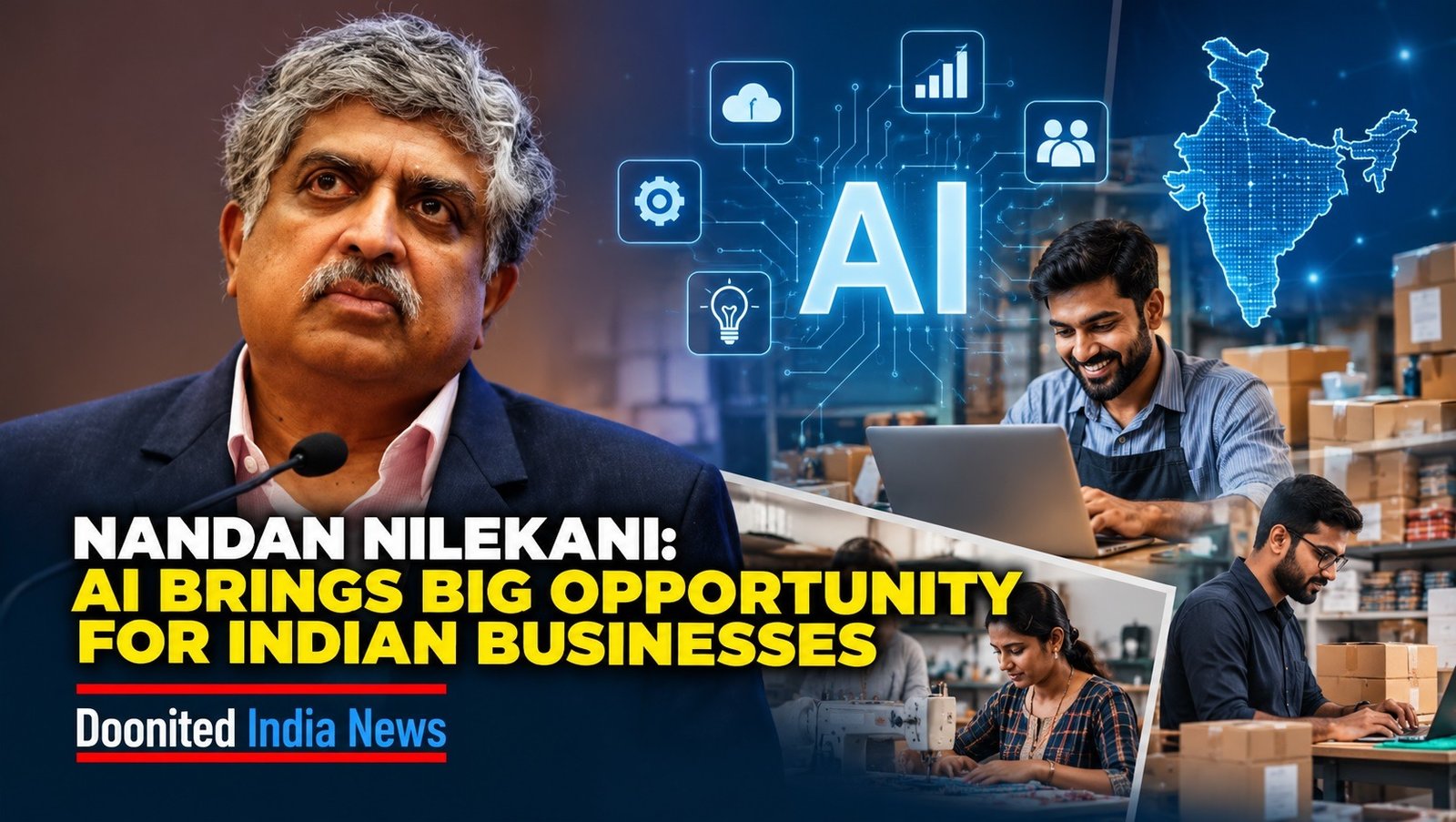
That is the broader idea behind a recent argument by Nandan Nilekani, Infosys co-founder and one of the architects of India’s digital public infrastructure. Speaking at the Bloomberg New Economy Forum in New Delhi on 13 October 2026, Nilekani rejected predictions of widespread job destruction, arguing that AI would create new work as businesses transformed their operations. He acknowledged that tasks such as coding are increasingly automated, but said enterprise transformation also requires people who understand customers, manage change and ensure AI systems work safely and reliably.
His optimism deserves attention. It also deserves scrutiny. AI can help small businesses become more productive, but it does not guarantee that every business will grow or that every worker whose tasks are automated will find a better job.
For India, the crucial question is whether AI can spread beyond large corporations and technology companies to the small enterprises that employ people across towns, industrial clusters and rural markets.
Why small businesses matter to India’s AI future
Micro, small and medium enterprises (MSMEs) form a vast and diverse part of India’s economy. They include manufacturing workshops, food processors, repair businesses, retailers, logistics operators, exporters and professional service providers. Many work with limited capital, small teams and narrow profit margins.
A World Economic Forum playbook, Transforming Small Businesses: An AI Playbook for India’s MSMEs, published in 2025, describes AI as a potential source of productivity, better access to markets and improved business resilience. It estimates that AI could unlock more than $500 billion in economic value for the sector. That figure is a projection of potential value, not revenue already generated by businesses adopting AI.
The scale of the opportunity is easy to understand. A large corporation may employ teams of analysts and software specialists to streamline its operations. A small business often cannot afford those resources. If affordable AI tools can perform some routine tasks, help owners interpret their records or improve customer service, they could make capabilities previously reserved for larger firms more accessible.
But access to software is only the beginning. A business needs reliable data, suitable devices and connectivity, people who understand the tools, and a clear idea of what it wants to improve. Without those foundations, AI can become another subscription expense rather than a source of competitive advantage.
Where AI can make a practical difference
For small businesses, the most promising applications are often specific and measurable.
Manufacturing: AI-supported visual inspection can help identify defects, while predictive systems can flag signs that machinery may need maintenance. These tools can potentially reduce waste and downtime, but their effectiveness depends on the equipment, data quality and production environment.
Retail and distribution: Sales records can help forecast demand, identify slow-moving inventory and improve replenishment decisions. Better forecasting may reduce stockouts and excess inventory, although seasonal demand and sudden market changes still require human judgement.
Customer service and marketing: AI tools can draft product descriptions, translate communications, answer routine questions and help businesses create marketing material in multiple languages. Human review remains important when a response affects pricing, contractual commitments or customer trust.
Accounting and administration: Document extraction, invoice categorisation and summarisation can reduce repetitive work. Businesses must still check financial records, protect sensitive information and ensure that errors do not flow into payments or tax filings.
Exports and supply chains: AI-assisted translation, document preparation and customer research may help smaller firms communicate with overseas buyers. It cannot replace product certification, quality control, reliable delivery or compliance with destination-country rules.
These are plausible use cases, not proof that every business will achieve higher profits. The appropriate test is straightforward: does the tool reduce costs, save staff time, improve quality, increase sales or solve a problem that matters to the customer?
What the evidence says—and what remains unproven
There is growing institutional interest in helping Indian MSMEs adopt AI. In March 2026, PwC India and the Observer Research Foundation published Unlocking the AI Edge for MSMEs, examining AI adoption in manufacturing. The report estimates that AI could contribute $135.6 billion to $149.9 billion to value creation by 2035 under a scenario in which MSMEs account for 50% of India’s manufacturing value added.
That is a scenario-based estimate, not a guaranteed economic outcome. It depends on substantial changes in the role of MSMEs and their ability to adopt and scale useful technology.
The Government of India’s IndiaAI Mission, approved with an outlay of ₹10,371.92 crore, includes initiatives covering computing capacity, datasets, skills, startup financing, application development and safe and trusted AI. The government has identified MSME productivity and competitiveness as areas where AI adoption could make a difference.
These programmes provide an important foundation, but national investment announcements should not be mistaken for proof that small businesses have already achieved measurable gains. To judge results properly, policymakers need evidence from real deployments: how much time a process takes before and after implementation, whether error rates fall, what the technology costs, and whether revenue or profit improves.
There is a further distinction between a successful pilot and sustained adoption. A tool may perform well in a demonstration but fail when faced with incomplete records, local-language variations, inconsistent internet access or the unusual situations that occur in real businesses.
A credible AI success story should disclose the business context, the period measured, the costs involved and the baseline against which improvement is claimed. Without that information, impressive percentage gains can be difficult to interpret.
Will AI create jobs—or reduce the need for workers?
Nilekani’s argument challenges the assumption that automating tasks must result in fewer jobs overall. He points out that introducing AI into a business involves more than generating code or producing automated answers. Organisations must understand their customers, redesign workflows, train staff, monitor performance and manage risk.
Those activities can create demand for new skills and services. Small firms may need people who can configure tools, clean data, review AI outputs, manage customer relationships and integrate software into existing operations. Technology providers and local consultants could also develop businesses helping MSMEs use AI effectively.
Yet it would be premature to conclude that job losses are merely a myth.
AI may reduce the time required for some tasks, and businesses under cost pressure may decide to operate with fewer workers. New roles may emerge in different locations or require skills that displaced workers do not yet have. The transition can therefore be uneven, even if the economy eventually creates new types of work.
The impact will also vary by sector. A small business using AI to answer routine enquiries may be able to serve more customers without expanding its workforce. Another might use the same capability to handle existing demand with fewer staff. A manufacturer may increase output and hire more workers—or use automation to limit recruitment.
Technology alone does not determine which outcome occurs. Demand, competition, management decisions, worker training and access to finance all matter.
The responsible conclusion is neither that AI will eliminate work nor that it will automatically create enough new jobs. India needs to prepare workers for changing tasks while helping businesses find productive uses for the technology.
The adoption gap could widen inequality between businesses
Large firms generally have more resources to experiment with AI, hire specialists and negotiate contracts with technology providers. Many micro-enterprises do not. Their owners may lack the time to compare tools, the confidence to assess claims or the money to absorb a failed implementation.
The World Economic Forum’s MSME playbook identifies access, trust, practical integration and institutional support as important conditions for broader adoption. PwC’s research also highlights risks involving skills, external vendors, data governance and regional disparities.
These barriers have direct consequences. A small business that relies on a poorly chosen AI supplier may become dependent on a tool it cannot easily change. Uploading customer records, supplier contracts or proprietary manufacturing information to an unsuitable service can expose confidential data. An inaccurate automated response may damage a customer relationship or create a costly business error.
Owners should therefore begin with low-risk tasks, check the provider’s data-use terms, limit access to sensitive information and keep a human responsible for important decisions. They should also calculate the full cost, including subscriptions, staff training, integration and ongoing review.
For many businesses, the best first investment may not be an expensive AI platform. It may be organising digital records, improving inventory data or training staff to use a simple tool safely.
What India should do next
If AI is to strengthen small businesses, adoption must be treated as a practical economic development challenge rather than a software-distribution exercise.
First, training should be linked to actual business needs. A workshop for a textile manufacturer should help it understand quality inspection, demand planning or production scheduling—not simply demonstrate how to write prompts. Retailers, accountants, exporters and service providers need equally specific guidance.
Second, MSMEs need access to trustworthy advice. Industry associations, chambers of commerce, technical institutions and local business networks could help owners evaluate vendors, compare costs and learn from deployments in similar businesses. Shared services and cluster-based programmes may make expertise more affordable for smaller firms.
Third, public programmes should measure outcomes. Useful indicators include time saved, defects reduced, customer response times, operating costs, sales and changes in staffing or wages. Results should be tracked over time, with failed pilots included in the learning process rather than hidden behind success stories.
Finally, workers must be part of the transition. Employers should explain how AI will change tasks, offer relevant training and consider redeployment where possible. A productivity gain is more sustainable when employees understand the new system and can contribute to improving it.
The real test of Nilekani’s optimism
Nandan Nilekani is right to focus attention on what happens when AI reaches businesses beyond the technology sector. India’s small enterprises could use it to improve quality, compete for larger contracts, serve customers in more languages and operate with greater efficiency.
But the promise will be realised only if the benefits reach businesses that have limited capital and technical support. It will also require honest measurement of what happens to jobs, wages and working conditions as routine tasks become automated.
The most useful way to assess AI is not by the number of businesses that sign up for a tool, or the number of demonstrations that attract attention. It is by whether businesses become stronger, workers gain useful skills, customers receive better service and productivity improvements translate into wider economic benefits.
AI may help India’s small businesses do more with their resources. The harder task is ensuring that they have the knowledge, infrastructure and bargaining power to use it well—and that the gains are shared rather than concentrated among those already best equipped to benefit.


World Beyond the News
Why Elephants Stay Close to Their Herd
Elephants live in highly social family groups and use calls, touch and body movements to maintain strong bonds.
Most of the Deep Ocean Remains Difficult to Explore
Extreme pressure, darkness and distance make deep-ocean exploration one of Earth’s greatest scientific challenges.
Spacecraft Can Travel Without Traditional Roads
Spacecraft use carefully calculated trajectories and gravity assists to travel enormous distances through space.
Why Movie Trailers Are Released in Stages
Major films often use teaser trailers, full trailers and final promotional spots to build awareness over time.