Little Italy Opens in Lonavala, Bringing Its 35-Year Vegetarian Legacy to a New Destination
Lonavala has never needed much convincing as a weekend destination.
The hills do most of the marketing.
The monsoon does the rest.
Now, however, the popular Maharashtra getaway is getting another reason for travellers to stop, eat and perhaps stay a little longer.
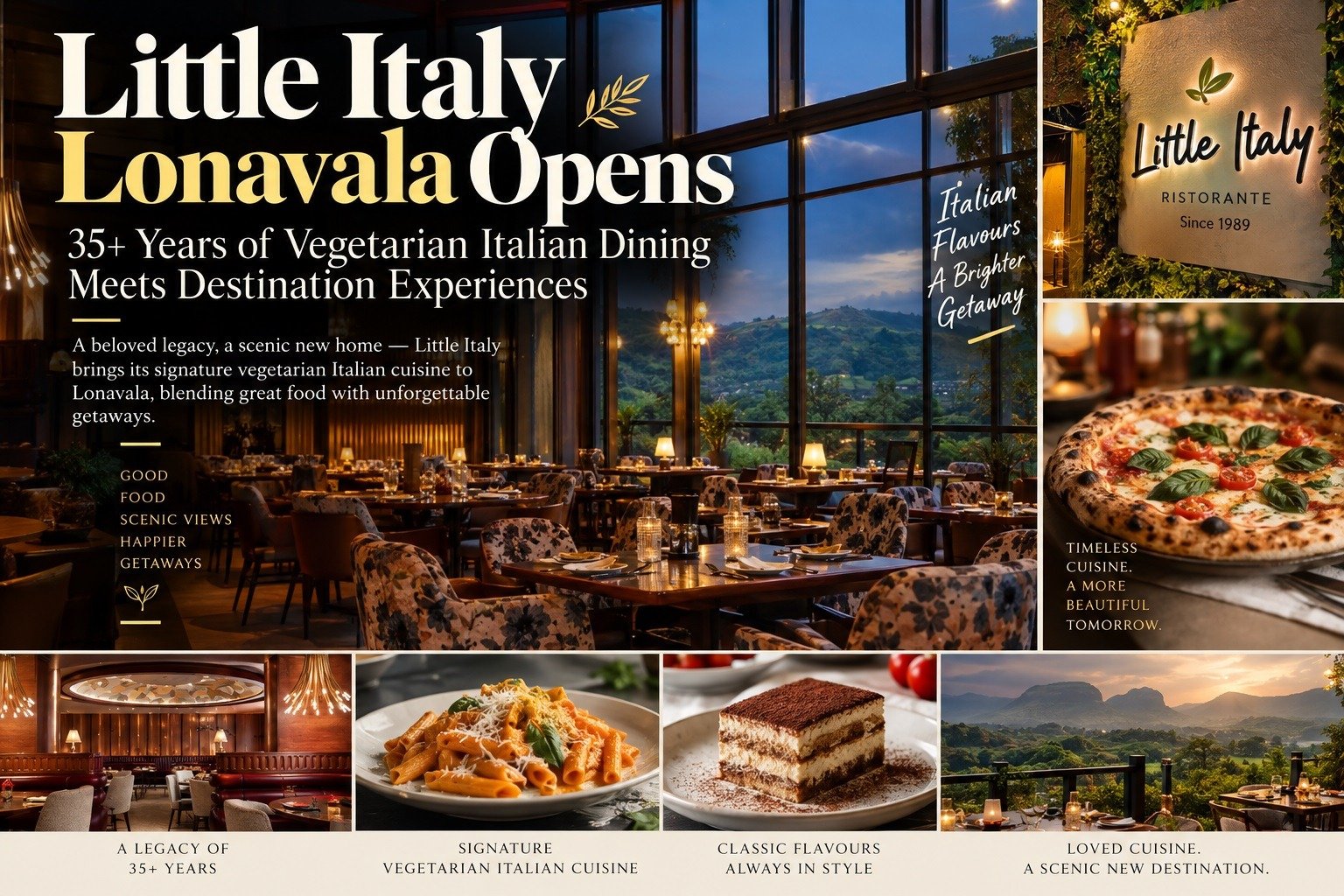
Little Italy has opened a new destination restaurant in Lonavala, marking another chapter for the Indian vegetarian Italian brand that began its journey in Pune in 1989. The new outlet, launched on September 8, occupies more than 11,000 square feet and has seating for approximately 110 guests, alongside indoor and outdoor dining and banquet facilities.
But this is not being positioned simply as another branch of a restaurant chain.
The company is using Lonavala to experiment with something broader: food combined with leisure, activities, events and destination experiences.
And that makes the opening particularly relevant to Maharashtra’s rapidly evolving weekend-travel economy.

From Pune restaurant to national brand
Little Italy’s story began in 1989, when founder Rajesh Mehta launched La Pizzeria in Pune.
The original idea was relatively straightforward but distinctive for its time: offer Indian diners a vegetarian Italian restaurant experience.
More than three decades later, the brand has grown substantially.
Little Italy’s own website currently describes the wider business as having 50+ outlets across 20 cities and four countries, while contemporary reports around the Lonavala opening put the network at more than 45 outlets across 20-plus cities in India and Dubai.
The company has also expanded beyond its original restaurant format into other food and hospitality concepts.
That history makes Lonavala less of a routine outlet opening and more of a test of how an established restaurant brand can evolve with changing consumer behaviour.
Why Lonavala makes sense
Lonavala sits between Mumbai and Pune, two of Maharashtra’s largest urban markets.
That geography is crucial.
A destination restaurant does not necessarily need customers living around the corner.
It needs people willing to drive there.
Families looking for a weekend outing.
Friends escaping the city.
Couples looking for a day trip.
Corporate groups.
Celebrations.
And travellers who have already decided to go to Lonavala and are looking for something beyond the standard highway stop.
Little Italy is clearly targeting that broader audience.
The new restaurant has been designed as a destination for dining and social experiences rather than only as a conventional meal stop.
A restaurant that wants to be more than a restaurant
This is where the new Little Italy Escapes idea enters the picture.
According to the company, the Lonavala property is intended to bring together food, music, leisure and activities, with experiences ranging from workshops and events to other destination-oriented offerings.
The September launch reporting also highlights “The Brundowner – Brunch to Sundown”, a weekend format incorporating activities such as photography and monsoon walks, painting, pottery, pizza-making, pasta experiences, board games, Books & Brews and Chai & Stories.
That is a significant shift in the restaurant business.
The customer is no longer being sold only a plate.
They are being offered a reason to spend several hours at the property.
And perhaps that is exactly what a destination like Lonavala needs.
Italian food remains the anchor
Despite the broader experience, the restaurant’s foundation remains Italian food.
The menu includes pizzas and pastas alongside signature preparations, with the company highlighting dishes including Barberesca, Roman Pizza and Tiramisu.
But the restaurant also offers Asian, Mexican and Indian options.
At first glance, that may seem slightly odd for a restaurant built around Italian food.
But destination dining has a practical problem.
A group of six people rarely arrives with six identical cravings.
One wants pizza.
Another wants pasta.
Someone else has suddenly announced that they “don’t eat Italian.”
And the person who organised the outing now has to solve everybody’s problem.
A wider menu can therefore be less about abandoning culinary identity and more about making group dining commercially viable.
Vegetarian Italian food remains the differentiator
The strongest part of Little Italy’s identity is arguably its vegetarian positioning.
The brand was built around vegetarian Italian cuisine at a time when Italian dining in India was still a relatively specialised proposition.
That legacy continues to distinguish the business.
Its own corporate material describes Little Italy as a home-grown Italian brand specialising in vegetarian cuisine and built around pizzas, pastas, cheeses and related dishes.
That is particularly relevant in India, where vegetarian dining is not a niche requirement but a major part of the restaurant market.
The brand’s longevity suggests that vegetarian Italian food can function as a mainstream restaurant proposition rather than simply a substitute menu.
The Maharashtra connection is stronger than it first appears
There is a satisfying circularity to the Lonavala opening.
Little Italy began in Pune.
It later expanded across India and internationally.
Now it is returning to Maharashtra’s wider destination economy with a format specifically designed around weekend travel.
That creates a natural connection between the brand’s history and its latest expansion.
Lonavala is not an arbitrary location selected simply because another outlet was required on a map.
It sits within the same broader Maharashtra food-and-travel ecosystem in which the brand first developed.
The bigger shift: India’s destination dining economy
The Lonavala opening also reflects a wider change in the way Indians use restaurants.
Eating out is increasingly becoming part of leisure.
A restaurant can be a place to celebrate, work remotely, spend an afternoon, attend a workshop, meet friends or simply escape the routine of the city.
Destination restaurants are particularly suited to this behaviour.
They can combine food with landscape, activities and social occasions.
For Lonavala, that model makes sense because the town already attracts visitors specifically looking for a break from Mumbai and Pune.
The challenge is turning the restaurant into part of that getaway rather than merely another stop along the way.
But experience cannot rescue mediocre food
There is a danger in the current “experience economy.”
Restaurants can become so focused on décor, activities, Instagram moments and event programming that the actual food becomes secondary.
That would be a mistake.
A pottery session may entertain the customer.
A monsoon walk may create memories.
A beautifully designed dining room may generate photographs.
But eventually someone will ask the most brutally simple restaurant question:
“Was the food good?”
For Little Italy, its 35-plus-year culinary history gives it an advantage — but also creates an expectation.
An established restaurant brand has to maintain consistency as it expands.
The more locations a brand operates, the harder that becomes.
There is another business challenge
Lonavala is seasonal.
The monsoon creates extraordinary demand, but destination businesses have to work through quieter periods too.
That makes the broader experience strategy commercially interesting.
If customers have reasons to visit beyond a meal — workshops, events, celebrations, family activities and weekend programming — the restaurant can potentially reduce its dependence on a single dining occasion.
That is likely one of the more important ideas behind Little Italy Escapes.
The destination becomes the product.
Food becomes the anchor.
DOONITED Editorial Perspective: The future restaurant may be somewhere between a café and a holiday
The interesting part of Little Italy’s Lonavala move is not simply the size of the property.
It is the attempt to change what a restaurant means.
For decades, the basic model was simple:
Come in. Eat. Pay. Leave.
The new destination model is different:
Come in. Eat. Stay. Experience something. Meet people. Celebrate. Return.
That does not mean every restaurant needs to become a resort.
Nor should every plate require a side of “curated experience.”
But in destination markets such as Lonavala, combining food with activities can create a stronger reason to travel.
Little Italy is therefore testing whether a restaurant brand can become part of the weekend itself.
That is a much bigger proposition than opening another dining room.
The bigger takeaway
Little Italy’s Lonavala opening tells a useful story about both food and Maharashtra.
A restaurant brand that began in Pune in 1989 is now using another Maharashtra destination to explore the next stage of its growth.
The new property combines a 35-plus-year vegetarian Italian legacy with a more contemporary idea of destination hospitality.
It offers food.
It offers space.
It offers events.
It offers activities.
And it is designed around the simple fact that people increasingly want their weekend outing to be more than lunch.
Whether the model succeeds will depend on the fundamentals — food quality, service, pricing, consistency and the ability to generate repeat visits outside peak seasons.
But the concept is worth watching.
Because India’s restaurant industry is slowly discovering something the travel industry has known for years:
People don’t always travel for the destination alone. They travel for the experience they expect to have there.
And in Lonavala, Little Italy is betting that a good pizza, a long afternoon and a little mountain air can make a rather convincing weekend.
DOONITED Reader Insight
For travellers from Mumbai and Pune, destination dining is becoming part of the weekend itinerary rather than an afterthought.
The useful question is no longer simply “Where shall we eat?”
It is increasingly:
“Where can we spend a good part of the day?”
Little Italy Lonavala is an example of how restaurants are adapting to that shift — turning dining spaces into broader leisure destinations while using food as the central reason to arrive.

World Beyond the News
Bees Communicate Where Food Is
Honeybees use movement patterns known as waggle dances to communicate information about food locations.
Street Food Reflects Local History
Many famous street foods developed from migration, trade, local ingredients and the everyday needs of working communities.
A Day on Venus Is Extremely Long
Venus rotates so slowly that one rotation relative to distant stars takes longer than its trip around the Sun.
Human Achievement Continues to Push Limits
Athletes, engineers, scientists and explorers regularly establish new benchmarks in speed, endurance, scale and precision.