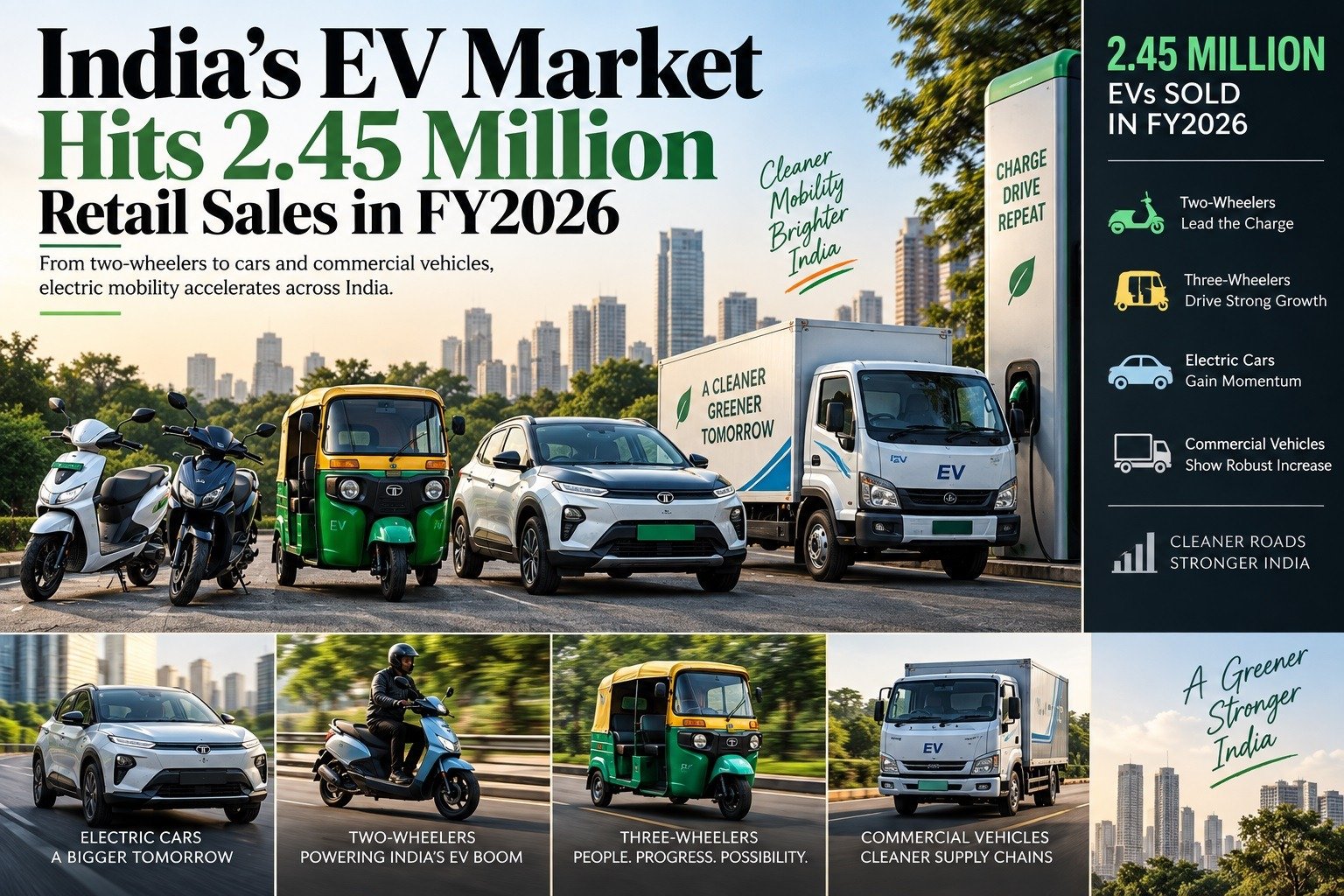
India’s EV Market Crosses 2.45 Million Sales as Electric Mobility Moves Into the Mainstream
India’s electric vehicle market crossed 2.45 million retail sales in FY2026, marking a 25% year-on-year increase and showing that electric mobility is moving beyond an early-adopter experiment into a much broader transport market.
For years, India’s electric-vehicle story was usually told through announcements: new factories, new battery plants, new charging stations and ambitious targets.
FY2026 provided something more concrete — buyers actually bought the vehicles.
According to Vahan-derived retail data analysed by Autocar Professional, India sold 2,452,921 electric vehicles across two-wheelers, three-wheelers, passenger vehicles and commercial vehicles during FY2026, compared with 1,967,547 in FY2025. EVs consequently increased their share of India’s overall automobile sales to 8.27%, from 7.52% a year earlier.
That is not yet an all-electric India. But it is no longer a niche market either.
Two-wheelers remain the electric workhorse
The biggest contributor was the electric two-wheeler.
India sold approximately 1.40 million electric two-wheelers in FY2026, up 22% from the previous year. That gave electric scooters and motorcycles a 57% share of total EV sales. Electric two-wheelers also reached a 6.54% penetration rate within India’s overall two-wheeler market.
The significance goes beyond the headline number.
Two-wheelers are among India’s most practical urban mobility tools. They are relatively inexpensive, require less parking space and are heavily used for commuting and commercial activity. For many consumers, therefore, switching from a petrol scooter to an electric one does not require rethinking their entire lifestyle.
It can be as simple as changing what gets plugged in at night.
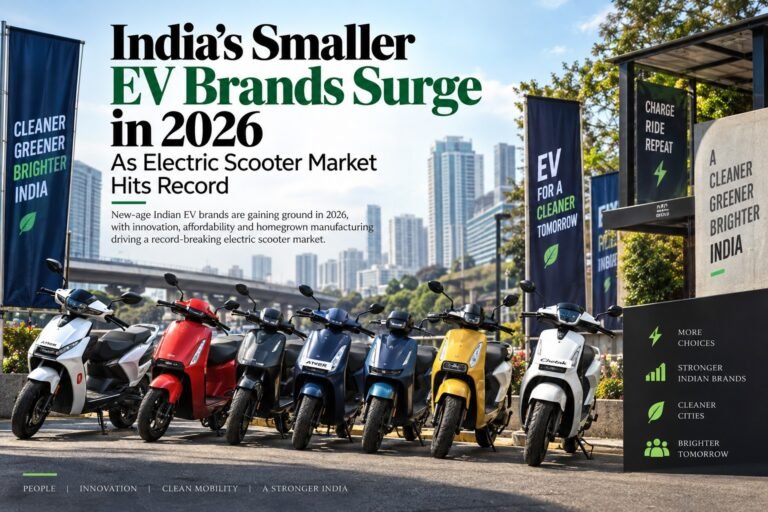
The market also became more competitive. TVS Motor, Bajaj Auto and Ather Energy were among the leading electric two-wheeler players in FY2026, while the sector continued to see competition from established manufacturers and newer EV specialists.
The three-wheeler revolution is arguably even more important
If two-wheelers dominate the numbers, electric three-wheelers tell another important Indian story: commercial economics can accelerate electrification.
India sold 830,818 electric three-wheelers in FY2026, up 19% year on year. Electric three-wheelers accounted for roughly 34% of India’s total EV sales, while their penetration within the overall three-wheeler market reached about 61%.
That matters because the vehicle is not merely a personal transport choice. It is frequently an income-generating asset.
For drivers and fleet operators, fuel expenditure directly affects the economics of every working day. That makes operating cost a powerful reason to consider electrification.
Mahindra Last Mile Mobility, Bajaj Auto and TVS Motor were among the significant players in this segment, with Mahindra Last Mile Mobility crossing 100,000 electric three-wheeler sales during the fiscal year.
Electric cars are finally gaining serious scale
Passenger vehicles remain a smaller part of India’s EV market, but their growth rate is striking.
Electric passenger-vehicle retail sales reached approximately 199,952 units in FY2026, representing growth of around 84% year on year. Maharashtra alone accounted for more than 34,000 electric passenger vehicles, or about 17% of India’s total, according to Vahan-derived data.
Tata Motors remained the largest electric passenger-vehicle seller in FY2026, with 78,811 units, followed by JSW MG Motor India with 53,089. The numbers show that the electric-car market is becoming more competitive as additional manufacturers and models enter the field.
This is particularly important because cars have historically presented a tougher EV proposition than scooters.
They cost more, typically travel longer distances and create greater expectations around charging convenience, highway infrastructure, battery range and after-sales support.
The fact that sales are nevertheless rising rapidly suggests that a section of Indian car buyers is increasingly willing to make that transition.
Commercial EVs are small — but growing very fast
The commercial-vehicle segment remains tiny in absolute terms compared with two- and three-wheelers.
But its growth rate deserves attention.
India sold 19,648 electric commercial vehicles in FY2026, up 122% from 8,840 in FY2025. Electric light goods carriers alone increased 167%, reflecting growing interest in electrification for urban and last-mile logistics.
This is where India’s e-commerce and delivery economy could become an important part of the EV story.
Delivery vehicles spend much of their working lives on the road. Consequently, the economics of electricity versus petrol or diesel can matter considerably more to a fleet operator than it does to an occasional private driver.
Companies such as Tata Motors, Mahindra Last Mile Mobility, Switch Mobility and Euler Motors are already competing in this emerging commercial market.
The important number is not 2.45 million alone
There is a temptation to look at 2.45 million EV sales and declare that India’s electric transition has arrived.
The data says something more interesting.
India’s EV transition is happening unevenly.
Two-wheelers and three-wheelers are already doing much of the heavy lifting. Passenger cars are growing rapidly from a smaller base. Commercial vehicles are still a small market, although their growth rate is substantial.
That distinction matters because the challenges are different.
A scooter owner needs convenient home or neighbourhood charging. A taxi operator needs dependable fast charging and predictable range. A delivery fleet needs charging infrastructure, vehicle uptime and financing. A long-haul commercial operator needs an entirely different ecosystem.
One charging strategy cannot solve all four problems.
The next battle is infrastructure — and trust
Sales growth is encouraging, but the EV industry now faces a more demanding phase.
Consumers will increasingly judge manufacturers not simply by range figures printed in brochures but by battery durability, service quality, software reliability, charging availability, resale value and total ownership cost.
The industry will also need to expand charging infrastructure alongside vehicle sales. Manufacturing capacity alone cannot create an electric mobility ecosystem.
There is another challenge: competition is becoming more serious.
The rapid rise of smaller electric two-wheeler manufacturers shows that the market is opening up, but established manufacturers still command a large proportion of sales. Recent 2026 data also shows smaller companies such as Greaves Electric Mobility, River Mobility, Bgauss and Simple Energy increasing their volumes, while larger players continue expanding capacity and product ranges.
That competition can ultimately benefit consumers — but only if companies can support the vehicles after the sale.
DOONITED VIEW: India’s EV story is becoming less about technology and more about economics
The most revealing lesson from FY2026 may be that Indians are not buying EVs simply because they are electric.
They are buying them when the economics, convenience and product proposition make sense.
That is why the strongest adoption is visible in two- and three-wheelers, where daily utilisation is high and running costs matter. Passenger cars are now following as products improve and the model choice expands.
The electric transition, therefore, should not be measured only by how many new EV models manufacturers announce.
A better question is much more ordinary:
Can an Indian consumer or business run the vehicle reliably, affordably and conveniently every day?
The 2.45 million sales recorded in FY2026 suggest that, for a rapidly growing part of the market, the answer is beginning to become yes.
The real test will be whether India’s charging network, manufacturing ecosystem, battery supply chain and after-sales infrastructure can grow at the same speed as consumer adoption.
Because India’s EV revolution will ultimately be won not in conference halls, but on India’s streets, delivery routes, highways and daily commutes.

World Beyond the News
Why Elephants Stay Close to Their Herd
Elephants live in highly social family groups and use calls, touch and body movements to maintain strong bonds.
Most of the Deep Ocean Remains Difficult to Explore
Extreme pressure, darkness and distance make deep-ocean exploration one of Earth’s greatest scientific challenges.
Spacecraft Can Travel Without Traditional Roads
Spacecraft use carefully calculated trajectories and gravity assists to travel enormous distances through space.
Why Movie Trailers Are Released in Stages
Major films often use teaser trailers, full trailers and final promotional spots to build awareness over time.