BMW’s September Offensive Brings New Electric and Luxury Models to India
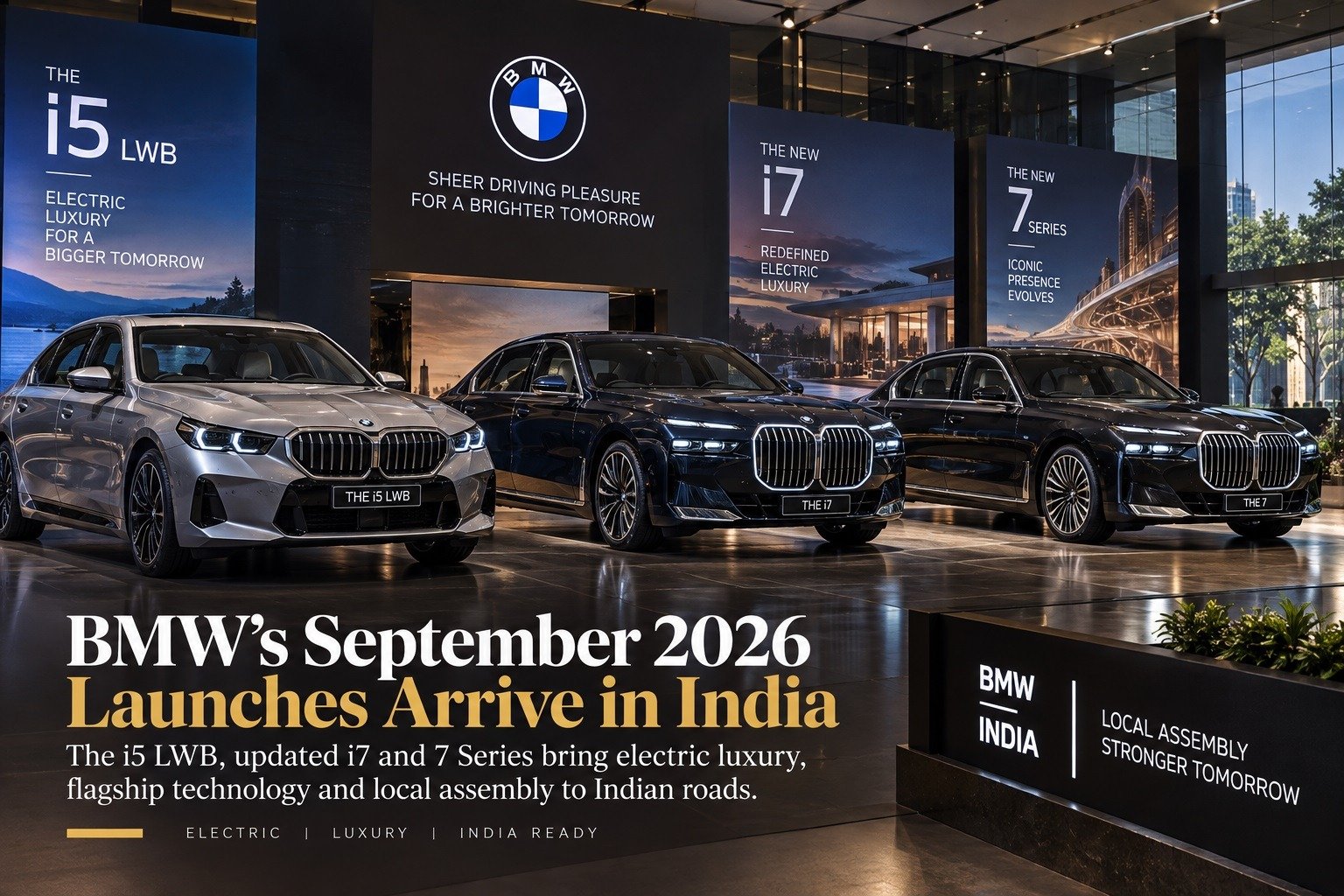
BMW has turned September 2026 into a significant product month in India, launching the locally assembled i5 LWB before bringing updated versions of its flagship 7 Series and i7. The strategy places electrification, rear-seat luxury and local manufacturing at the centre of BMW’s Indian portfolio.
September is usually associated with festive-season buying, new-car offers and manufacturers trying to put shiny things in showrooms before the year-end rush.
BMW, however, appears to have chosen a slightly more expensive way of making the month interesting.
In the first half of September, the German luxury carmaker introduced the BMW i5 LWB, followed days later by the updated BMW 7 Series and BMW i7. Together, the launches show how BMW is approaching India’s premium-car market: not by choosing between conventional luxury and electric mobility, but by developing both alongside each other.
And there is a distinctly Indian element to the strategy.
The i5 LWB: electric, longer and made in India
BMW launched the i5 LWB on September 7 at an introductory ex-showroom price of ₹79.6 lakh. More importantly for the Indian market, it is assembled at BMW Group’s Chennai plant, making it the company’s first locally produced electric sedan in India.
The LWB — or Long Wheelbase — designation is not merely automotive alphabet soup.
The i5 LWB gets a wheelbase that is 110mm longer than the standard i5, creating additional rear-seat space. That is particularly relevant in India, where luxury sedans are often evaluated not only by the person behind the wheel but also by the people sitting behind them.
Underneath, the i5 LWB uses an 81.6kWh battery and a rear-mounted electric motor producing 268hp and 410Nm. BMW claims a 669km MIDC range, while 10–80% DC charging is claimed to take about 33 minutes using a 160kW charger.
The car therefore combines three things that increasingly matter in India’s premium EV market: substantial rear-seat space, long claimed range and local assembly.
There is also a curious pricing story.
At ₹79.6 lakh, the i5 LWB is around ₹3 lakh more expensive than the petrol 530Li M Sport, according to Autocar India’s September comparison. That makes the electric alternative less about being the cheapest way into a BMW and more about giving luxury buyers another type of powertrain.
Then came the flagships
Four days after the i5 LWB launch, BMW introduced the updated 7 Series and i7 on September 11.
The facelifted BMW 7 Series starts at ₹1.95 crore ex-showroom in India and is offered with a 3.0-litre six-cylinder turbo-petrol engine paired with a 48-volt mild-hybrid system. BMW has also retained local assembly of the 7 Series at its Chennai facility.
The changes are not limited to a new grille and a few lines in the brochure.
The refreshed 7 Series receives updated exterior styling and a significantly revised cabin, including BMW’s newer display and infotainment architecture, a 14.6-inch passenger display and a large 31.3-inch 8K rear entertainment screen.
In this segment, rear-seat technology has become almost a competitive sport.
The person sitting in the back may not care about 0–100kph times, but apparently an 8K cinema screen is becoming a perfectly reasonable way to pass the time while someone else drives.
The i7 makes the electric argument at another level
The updated BMW i7 arrived alongside the 7 Series, starting at ₹1.95 crore ex-showroom for the 50 xDrive M Sport, while the range-topping M70 xDrive is priced at ₹2.65 crore.
The i7 50 xDrive uses a 112.5kWh battery and dual electric motors. BMW quotes 455hp and 600Nm, a claimed 0–100kph time of 5.5 seconds and a 728km WLTP range. The M70 takes performance considerably further, with BMW quoting 680hp and up to 1,100Nm using Sport Boost.
There is an important qualification for Indian buyers, however.
The 728km figure is a WLTP figure, not an India-certified figure. WLTP and India’s certification methodology are not directly interchangeable, so buyers should not interpret the international range number as a guaranteed real-world Indian driving range. Current reporting notes that BMW India had not published an India-certified range figure for the facelifted i7 at launch.
That distinction may sound technical, but it is precisely the sort of detail that matters when a luxury EV costs around ₹2 crore.
Why local assembly matters
Perhaps the most consequential part of BMW’s September strategy is not the number of screens or the acceleration figures.
It is local manufacturing.
The i5 LWB is assembled in Chennai, and the i7 50 xDrive and 7 Series are also locally assembled, while the higher-performance i7 M70 comes to India as a completely built unit.
For India, this matters because localisation can influence pricing, supply and the manufacturer’s ability to build a sustained business around a model.
BMW has already established a manufacturing footprint in India. The September launches show that the company is increasingly using that infrastructure not just for conventional luxury cars but also for electric products.
That is a subtle but important shift.
The question is no longer whether luxury EVs will be imported into India. The more interesting question is how much of the premium EV portfolio can eventually be built here.
India’s luxury market is changing — but slowly
BMW’s strategy also reflects a broader reality about India’s automobile market.
Electric vehicles are growing rapidly overall, but luxury EV adoption operates in a different economic universe. Buyers in this segment are not necessarily making their purchase primarily because electricity is cheaper than petrol.
They are buying a combination of performance, technology, comfort, brand identity and, increasingly, electric propulsion.
That means the premium EV battle will be fought on considerably more than range.
Charging convenience, service capability, software, battery warranty, resale expectations and the quality of the ownership experience will become increasingly important.
A ₹2-crore electric sedan cannot simply be a good EV. It has to deliver the expectations associated with a ₹2-crore luxury car.
DOONITED VIEW: BMW is selling two futures at once
BMW’s September launches reveal an interesting strategy.
The company has not attempted to force Indian luxury buyers into an all-electric future overnight.
Instead, it has put a petrol mild-hybrid 7 Series and fully electric i7 next to each other, while positioning the locally assembled i5 LWB below them.
That gives customers different routes into the same broad luxury ecosystem.
For BMW, this flexibility may be valuable in a market where EV adoption is growing but charging infrastructure, consumer habits and long-distance travel patterns are still evolving.
The more significant development may therefore be the i5 LWB.
The 7 Series and i7 demonstrate what BMW’s flagship technology looks like. The i5 LWB demonstrates something more practical: BMW is willing to manufacture an electric luxury sedan in India for the Indian market.
That is a more meaningful statement about the country’s automotive future than another spectacular acceleration figure.
India’s premium-car market may still be small compared with the mass market, but it is becoming an important testing ground for how global luxury manufacturers combine electrification with localisation.
BMW’s September offensive is, in that sense, not simply about three new cars.
It is about giving Indian luxury buyers a choice between two powertrains, multiple interpretations of luxury and one increasingly important manufacturing base in Chennai.

World Beyond the News
Why Elephants Stay Close to Their Herd
Elephants live in highly social family groups and use calls, touch and body movements to maintain strong bonds.
Most of the Deep Ocean Remains Difficult to Explore
Extreme pressure, darkness and distance make deep-ocean exploration one of Earth’s greatest scientific challenges.
Spacecraft Can Travel Without Traditional Roads
Spacecraft use carefully calculated trajectories and gravity assists to travel enormous distances through space.
Why Movie Trailers Are Released in Stages
Major films often use teaser trailers, full trailers and final promotional spots to build awareness over time.