India’s Mental Health Conversation Is Changing — But Can the Healthcare System Keep Up?
India is talking about mental health more openly than it once did. The harder question is whether the country’s healthcare system can expand quickly enough to turn that changing conversation into accessible, affordable and continuous care.
For a long time, mental health in India existed in an uncomfortable space between private suffering and public silence.
A person could discuss diabetes, blood pressure or a broken bone without much hesitation. Anxiety, depression, addiction or suicidal thoughts were often treated differently — sometimes as a family matter, sometimes as a personal weakness and sometimes simply as something that should not be discussed outside the home.
That culture is changing.
Mental health has moved into schools, workplaces, universities, social media, public-health campaigns and increasingly ordinary family conversations. Government programmes have expanded, digital counselling has become more visible and the Mental Healthcare Act, 2017 established a rights-based legal framework for mental healthcare.
But awareness has moved faster than capacity.
And that may be India’s next mental-health challenge.
From “Don’t Talk About It” to “Where Can I Get Help?”
The change in conversation matters because stigma is not merely a social inconvenience.
It can delay diagnosis, discourage treatment and turn a manageable condition into a more complicated one.
India’s National Mental Health Survey 2015–16, conducted by NIMHANS, estimated that about 10.6% of adults were living with mental disorders at the time of the survey. Government material citing the survey also reports a treatment gap of approximately 70% to 92%, depending on the disorder.
In other words, the problem has never simply been that Indians do not recognise mental illness.
The problem has also been what happens after recognition.
A person may finally say, “I need help,” and then discover that the nearest specialist is far away, the waiting period is long, the consultation is expensive or the family does not know where to begin.
Awareness opens the door.
Healthcare capacity determines whether there is actually a room behind it.
The Specialist Shortage Remains a Structural Problem
India’s mental-health workforce has expanded, but the gap remains substantial.
Government material citing research published in the Indian Journal of Psychiatry has put India’s psychiatrist availability at around 0.75 psychiatrists per 100,000 population, compared with a WHO reference of at least three psychiatrists per 100,000. Because the underlying workforce study is older, the figure should be understood as evidence of structural shortage rather than a precise 2026 census.
And psychiatry is only one part of the system.
Mental healthcare also depends on clinical psychologists, psychiatric social workers, psychiatric nurses, counsellors, primary-care doctors, community workers and trained caregivers.
That makes the workforce question bigger than simply asking, “How many psychiatrists does India have?”
The more useful question is:
How many people can provide appropriate mental-health support at the level where ordinary Indians actually seek healthcare?
That answer increasingly points toward primary care.
Mental Healthcare Cannot Remain a Specialist-Only Service
India has been moving in this direction.
The District Mental Health Programme (DMHP) has been sanctioned for implementation in 767 districts, with services designed to extend into Community Health Centres and Primary Health Centres. These include outpatient care, assessment, counselling and psychosocial interventions, continuing support for people with severe mental disorders, medicines and outreach.
Mental-health services have also been incorporated into comprehensive primary healthcare delivered through Ayushman Arogya Mandirs.
This is important because not every person experiencing psychological distress needs to begin with a tertiary psychiatric hospital.
Sometimes the first point of contact is a family doctor.
Sometimes it is a school counsellor.
Sometimes it is an ASHA worker, teacher, nurse, workplace supervisor or family member who notices that something has changed.
The healthcare system needs to make those first contacts useful rather than forcing every problem toward an already limited specialist pool.
Tele-MANAS Is Showing What Digital Scale Can Look Like
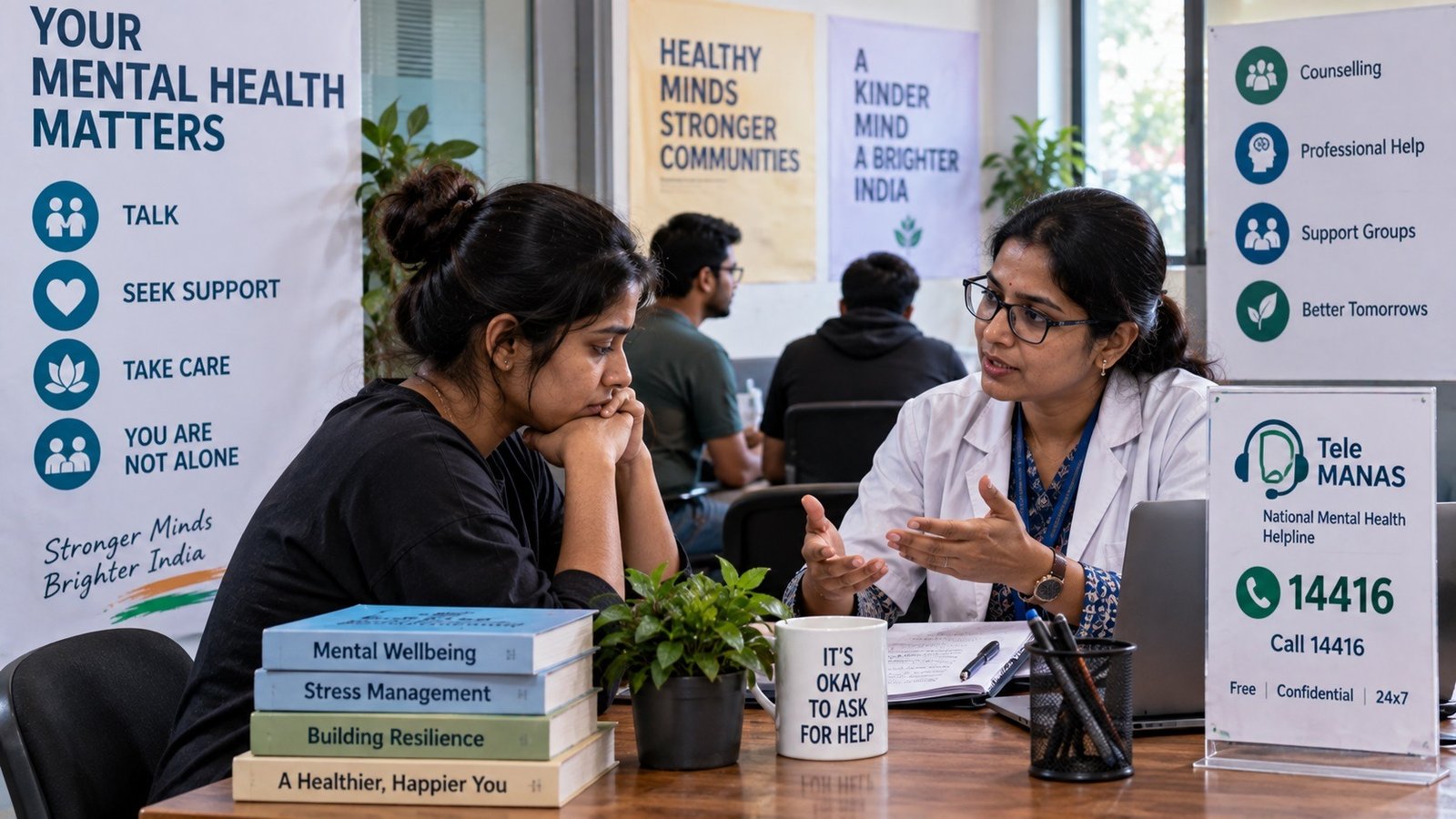
One of the clearest examples of India’s attempt to bridge the access gap is Tele-MANAS, the government’s national tele-mental-health programme launched in October 2022.
As of 11 August 2026, government data reported that Tele-MANAS had received 43.64 lakh calls since launch. The service operates through 53 Tele-MANAS Cells across all 36 States and Union Territories and is available in 20 languages.
That scale is significant.
The programme has also developed beyond a simple telephone helpline. Its mobile application provides mental-health information and support, while video consultation has been introduced as an additional route to professional care. Earlier 2026 government data showed that Tele-MANAS was also making referrals to in-person services and mental-health professionals.
But there is an important lesson here.
A helpline is an entry point, not the entire healthcare system.
If a caller requires long-term therapy, psychiatric treatment, medication management, rehabilitation or emergency intervention, the system needs somewhere appropriate to send that person.
Digital access without physical follow-through can become a very sophisticated waiting room.
Young Indians Are Bringing Mental Health Into the Mainstream
India’s youth are also changing the conversation.
Academic pressure, employment uncertainty, social comparison, relationship problems, family expectations and constant digital connectivity have made psychological wellbeing a more visible part of young people’s lives.
But the public conversation needs some discipline here too.
Not every period of stress is a psychiatric disorder. Not every bad day is depression. And not every teenager who spends too much time on a phone has a clinical condition.
The opposite mistake is equally serious: dismissing persistent anxiety, depression, self-harm, severe behavioural changes or suicidal thoughts as “just stress.”
The sensible approach is neither to medicalise ordinary life nor to trivialise genuine distress.
It is to make early recognition and professional assessment easier.
The government’s own programmes increasingly recognise this need. Mental-health and emotional-wellbeing components have been incorporated into the School Health and Wellness Programme, while Manodarpan provides psychosocial resources for students, teachers and families.
The Mental Healthcare Act Changed the Conversation — But Implementation Matters
The Mental Healthcare Act, 2017 represented an important shift in India’s legal approach to mental healthcare.
It established rights-oriented provisions concerning access to mental healthcare and treatment, confidentiality, advance directives, nominated representatives and protection of people receiving mental-health services.
But legislation cannot by itself create psychiatrists, counsellors, beds, medicines or community services.
That is where implementation becomes decisive.
India now has a framework.
The unfinished task is making that framework equally meaningful in a district hospital, a small town, a university campus and a rural community.
Funding Is Only One Part of the Equation
Mental health has historically occupied a relatively small place within India’s overall health expenditure.
But simply announcing a larger allocation would not solve everything.
Money has to translate into trained personnel, functioning district programmes, medicines, counselling services, referral networks, emergency response and reliable follow-up.
The government has indicated a further expansion of advanced mental-health infrastructure, including the establishment of NIMHANS-2 and strengthening existing institutions for clinical care, training, research and innovation.
That is important at the tertiary end of the system.
At the other end, however, India must make sure that someone with a mental-health problem does not have to travel hundreds of kilometres before encountering a trained professional.
The Next Revolution May Be Normalising the First Conversation
India’s mental-health transformation is therefore not simply about removing stigma.
It is about building a system in which saying “I need help” produces a practical next step.
That means strengthening district mental-health services, integrating mental healthcare into primary care, expanding the professional workforce, improving school and workplace support, building reliable referral systems and using telemedicine to overcome geography.
It also means recognising that mental healthcare is not one-size-fits-all.
A college student experiencing acute anxiety, a farmer dealing with prolonged distress, a new mother experiencing depression, an older person living with loneliness and cognitive decline, and someone requiring specialist psychiatric treatment may all enter the system differently.
The system needs enough flexibility to meet them where they are.
DOONITED View: The Stigma Conversation Was Only Act One
India deserves credit for making mental health more discussable.
But conversation is the beginning, not the destination.
There is a slightly amusing contradiction in the way modern India approaches mental health: we have become extraordinarily comfortable telling strangers on the internet about our sleep, productivity, relationships and “wellness journeys” — while some families still become uncomfortable when someone asks for a psychologist.
That contradiction is gradually weakening.
The next challenge is harder.
India must convert awareness into infrastructure.
Tele-MANAS demonstrates that technology can bring the first point of contact closer to millions. The District Mental Health Programme shows that mental healthcare can be embedded closer to communities. New investments in specialist institutions can strengthen the top of the system.
But these pieces have to connect.
The real measure of progress will not be how many awareness campaigns India conducts or how many people download a mental-health application.
It will be whether an ordinary person — in a village, a small town or a major city — can recognise a problem, ask for help, find an appropriate professional, afford the care and continue receiving support.
That is when mental healthcare will have moved from conversation to capacity.
Learning Point
India does not need to choose between awareness and infrastructure. It needs both.
A society that talks openly about mental health but cannot provide care leaves people frustrated.
A healthcare system that provides services but remains surrounded by stigma leaves people silent.
The next phase of India’s mental-health journey must connect the two:
less shame, earlier recognition, stronger primary care, more professionals, better referrals and continuous support.
That is not merely a mental-health policy.
It is a public-health investment in India’s people and its future.


World Beyond the News
Octopuses Can Change Their Appearance
Octopuses can rapidly alter their skin colour and texture to communicate, camouflage themselves and respond to danger.
Some Cities Exist Across Two Continents
A small number of cities are geographically associated with two continents, creating unusual cultural and geographic identities.
Earth’s Climate Is Measured in Many Ways
Scientists track temperature, atmospheric gases, sea level, ice cover and other indicators rather than relying on a single climate number.
Streaming Changed How Audiences Discover Shows
Recommendation systems and global streaming releases allow audiences to discover programmes far beyond their original markets.