Eating Kolkata During Durga Puja: A Festival Built Around Food, Community and Memory
There are cities you visit to see.
And then there is Kolkata during Durga Puja — a city you almost have to eat to understand.
The lights come on, the dhaak begins, neighbourhoods turn into temporary works of art and millions of people move from one pandal to another. Somewhere along that journey, someone is inevitably asking the most important question of the evening:
“Kheyechho?” — Have you eaten?
During Durga Puja, food is not merely something that happens between rituals and pandal-hopping.
It is part of the festival’s memory.
Kolkata’s Durga Puja is recognised by UNESCO as an Intangible Cultural Heritage, while West Bengal Tourism describes the festival as the state’s biggest celebration, with months of preparation going into idols, pandals, lighting and community events.
In 2026, the main days of Kolkata’s Puja fall in October, with Saptami on October 18, Ashtami on October 19, Navami on October 20 and Dashami on October 21.
But for anyone experiencing the festival through food, the calendar tells only half the story.
The other half is served on a banana leaf, in a steel plate, inside a family kitchen, at a neighbourhood pandal — or wrapped in paper at one o’clock in the morning.
Bhog: Where Food Becomes Community
The most meaningful place to begin is bhog.
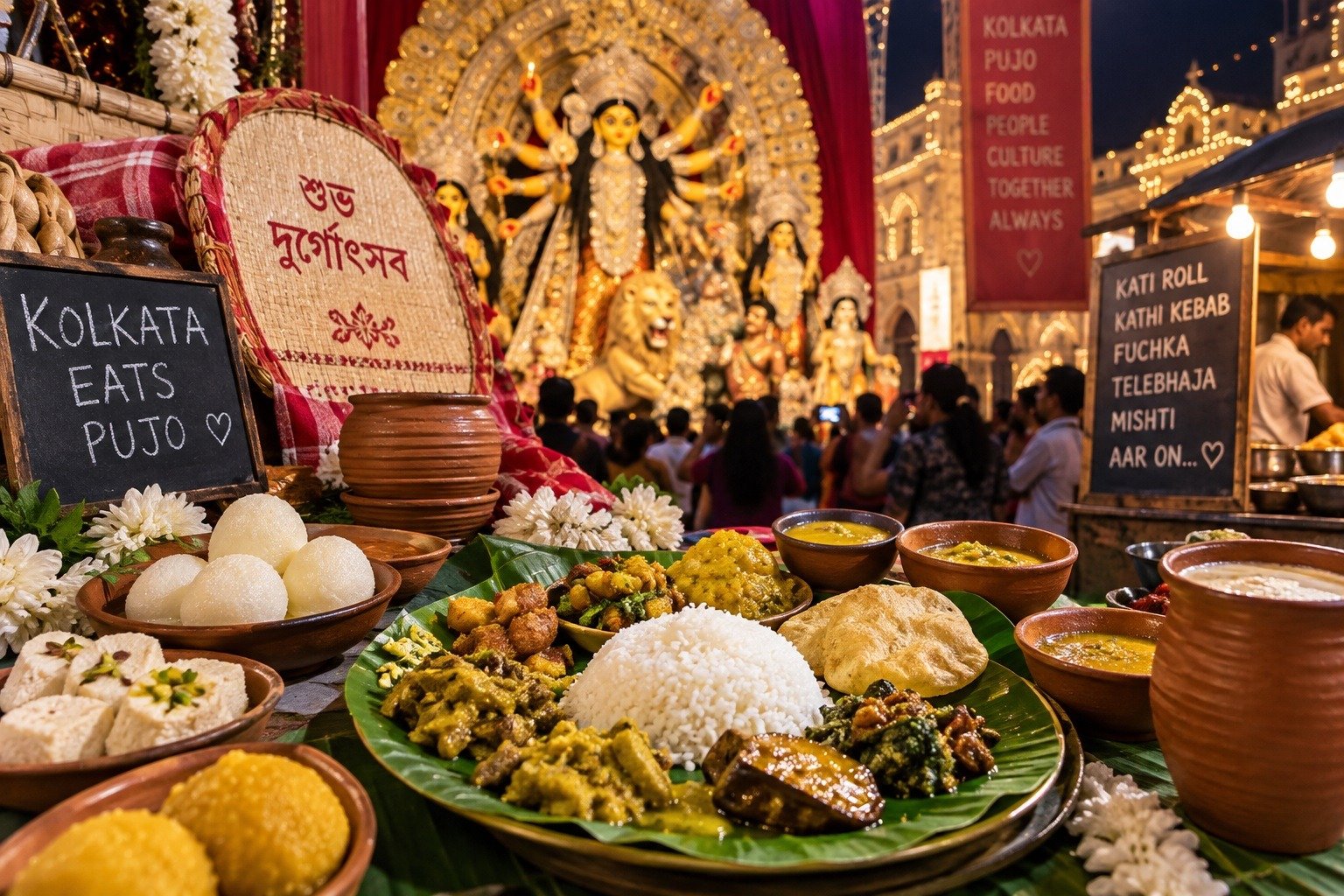
Bhog is food prepared as an offering during worship and subsequently distributed as a communal meal. At many community pujas, it traditionally becomes an important part of the festival experience.
A typical bhog may feature khichuri, vegetable preparations, chutney, sweets and payesh, although the precise menu varies from one Puja to another.
The simplicity is part of its appeal.
You do not need an elaborate restaurant table.
You may simply sit among strangers, volunteers and neighbours and eat the same food.
That makes bhog fundamentally different from a restaurant meal.
At a restaurant, you are a customer.
At bhog, you are part of the gathering.
And perhaps that is why people remember it so vividly.
The food may be simple, but the setting gives it a different flavour.
Bengali Food Has Never Been One Menu
It is tempting to describe Bengali Puja food as though every household follows one standard menu.
It does not.
Food traditions vary according to family, community, region and the particular Puja being observed.
The contrast between public bhog and historic bonedi bari traditions is especially revealing.
West Bengal Tourism’s own cultural material records examples of historic family Pujas where elaborate offerings have included rice, Basanti pulao, khichuri, vegetables, fish preparations, payesh and sweets. At some traditional households, distinctive Dashami offerings and particular fish preparations form part of inherited rituals.
Recent reporting has likewise documented historic Bengali families continuing long-established traditions involving fish or other non-vegetarian offerings.
The important point is not to turn these differences into a debate about what is “correct.”
They demonstrate something more interesting:
Bengal’s food culture is diverse enough to accommodate different ritual traditions without reducing them to one template.
Then Comes the Street
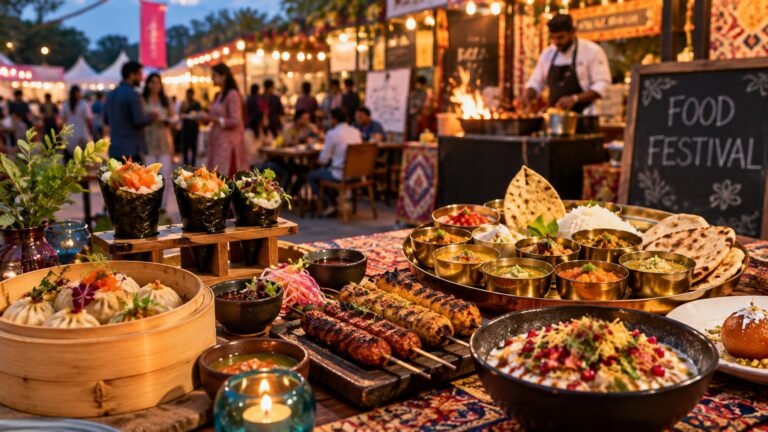
Once the formal part of the Puja experience gives way to pandal hopping, Kolkata’s streets become another kind of dining room.
There are no carefully printed menus.
The queue is the menu.
The smell is the advertisement.
And the person ahead of you often becomes the food critic.
Phuchka is an obvious contender.
Then come egg rolls, chicken rolls, chops, fritters, biryani and countless other quick meals that make sense when thousands of people are walking through the city.
The kathi roll is particularly suited to Puja.
It can be held in one hand while the other hand is occupied with a phone, a bag, an umbrella, a camera or the increasingly complicated task of navigating through a crowd.
Kolkata’s established street-food culture becomes especially prominent during Puja, when pandal-hopping keeps people moving late into the night. Contemporary Kolkata food guides and local reporting describe everything from phuchka and rolls to biryani and snacks as part of the seasonal experience.
The genius of street food during Puja is its informality.
You do not need to stop the festival to eat.
The food travels with the festival.
The Bengali Sweet Is a Memory Device
Then there are the sweets.
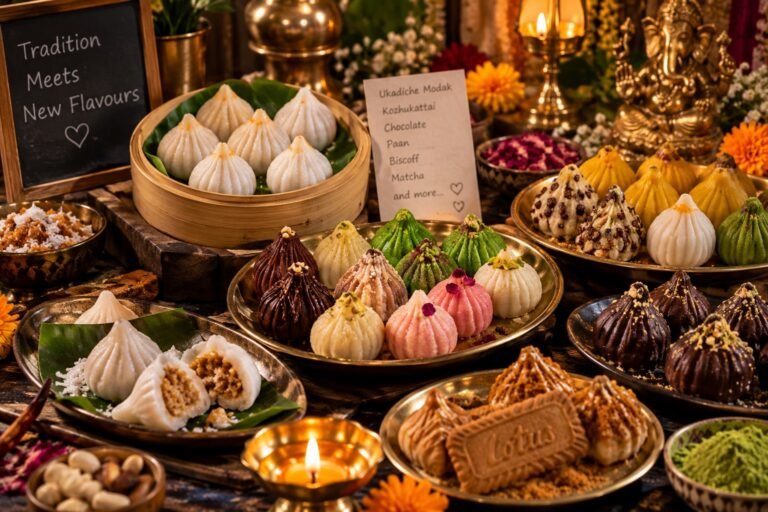
Rosogolla, sandesh, mishti doi, pantua and numerous regional varieties occupy a special place in Bengali food culture.
During Puja, sweets are not simply desserts.
They are social currency.
A box may arrive at a relative’s house.
Someone may carry sweets back after visiting a neighbourhood Puja.
Friends exchange them.
Families serve them to guests.
And after Dashami, the tradition of Bijoya turns hospitality into another reason to open the sweet box.
A sweet can therefore become attached to a person, a house or a particular year.
You may forget what the pandal looked like.
You may forget the colour of the lights.
But someone will remember:
“That was the year we had that incredible sandesh.”
There is a certain Bengali practicality to preserving history through dessert.
The Restaurant Becomes Part of the Festival
Puja food is not restricted to pandals and homes.
Kolkata’s restaurants become part of the celebration too.
Restaurants often create festive menus, special Bengali meals and seasonal experiences aimed at families, visitors and groups of friends.
This creates another layer of the city’s food culture.
A visitor can move from a traditional community bhog to a contemporary restaurant, then finish the night with street food.
That combination reflects Kolkata itself.
Its food culture is not frozen in nostalgia.
It contains heritage restaurants, home kitchens, street vendors, contemporary chefs, sweet shops and new food businesses operating alongside one another.
For food tourism, this is particularly valuable.
A traveller does not have to choose between “traditional Kolkata” and “modern Kolkata.”
The city serves both.
Pandal Food Is Its Own Experience
There is another category that deserves attention: food served around the pandal itself.
Not every Puja committee operates the same way, and food arrangements vary considerably.
Some locations are surrounded by temporary stalls.
Others sit within neighbourhoods already known for food.
Some visitors deliberately plan their routes around particular eating stops.
That has transformed pandal hopping into something resembling an informal food trail.
The architecture provides the route.
The appetite provides the itinerary.
And the feet eventually file a formal complaint.
This combination of visual culture and food culture is one reason Kolkata’s Puja can function as a form of cultural tourism rather than simply a religious visit.
The Family Table Remains the Quiet Centre
Yet for all the public spectacle, some of the most important Puja food never appears in a food guide.
It happens at home.
Families cook.
Relatives arrive.
Old recipes return.
Children who live elsewhere come back.
Someone insists on making a dish exactly the way it was made by a grandmother.
Someone else quietly changes the recipe.
Nobody admits it.
Family food traditions matter because they preserve memories that restaurants cannot reproduce.
A restaurant can recreate a dish.
It cannot recreate the person who taught you how to eat it.
That is why food remains such a powerful part of Bengali family identity during the festival.
Food Tourism Is Growing Around the Festival
For visitors, this creates a compelling form of cultural tourism.
Kolkata’s Puja is already famous for its art, lighting, neighbourhood celebrations and elaborate pandals. Adding food to that experience creates a broader cultural journey.
A visitor can encounter:
ritual → neighbourhood → architecture → street food → sweets → family traditions → restaurants → music → art.
Food becomes the thread connecting all of them.
The current push to present Kolkata’s Durga Puja to international visitors also reinforces this broader tourism potential. A 2026 preview initiative is planned for October 10–12, with selected traditional and theme Pujas being presented to diplomats, overseas guests and cultural figures.
That makes food an important part of the city’s cultural proposition.
International visitors may come for the spectacle.
But it is often the ordinary experiences — sitting down for bhog, eating a roll after midnight, trying a sweet or sharing a family meal — that make a cultural trip memorable.
Tradition Has to Survive the Modern City
There is, however, another side to the food story.
Festivals are becoming larger, more commercial and increasingly attractive to visitors.
That brings economic opportunity for restaurants, sweet shops, street vendors, transport operators and local businesses.
But it can also put pressure on neighbourhoods, waste systems and food prices.
Even the sweet industry is not immune to economic pressures. Recent reporting has pointed to rising sugar prices affecting plans for elaborate Puja sweet assortments in Kolkata.
This is an important reminder.
Cultural traditions survive not only through nostalgia.
They survive because the people who make, sell, cook and serve the food can continue doing so.
For a festival that depends so heavily on community participation, the economic sustainability of its food ecosystem matters.
Kolkata’s Greatest Food Festival Is Not Really a Food Festival
That may sound contradictory.
But Durga Puja is not a food festival in the conventional sense.
Food is not the central attraction.
It is the social language surrounding the attraction.
People eat because they have gathered.
They gather because the Puja brings them together.
They remember what they ate because memory attaches itself to people and places.
And they return the following year carrying those memories with them.
That is why bhog tastes different from an ordinary plate of khichuri.
Why a midnight roll after four hours of pandal hopping feels disproportionately magnificent.
Why a sweet received from a relative matters more than an expensive dessert.
And why the smell coming from a neighbourhood kitchen can transport someone back decades.
The Real Taste of Puja
Kolkata’s Durga Puja is often photographed through idols, pandals and lights.
But another portrait exists.
It is made from steam rising from a pot of khichuri.
The crackle of a street-side fryer.
A plate of bhog passed from one person to another.
A sweet box opened after a relative arrives.
A family recipe repeated for another generation.
A group of friends arguing about where to eat next while standing under a giant Puja decoration.
That is the food story of Durga Puja.
Not simply what Kolkata eats.
But how Kolkata uses food to remember, welcome, celebrate and belong.
And perhaps that is the most delicious lesson of all:
A festival can be seen with the eyes, heard with the ears and celebrated with the heart — but in Kolkata during Durga Puja, it is remembered through the taste.
DOONITED Editorial Perspective
The strongest food story of Durga Puja is not a ranking of restaurants or a list of “must-eat” dishes.
It is the relationship between food and community.
Bhog demonstrates collective sharing. Street food keeps the city moving. Family meals preserve inherited knowledge. Sweets carry hospitality. Restaurants turn tradition into contemporary experiences.
That makes Kolkata’s Puja food culture an unusually complete example of living culinary heritage.
The challenge for the future is to allow that culture to evolve without turning every tradition into a commercial product.
The festival should remain something people participate in, not merely something they consume.
Meaningful Learning for Readers
Food tourism works best when food is treated as a gateway to culture rather than a checklist of dishes.
During Durga Puja, a visitor who understands why bhog is shared, why family recipes matter and how neighbourhood food traditions developed is experiencing much more than a meal.
They are experiencing Kolkata’s memory.


World Beyond the News
Why Elephants Stay Close to Their Herd
Elephants live in highly social family groups and use calls, touch and body movements to maintain strong bonds.
Most of the Deep Ocean Remains Difficult to Explore
Extreme pressure, darkness and distance make deep-ocean exploration one of Earth’s greatest scientific challenges.
Spacecraft Can Travel Without Traditional Roads
Spacecraft use carefully calculated trajectories and gravity assists to travel enormous distances through space.
Why Movie Trailers Are Released in Stages
Major films often use teaser trailers, full trailers and final promotional spots to build awareness over time.