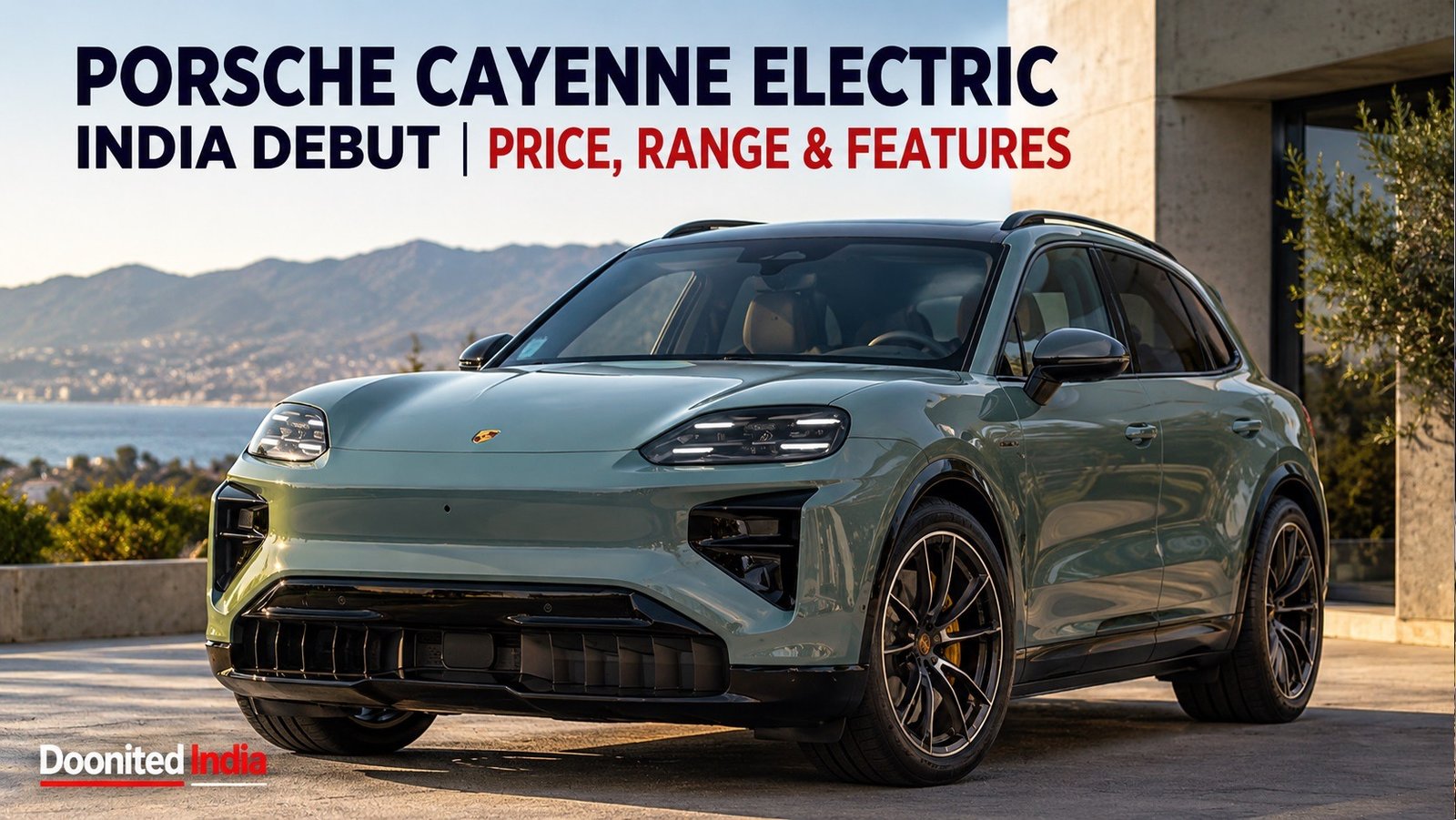
Porsche Cayenne Electric: India’s ₹1.77-Crore Luxury EV Arrives in the Spotlight
A date and price clarification: Porsche’s India debut event is scheduled for 30 September 2026. The Cayenne Electric was already globally revealed and its India pricing had been reported earlier, so this is best described as its formal India debut, rather than the first-ever launch of the model. Current Porsche India configurator listings show the standard Cayenne Electric from ₹1,77,27,000 and the Cayenne Turbo Electric from ₹2,27,51,000.
The Cayenne’s electric chapter reaches India
For years, the Porsche Cayenne has occupied a distinctive place in the luxury SUV market: a vehicle expected to deliver the comfort and space of an SUV while retaining the performance-led character associated with the Porsche badge. The all-electric Cayenne carries that proposition into a new era.
Its formal India debut on 30 September comes at a time when luxury carmakers are expanding their electric portfolios. For Porsche, the Cayenne Electric is more than another battery-powered model. It brings the brand’s large, performance-oriented SUV format into an electric architecture, with substantial power, rapid charging capability and a technology-heavy cabin.
The Indian range is expected to comprise two versions: the Cayenne Electric and the Cayenne Turbo Electric. Current listings put their starting prices at approximately ₹1.77 crore and ₹2.28 crore, respectively, ex-showroom. The
Two versions, one substantial battery
Both variants use a 113kWh battery pack and dual electric motors driving all four wheels. The standard Cayenne Electric produces 442PS in Porsche’s current specifications, while the Turbo Electric can deliver up to 1,156PS with Launch Control.
The performance figures underline the scale of the engineering. Porsche quotes a 0–100kph time of 4.8 seconds for the standard model and 2.5 seconds for the Turbo Electric. These are sports-car figures delivered in a large five-seat SUV.
Key specification | Cayenne Electric | Cayenne Turbo Electric |
|---|---|---|
Battery capacity | 113kWh | 113kWh |
Drive | Dual-motor AWD | Dual-motor AWD |
Maximum power with Launch Control | 442PS | 1,156PS |
0–100kph | 4.8 seconds | 2.5 seconds |
Claimed range | Up to 642km | Up to 623km |
Figures are manufacturer claims or published specifications. Range depends on test cycle, configuration, driving conditions and equipment.
There is an interesting detail in those figures: the Turbo is dramatically quicker, yet its claimed range is lower than that of the standard model. That is hardly surprising. High-performance power delivery, wheel and tyre choices, and driving style can all affect energy consumption. In an electric vehicle, the right foot remains an important part of the range equation.
Charging: impressive numbers, with conditions attached
The Cayenne Electric supports DC fast charging at up to 390kW under suitable conditions. Porsche’s published claim is that the battery can charge from 10 to 80 per cent in around 16 minutes when connected to a sufficiently powerful compatible charger and when the battery is at the required temperature and state of charge. The vehicle can also recover energy through regenerative braking, reducing reliance on the friction brakes in many driving situations.
An optional 11kW wireless charging system is another technology highlight. It is designed to let owners charge by parking over a compatible ground plate, rather than plugging in a conventional cable. That could make home charging more convenient for buyers who have a dedicated parking space and can install the required equipment.
But charging figures need context. A car capable of accepting 390kW cannot make a lower-powered public charger deliver that output. Actual charging speed depends on the charger, battery temperature, battery state of charge and other conditions. For Indian buyers, the availability of suitable high-power charging infrastructure along their regular routes may matter more than the peak number in the brochure.
A digital cabin, without abandoning the SUV’s practical role
The Cayenne Electric retains the familiar broad-shouldered SUV shape, but its design has been adapted for an electric powertrain. The exterior features a revised front end, active aerodynamic elements and a full-width rear light bar.
Inside, the cabin centres on a curved 14.5-inch infotainment display and a digital driver’s display. An optional passenger screen and augmented-reality head-up display extend the digital experience. Porsche also lists adaptive air suspension as standard, while rear-axle steering is available as an option.
The electric platform also allows a front luggage compartment alongside the rear boot. Published specifications indicate a 90-litre front storage area and substantial rear luggage capacity, giving the vehicle a practical dimension beyond acceleration figures.
That matters because a luxury SUV is not purchased only for a sprint from zero to 100kph. It must carry passengers, luggage and the everyday routines of its owners. The Cayenne’s challenge is to combine its performance credentials with the space and comfort expected of a premium family vehicle.
The Indian ownership question
At ₹1.77 crore before registration, insurance and other charges, the Cayenne Electric belongs to a narrow segment of the Indian market. Its immediate appeal will be to buyers who want an electric SUV with a luxury badge, substantial performance and the convenience of all-wheel drive.
Yet the purchase decision should extend beyond the showroom. Buyers need to consider whether home charging is feasible, how often they undertake long-distance journeys, and whether their usual routes have dependable fast-charging options. They should also compare the full on-road cost of each variant and understand the implications of optional equipment.
A claimed range of more than 600km sounds reassuring, but it is not a promise of that distance in every real-world situation. Highway speeds, weather, passenger load, terrain, air-conditioning use and driving style can all reduce the distance between charges. As with any EV, a realistic ownership plan should include a margin for those variables.
The Cayenne Electric’s performance may be the headline, but charging convenience and the ownership experience will help determine how satisfying it is over time.
DOONITED View: luxury EVs are selling a complete ecosystem
The Cayenne Electric demonstrates how quickly the definition of a high-performance SUV is changing. Electric propulsion can deliver immediate torque, rapid acceleration and a quiet cabin, while sophisticated suspension and chassis systems aim to preserve comfort and control.
However, premium electric mobility is not simply a matter of installing a large battery and powerful motors. It depends on the complete ecosystem: reliable charging, suitable parking, service support, transparent ownership costs and a clear understanding of real-world range.
For India’s luxury-car buyers, the Cayenne Electric offers a compelling set of specifications. Whether it proves convenient in daily use will depend on where and how it is driven. A buyer with home charging and predictable travel patterns may experience electric ownership very differently from someone who regularly drives between cities with limited charging options.
There is also a useful reminder in the Turbo’s astonishing acceleration: technology can make extraordinary performance accessible, but extraordinary performance is not the same as everyday usefulness. At this price, buyers are entitled to expect both engineering excellence and an ownership experience that works beyond ideal conditions.
Learning Point
When evaluating a luxury EV, compare the complete ownership proposition—not just the price, power or claimed range. Charging access, real-world driving needs, equipment costs and after-sales support are just as important as the headline specifications.


World Beyond the News
Bees Communicate Where Food Is
Honeybees use movement patterns known as waggle dances to communicate information about food locations.
Street Food Reflects Local History
Many famous street foods developed from migration, trade, local ingredients and the everyday needs of working communities.
A Day on Venus Is Extremely Long
Venus rotates so slowly that one rotation relative to distant stars takes longer than its trip around the Sun.
Human Achievement Continues to Push Limits
Athletes, engineers, scientists and explorers regularly establish new benchmarks in speed, endurance, scale and precision.