Lalit Kala Akademi Awards 2026: 20 Artists, 6,175 Entries and a Changing Landscape of Indian Art
President Droupadi Murmu presented the Lalit Kala Akademi Awards to 20 artists selected for the 65th National Exhibition of Art. From terracotta and teak wood to printmaking and mixed media, this year’s selection reflects the breadth of India’s contemporary visual arts—and raises a larger question about how emerging artists gain recognition and reach new audiences.
A national art exhibition, with many ways to see India
Indian art does not speak in a single visual language. It can take shape in terracotta, wood, marble, oil paint, watercolour, printmaking or experimental combinations of materials. It can explore memory and urban life, environmental concerns, spiritual traditions or the ordinary details of human experience.
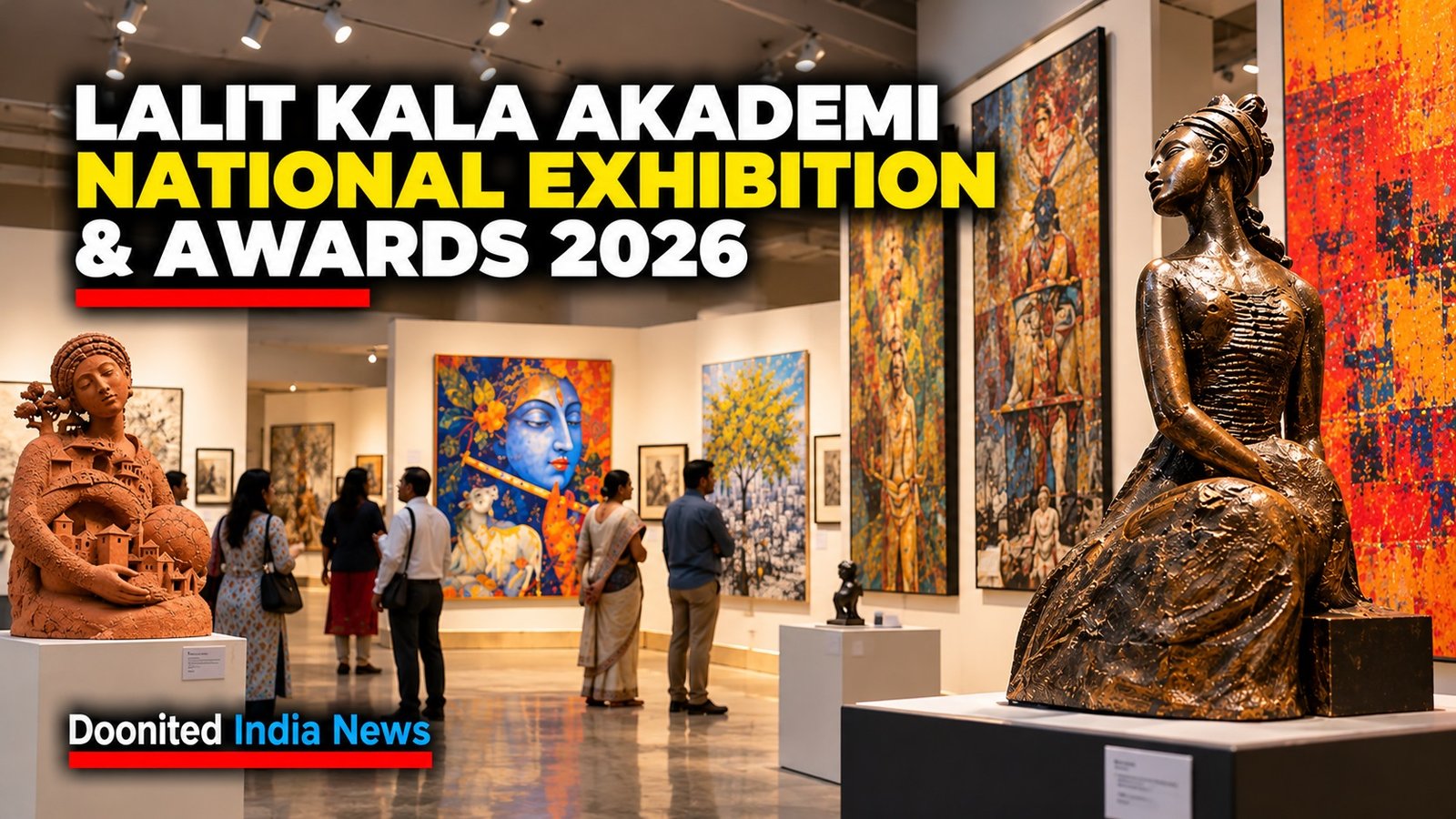
The 65th National Exhibition of Art, organised by the Lalit Kala Akademi under the Ministry of Culture, brought together this variety in its 2026 edition. On 21 October, President Droupadi Murmu presented the Akademi’s awards to 20 selected artists at the Dr. Ambedkar International Centre in New Delhi. The ceremony also recognised winners and honourable mentions of the 3rd Print Biennale India 2026.
The award-winning works: different materials, different questions
The 20 awardees work across painting, sculpture, drawing, printmaking and other media. Their titles and listed materials suggest a wide range of artistic approaches, although a work’s full meaning is best understood by seeing it and considering the artist’s own explanation rather than inferring too much from its title alone.
Several titles explicitly evoke environmental and social questions. Kishor Kumar Narkhadiwala’s Paryavaran and Pooja Rajpoot’s Prakriti Shoshan bring the environment into focus through painting and sculpture respectively. Mrinal Dey’s Hopeless Settlement and Praveen Kumar’s Where the Walls Remember suggest different ways of approaching settlement, architecture and memory.
Other titles point towards time, movement and urban experience. Pritam Madhukar Deuskar’s Of Time and the City is an etching, while Usharanjan Mandal’s Wheel of A Crowded City is listed under “Any Other Medium”. These works sit within a selection that spans established artistic techniques and varied material practices.
The sculptural works are particularly diverse in their listed media: Chandra Shekhar Sain’s My Entire World – I uses terracotta; Nidhi Chopra’s Tangible Dreams uses ceramic; Nimai Singh Sarungbam’s Mudra – I uses teak wood; Pooja Rajpoot’s Prakriti Shoshan uses white marble; and Raviram Ramakrishnan’s Fisherwoman uses copper that is oxidised and welded. The range demonstrates that contemporary Indian sculpture is not confined to a single material or finish.
The selection also includes works drawing on spiritual and philosophical references. Gopal Chandra Naskar’s The Tune of The Srimad Bhagavad Gita is an acrylic painting, while Rajendra Prasad’s Sujata With Buddha uses watercolour in the wash technique. Sanjib Kumar Gogoi’s Aakar Nirankar – II combines acrylic and oil on canvas.
These titles provide useful starting points for visitors, but they should not substitute for direct engagement with the artworks. The significance of an image, texture or form can exceed what a title alone communicates.
All 20 Lalit Kala Akademi awardees
The following names, artwork titles and media are drawn from the official award list published by the Press Information Bureau.
| Artist | Award-winning work | Medium |
|---|---|---|
| Chandra Shekhar Sain | My Entire World – I | Terracotta |
| Gopal Chandra Naskar | The Tune of The Srimad Bhagavad Gita | Acrylic on canvas |
| Kishor Kumar Narkhadiwala | Paryavaran | Oil on canvas |
| Mrinal Dey | Hopeless Settlement | Acrylic on canvas |
| Nidhi Chopra | Tangible Dreams | Ceramic |
| Nimai Singh Sarungbam | Mudra – I | Teak wood |
| Pankaj Kumar Sharma | Haloed Traveler – II | Panel works |
| Pooja Rajpoot | Prakriti Shoshan | White marble |
| Praveen Kumar | Where the Walls Remember | Mixed medium |
| Pritam Madhukar Deuskar | Of Time and the City | Etching |
| Rajendra Prasad | Sujata With Buddha | Watercolour (wash) |
| Ramesh Vithal Thorat | Untitled – II | Oil on canvas |
| Raviram Ramakrishnan | Fisherwoman | Oxidised, welded copper |
| Sanjay Kumar | When Memories Come Back – 7 | Mixed media |
| Sanjay Kumar Sahani | Youth | Oil on canvas |
| Sanjib Kumar Gogoi | Aakar Nirankar – II | Acrylic and oil on canvas |
| Santa Deb | Attraction of Simplicity | Ceramic |
| Siddharth Shahjirao Shingade | Trees | Mixed media |
| Usharanjan Mandal | Wheel of A Crowded City | Any other medium |
| Vijendra Sharma | Life 2025 | Oil on canvas |
Why the selection matters beyond the awards
The National Exhibition of Art has a history stretching back to 1955. The Lalit Kala Akademi describes it as a platform for presenting developments in visual art, with earlier editions travelling to major Indian art centres and helping artworks enter public and institutional collections.
The Ministry of Culture’s account of the 2026 ceremony highlighted the integration of artwork sales into the programme as a step towards expanding opportunities for artists and strengthening creative livelihoods. That is a constructive direction, although the long-term impact will depend on actual sales, fair pricing, repeat opportunities and the ability of artists to sustain their practices.
But visibility should not be confused with guaranteed international recognition. The next steps—documentation, translation where necessary, professional representation, accessible exhibition programmes and transparent sales practices—help determine whether attention lasts beyond a single award.
Preserving tradition without freezing it
One of the most interesting features of the award list is the coexistence of familiar materials and contemporary concerns. Terracotta, teak wood, marble, watercolour and oil paint sit alongside mixed media, etching and welded, oxidised copper.
This combination challenges the idea that preserving artistic heritage means keeping art unchanged. Traditions remain alive when artists can reinterpret materials, techniques and ideas in response to their own times. Equally, innovation does not require abandoning inherited knowledge.
The exhibition’s range also offers an opportunity for audiences who may feel unfamiliar with contemporary art. A useful first step is to look closely at the material and method: how a sculptor handles weight or texture, how a painter builds a surface, or how a printmaker creates an image through repeated impressions. Reading the title and the artist’s statement can then deepen that first encounter.
For schools, colleges and families, exhibitions of this kind can become entry points into visual literacy—the ability to look carefully, ask questions and consider interpretations without assuming there is only one correct response.
The real measure of recognition
The 65th National Exhibition of Art demonstrates the breadth of artistic activity represented across India. Its 6,175 entries, 270 selected exhibition works and 20 award-winning artists provide a snapshot of a large and varied creative community.
The more difficult task begins after the prizes are presented. Can the selected artists find new audiences? Will their work remain accessible to the public? Can art institutions create sustained opportunities for artists at different stages of their careers, including those outside major cultural centres?
Those questions matter as much as the ceremony itself. A national award can mark a significant milestone, but a vibrant art ecosystem needs continuing exhibition opportunities, responsible collecting, arts education and support for artists’ livelihoods.
The lasting achievement of a national art exhibition is not simply identifying 20 winners. It is helping more people discover the range of work being made across India—and giving artists meaningful opportunities to keep creating.


World Beyond the News
Bees Communicate Where Food Is
Honeybees use movement patterns known as waggle dances to communicate information about food locations.
Street Food Reflects Local History
Many famous street foods developed from migration, trade, local ingredients and the everyday needs of working communities.
A Day on Venus Is Extremely Long
Venus rotates so slowly that one rotation relative to distant stars takes longer than its trip around the Sun.
Human Achievement Continues to Push Limits
Athletes, engineers, scientists and explorers regularly establish new benchmarks in speed, endurance, scale and precision.