Mahindra Thar OG: A Familiar Off-Roader Gets a Serious Upgrade
Important fact-check before publication: Mahindra’s official release confirms the introductory price of ₹10.32 lakh and deliveries from 11 October 2026. However, six airbags are not standard across every trim: the AXT and LXT get dual airbags, while the six-airbag setup is listed for the top-spec ZXT. The introductory prices apply to vehicles delivered by 30 November 2026. This distinction matters for an accurate buyer-focused story.
The Thar OG’s bigger story: keeping the adventure, improving the everyday
Mahindra’s three-door Thar has always occupied an unusual place in the Indian car market. It is an SUV bought not only to get from one destination to another, but also to make a statement about the journey. Its upright stance, removable-roof heritage and off-road character have helped it become a recognisable lifestyle vehicle.
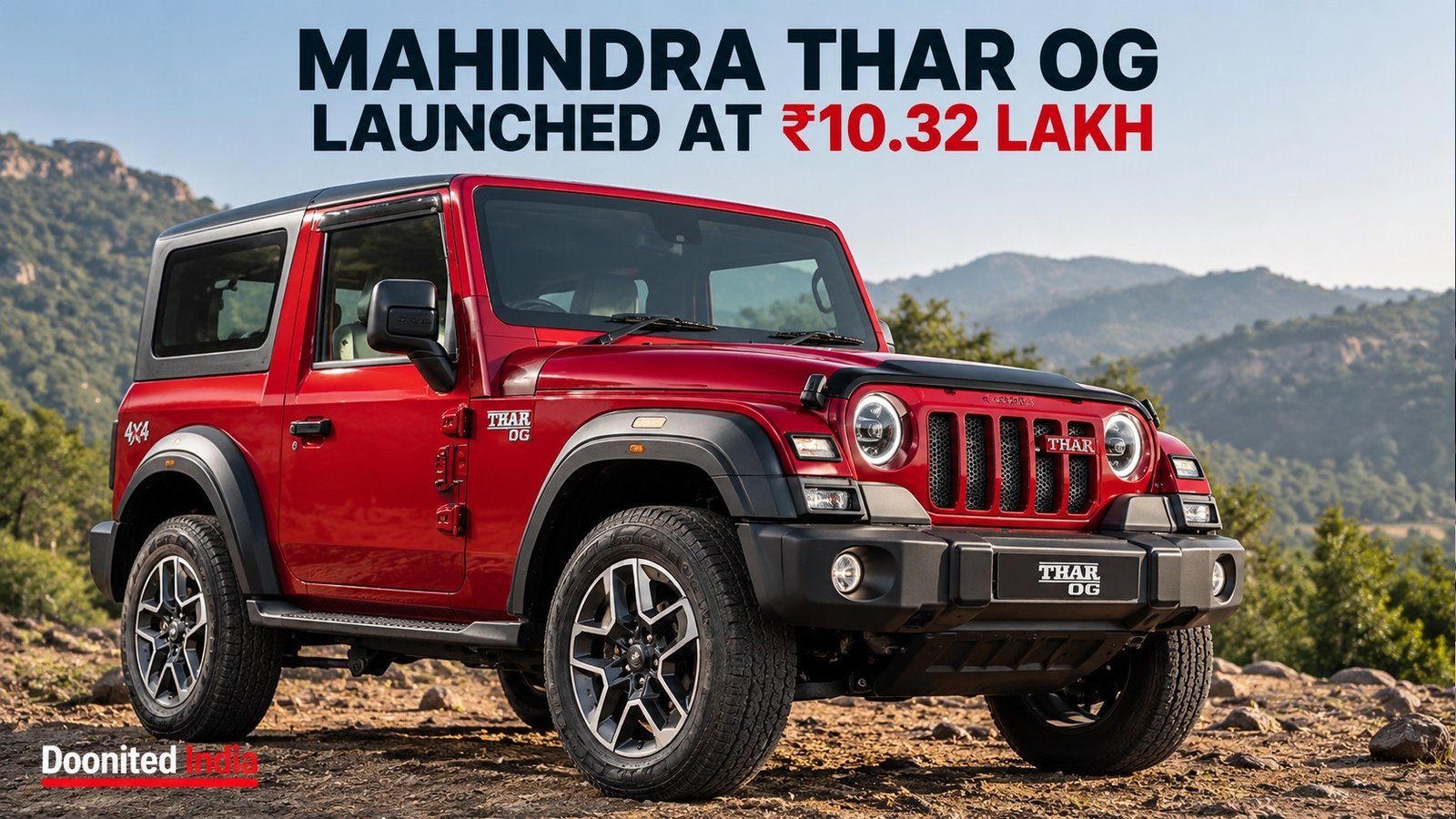
Now, the Mahindra Thar OG arrives as the successor to the three-door Thar introduced in 2020. The name may sound like a nod to the original, but the brief is decidedly contemporary: improve refinement, add technology, strengthen capability and address safety—without sanding away the rugged character that made the Thar distinctive.
The introductory price starts at ₹10.32 lakh ex-showroom, with the range extending to ₹18.99 lakh. Deliveries are scheduled to begin on 11 October 2026. These are introductory prices, valid for vehicles delivered by 30 November 2026, rather than a permanent price guarantee.
Price and variants: the entry point is only part of the story
The Thar OG is offered in three trims—AXT, LXT and ZXT—with petrol and diesel powertrains, manual and automatic transmissions, and rear-wheel-drive or four-wheel-drive configurations depending on the combination.
|
Variant / configuration |
Introductory ex-showroom price |
|---|---|
|
AXT, 1.5-litre diesel, RWD, manual |
₹10.32 lakh |
|
LXT, 1.5-litre diesel, RWD, manual |
₹12.99 lakh |
|
LXT, 1.5-litre diesel, RWD, automatic |
₹16.49 lakh |
|
ZXT, 1.5-litre diesel, RWD, manual |
₹13.99 lakh |
|
ZXT, 2.2-litre diesel, 4WD, automatic |
₹18.99 lakh |
|
ZXT, 2.0-litre petrol, 4WD, automatic |
₹17.75 lakh |
Selected configurations shown; the full price list contains additional engine, transmission and drivetrain combinations. All prices are ex-showroom and subject to the introductory-price conditions.
That distinction is especially important for a lifestyle SUV. The version that looks most appealing in a photograph may not be the one that best fits a buyer’s budget, commute or intended use.
A familiar face, with a more modern finish
The Thar OG retains the boxy silhouette and upright proportions associated with the nameplate, while introducing a redesigned grille, LED headlamps with signature C-shaped daytime-running lights, revised bumpers and new 19-inch alloy wheels on the top trim. New colour choices include Artemis Silver and Jeans Blue.
Inside, Mahindra has introduced Truffle Brown leatherette upholstery and a second-row armrest with cupholders. The company also says it has worked to reduce noise, vibration and harshness, an important area for a vehicle whose rugged image has sometimes meant making compromises in everyday comfort.
The 10.25-inch touchscreen is available from the LXT trim upwards, alongside smartphone connectivity. The top-spec ZXT adds features including a wireless charger and rear-view camera. Equipment varies by trim, so buyers should check the variant-level list rather than assume every advertised feature comes with the entry model.
More than cosmetic changes underneath
The Thar OG is based on Mahindra’s M_Glyde 4G platform. The manufacturer says the platform has increased stiffness, while the rear PENTALINK suspension incorporates a Watts Link to improve stability and control. Electric power steering is another significant change, intended to make low-speed manoeuvring easier.
Mahindra also introduces DAVINCI damping technology with Frequency Dependent Damping. In simple terms, the suspension is designed to respond differently as road inputs change, with the aim of balancing ride comfort and control. The real test, of course, will be how it feels on broken urban roads, highways and uneven trails—not just how the technology sounds in a launch presentation.
Engine choices include the 1.5-litre D117 diesel, the 2.2-litre mHawk diesel and the 2.0-litre mStallion turbo-petrol. The more powerful engine options are advertised with outputs of up to 330Nm of torque. Four-wheel-drive versions also offer an electronic locking differential and terrain modes for conditions such as mud, sand and snow.
The important point is that not every Thar OG is a 4WD off-roader. The entry-level AXT is a rear-wheel-drive diesel with a manual gearbox. Buyers who specifically want four-wheel-drive hardware and the associated terrain features must choose an eligible configuration.
Safety: an important upgrade, but read the variant list
Safety deserves more than a passing mention. Mahindra lists an ESP suite with rollover mitigation, while the top-spec ZXT adds six airbags, all-wheel disc brakes, a tyre-pressure monitoring system and front parking sensors.
But the six-airbag provision needs to be stated accurately: the AXT and LXT are listed with dual airbags; the six-airbag setup is offered on the ZXT. It is therefore incorrect to describe six airbags as standard across the entire Thar OG range.
The presence of additional safety equipment is welcome, but a feature list alone cannot establish a vehicle’s crashworthiness. Buyers should look for independently verified crash-test information for the exact model and specification, where available.
The Indian lifestyle-SUV equation
The Thar OG’s appeal is easy to understand in India. It offers the visual presence of a large SUV in a relatively compact three-door format, with genuine off-road hardware available in selected variants. It can suit buyers who enjoy road trips, outdoor activities and the idea of travelling beyond the usual paved itinerary.
Yet the same design creates practical questions. A three-door body is less convenient for frequent rear-seat access than a conventional five-door SUV. The vehicle’s size, running costs, fuel consumption, ride behaviour and parking needs should be assessed against the owner’s actual routine. And while four-wheel drive can be valuable on difficult terrain, it may be unnecessary for someone whose driving consists almost entirely of city roads and highways.
The sensible approach is to test-drive the exact variant, sit in the rear seats, assess luggage space and compare the on-road price—not simply the ex-showroom headline.
DOONITED View: the upgrade should be judged beyond the showroom
The Thar OG’s most meaningful promise is not its new grille or larger wheels. It is the effort to make a recognisably rugged SUV more refined and usable, while retaining the mechanical options that give it off-road credibility.
That ambition will be tested in everyday ownership. Does the revised steering make city driving less tiring? Does the suspension improve comfort on uneven roads? Are the safety features buyers want available within their budget? And does the price of the chosen configuration remain sensible once insurance, registration, fuel and maintenance are included?
The answers will differ from buyer to buyer. For someone who genuinely uses four-wheel drive, the added hardware may be central to the purchase. For someone drawn mainly to the Thar’s appearance, a lower-priced rear-wheel-drive version may be sufficient—provided its equipment and practical limitations are understood.
A lifestyle vehicle should deliver enjoyment, but it should also fit the life around it. The best buying decision is not necessarily the most expensive trim; it is the one whose capability, safety equipment and everyday compromises match the owner’s needs.
Learning Point
A starting price is an invitation to investigate, not the final cost of ownership. Compare the exact engine, drivetrain, transmission, safety equipment and on-road price before choosing. With the Thar OG, those details make a substantial difference between variants.


World Beyond the News
Bees Communicate Where Food Is
Honeybees use movement patterns known as waggle dances to communicate information about food locations.
Street Food Reflects Local History
Many famous street foods developed from migration, trade, local ingredients and the everyday needs of working communities.
A Day on Venus Is Extremely Long
Venus rotates so slowly that one rotation relative to distant stars takes longer than its trip around the Sun.
Human Achievement Continues to Push Limits
Athletes, engineers, scientists and explorers regularly establish new benchmarks in speed, endurance, scale and precision.